Beyond the last roof
I had walked the village a dozen times — every lane, every shrine, every house open to the public. But I had never walked south. Not properly: past the Iijima Shrine roadside station, past the terraced rice fields where the drying poles stand empty now, the grain already gathered and stored for winter.
.jpg)
The road follows the Shogawa, and after twenty minutes of walking the gassho roofs disappear from the rearview and you are between cedar plantations and the raw green of mountain slopes. This is the route to Hirase Onsen and Oshirakawa — the southern nature area of the village, a land of hot springs and hidden waterfalls inside Hakusan National Park. The bus runs three times a day. In late September, with the foliage just beginning to turn in isolated pockets, the road is almost empty.
I came for the walk but kept thinking about what happens when the valley darkens. The tour buses leave Ogimachi by four. By five the village is what it must have been before the UNESCO designation: a farming community at the bottom of a steep valley, turning inward for the evening. I wanted to see that transition — the moment when the last tripod folds and the place belongs to itself again.
I walked south for nearly an hour, past the turnoff to Shiramizu Waterfall, where the path climbs through cryptomeria toward a cascade that plunges fifty-three metres into a pool the colour of dark jade. 'White Water' is what the name means — for the way the stream catches light against the dark rock. I stood at the base until my hands were cold and the spray had settled on my jacket like a fine dust of early autumn.

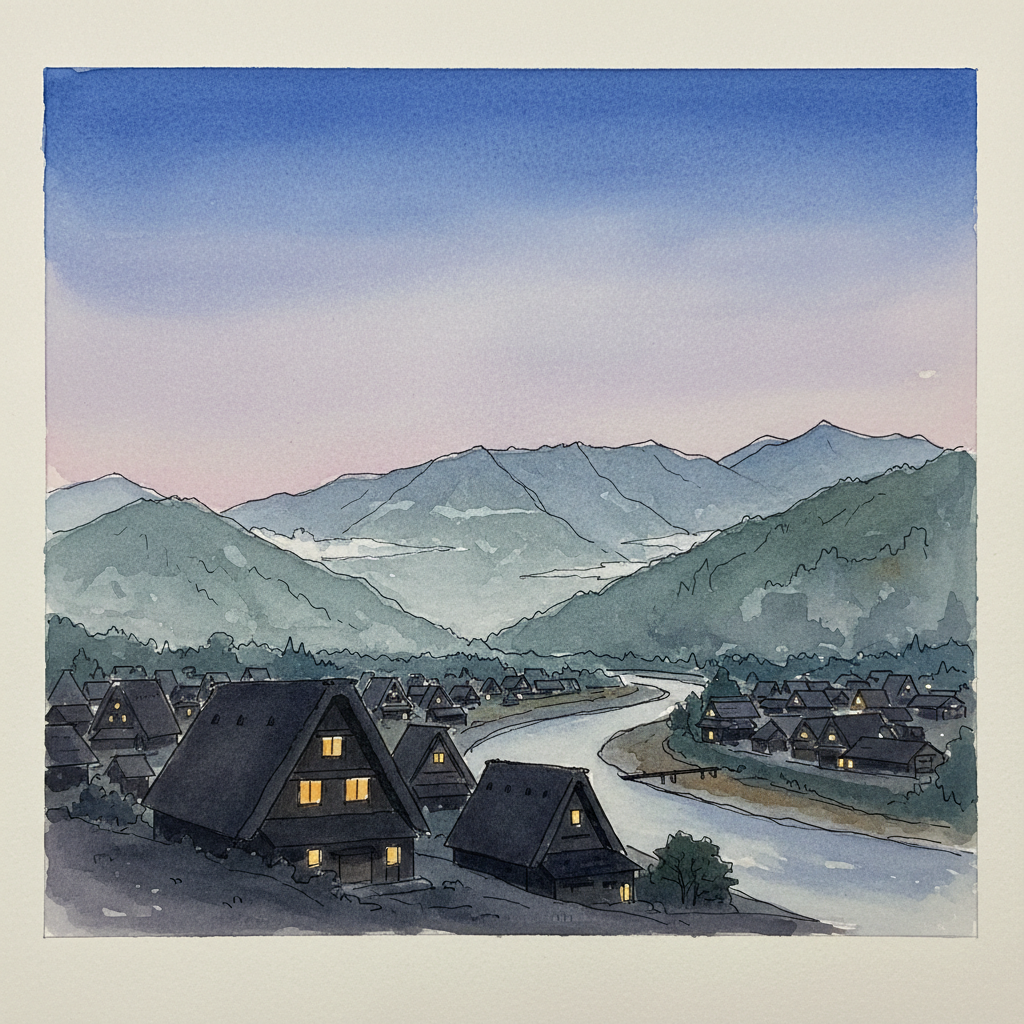
Coming back, the light had changed. The sun had slipped behind the main ridge, and the valley floor lay in shadow. From the edge of Ogimachi I saw the first lanterns come on — a handful of warm points in the deepening grey. The voices of the last day-trippers faded toward the bus stop. And then, for a long sweet moment, there were no voices at all, only the Shogawa running over stones and the bell of Myozenji striking six.

I walked into the village past Kanda House, its wooden door closed now, the light behind the shoji screens a soft gold. A woman was taking down the last of the drying persimmons from a rack beside her door. She nodded at me — the same quiet nod the woodcarver had given me days ago — and carried the basket inside.
There is a version of this valley that belongs to the photographs. And there is a version that belongs to the people who stay when the light fades — the ones who light the hearth, who close the shutters against the mountain cold. Tonight, walking the empty lanes of a village that had already become itself again, I was a guest of the second version. It asked for nothing but that I be quiet and watch.
The quiet side of the ridge
The southern part of Shirakawa village — Oshirakawa and the Hirase Onsen area — is the UNESCO valley's quieter cousin, designated within Hakusan National Park, one of Japan's oldest national parks established in 1962. The star of this southern nature area is Shiramizu Waterfall (白水の滝), a 53-metre cascade accessible by a short trail through cryptomeria forest from the Hirase Onsen bus stop, about 15 minutes by bus or an hour's walk from Ogimachi. The waterfall feeds into Shiramizu-no-yu, a 100% natural hot spring open for day use from 11:00 to 20:00 (closed Wednesdays and the 2nd and 4th Tuesdays of each month), with indoor hinoki cypress baths at ¥700 for adults and an open-air bath.
Back in Ogimachi, those waiting for the Doburoku Festival (October 14–19 across three shrines — now just over two weeks away) can visit Myozenji Temple at the southern edge of the village, a quiet gassho-style Buddhist temple with a garden that frames the valley better than any observation deck. It stays open through the evening, and from its grounds you can watch the lamps come on across the village as the light leaves the Shogawa.
What comes in the evening
The village shops stay open later than the tourist attractions — the roadside station at Iijima Shrine is still selling as dusk settles: bottles of Hida sake from the Koshi no Shizuku brewery, jars of doburoku sealed to transport, bags of sansai (wild mountain vegetables) foraged from the slopes I had just walked, and the walnut-miso gohei mochi grilled to order. But the real product of the evening is hoshigaki — dried persimmons. All through the village, the last of the fruit is being brought inside, peeled and strung, the process only half done, each one a small argument for patience: they will not be ready for weeks, but they will be worth it.
A roof that stays lit
The General Incorporated Foundation Shirakawa-go World Heritage Site Gassho Style Preservation Trust keeps the thatch on these roofs and the lamps in these windows. A single rethatching costs several million yen, and the community labour system of yui now passes through a foundation that trains the next generation of thatchers, subsidises repairs for families living in gassho houses, and manages the Seseragi Park parking revenue that funds it all. On an evening when the village is lit from within, it is worth remembering what keeps that light possible. The village office in Ogimachi carries information on how to help.
The tour buses go
The tour buses go. The valley returns to itself.
Smoke rises from a roof I have passed a dozen times without noticing.
The Shogawa runs green-grey under the footbridge that only the villagers use.
A woman closes a shutter. A lantern catches. A bell.
I have been here four times and never seen the evening.
The village does not need me to be beautiful. It was beautiful before I came, before the sunlight, before the photographs, before I walked its lanes trying to understand.
It will be beautiful, lit from within, in the dark.