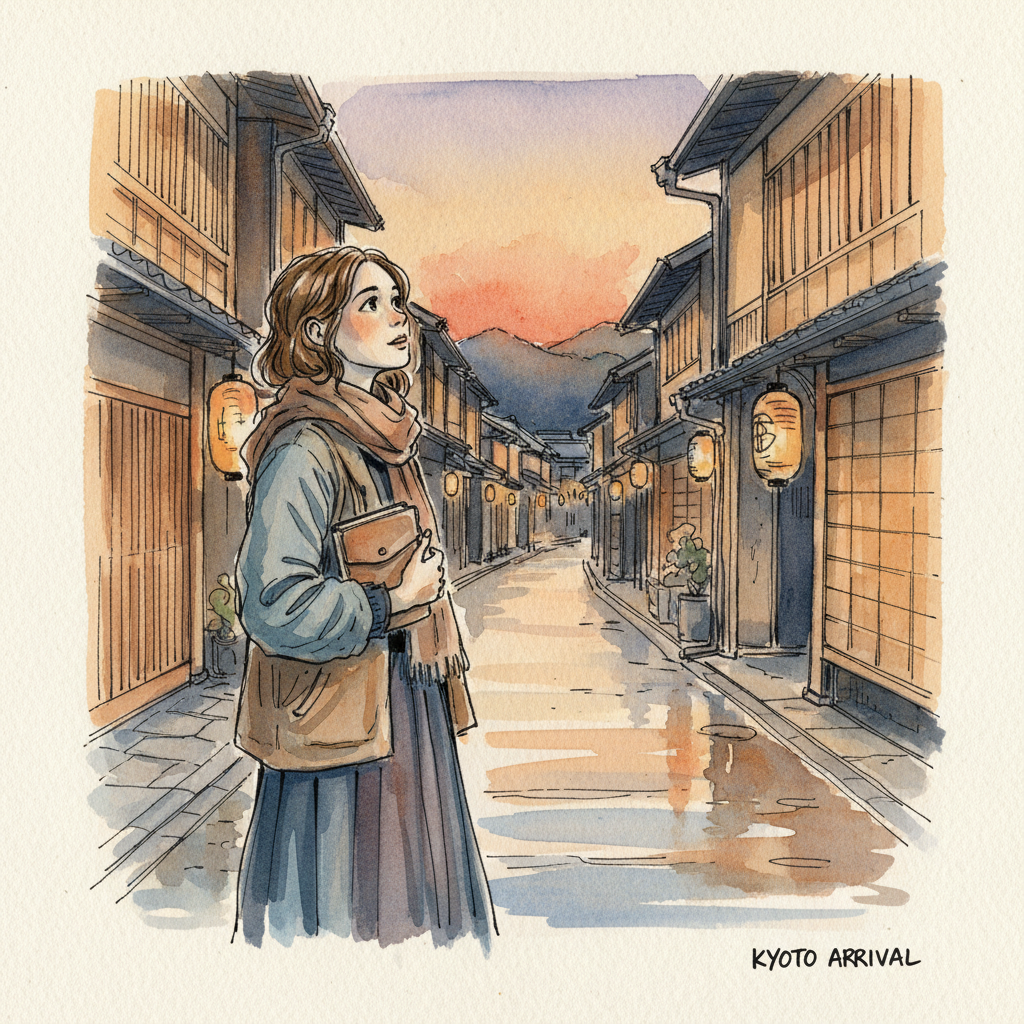
Up through the rain
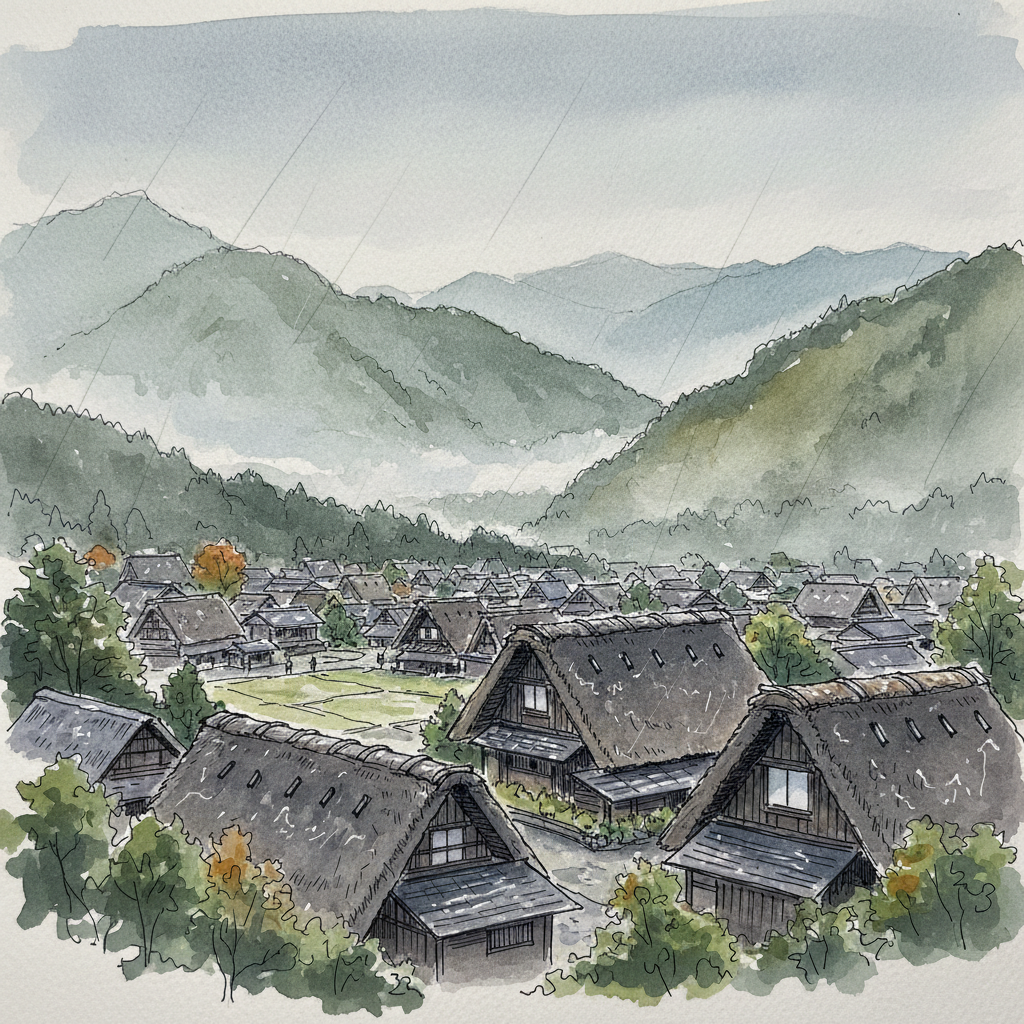
I had walked past the trailhead to the Shiroyama observation deck four times — once on every visit, at least — and each time I told myself tomorrow. The path climbs from the northern edge of Ogimachi through a stand of cryptomeria toward the ruins of Ogimachi Castle, a fortification that guarded this valley during the Sengoku period, when the mountain passes were worth controlling. The walk takes about thirty minutes, and from the top you see the whole village laid out like a model of itself: the gassho roofs in their precise rows, the Shogawa bending through the rice paddies, the mountains rising on every side.
Today it was raining. Not the dramatic kind that fills the Shogawa in an hour, but a steady September drizzle, the kind that settles into your collar and stays there. The forecast had said 92% chance, and the sky no longer looked like it was keeping options open. I put on the rain jacket I bought in Takayama three weeks ago — still stiff, still smelling of the shop — and started up.
The trail was empty. Everyone else was either sheltering in the bus terminal or already gone, the day-trippers having looked at the grey ceiling and decided there would be better photographs tomorrow. The cryptomeria kept some of the rain off, but there is always a second layer of wet under a forest: the drip from the branches, the mist that rises from the wet leaf litter, the way the air itself feels like a damp cloth pressed against your face.
After twenty minutes the trees opened and the observation deck appeared. It is nothing grand — a flat concrete platform with a railing and a sign in Japanese and English — but the view is the view. I had seen it in a hundred photographs before I ever came to Japan: the forty-odd gassho roofs clustered in the valley like a herd of enormous sleeping animals, their thatched ridges dark and streaming with rain. The mountains were lost in mist above a certain line, and the valley lay in a soft grey-green light that made every colour deeper — the moss on the roofs nearly black, the rice paddies a vivid wet green, the Shogawa a pale silver thread.
I stood there long enough that my hands grew cold on the railing. Two crows sat on a roof below, heads tucked against the rain, not moving. The village was silent except for the hush of the rain on the thatch — a sound I had never noticed before, because I had never been above it, listening down. It is not the same sound rain makes on tile or tin. Thatch absorbs and releases at once: a soft, sifting noise, like grain being poured slowly onto earth.
Coming down, I passed Wada House — the largest gassho in the village, a designated Important Cultural Property — and for the first time I stopped. I had photographed it from outside on every visit: the immense thatch, the wooden walls darkened by decades of smoke and weather, the small garden visible through the side gate. But I had never gone in. Four hundred yen, the sign said. I paid, left my shoes at the entrance, and stepped onto the tatami.
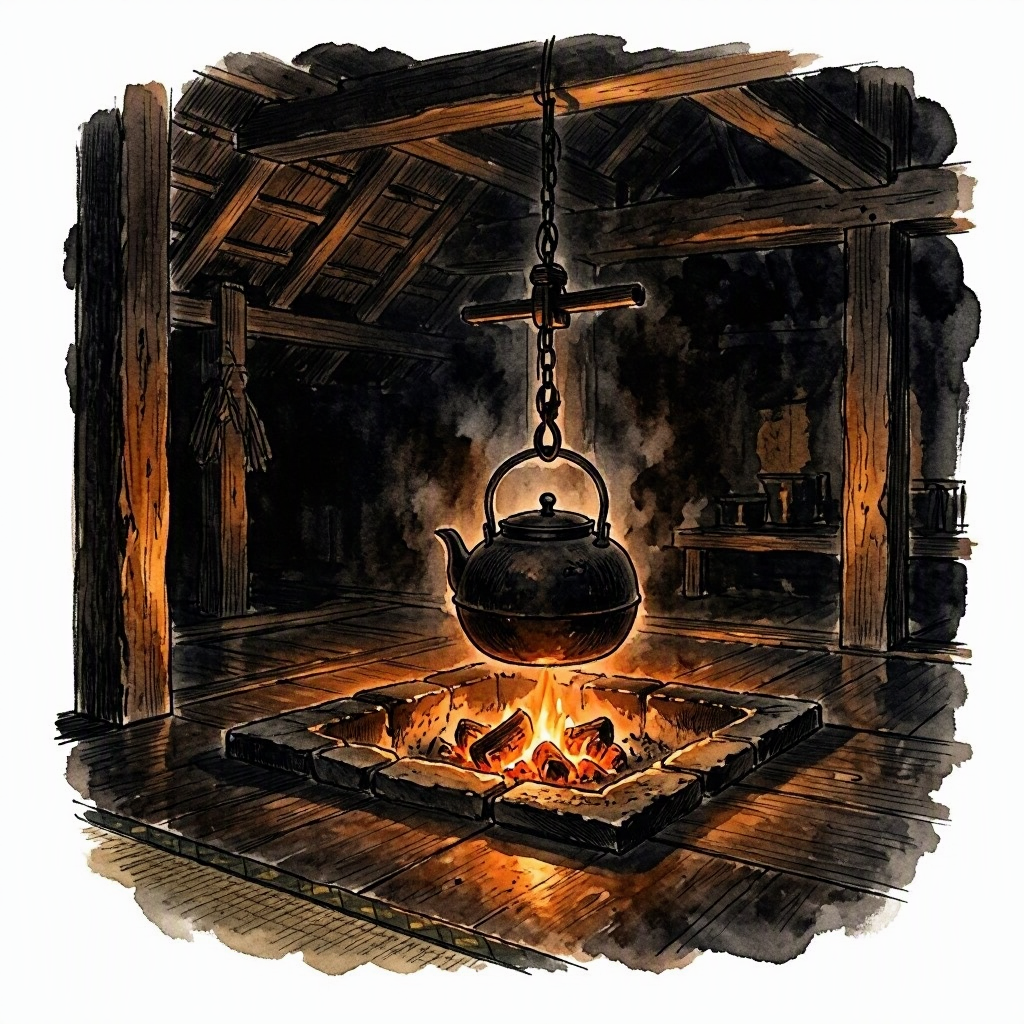
The first thing was the smell. Wood smoke and old cedar and the faint sweetness of the tatami itself, compounded by four centuries of use. The second thing was the light: inside, a gassho house is a cave. The windows are small — the steep thatch does not allow for much — and what light enters falls in narrow shafts, illuminating dust motes and nothing else. The irori hearth at the centre of the main room was cold now, the hook hanging blackened above it, but the ashes were still there, and the room still held the memory of every fire that had burned in it.
The family Buddhist altar stood against the far wall, gilded and ornate in a space that was otherwise all wood and earth. Beside it, a sliding door opened onto a tiny Japanese garden — moss and a single stone lantern and a maple just beginning to turn. The Kanpai guide notes that a garden is rare in Shirakawa-go; most houses have no room for one between the road and the rice fields. The Wada family, who served as village headmen and controlled the transit of goods through this mountain pass during the Edo period, could afford the space.
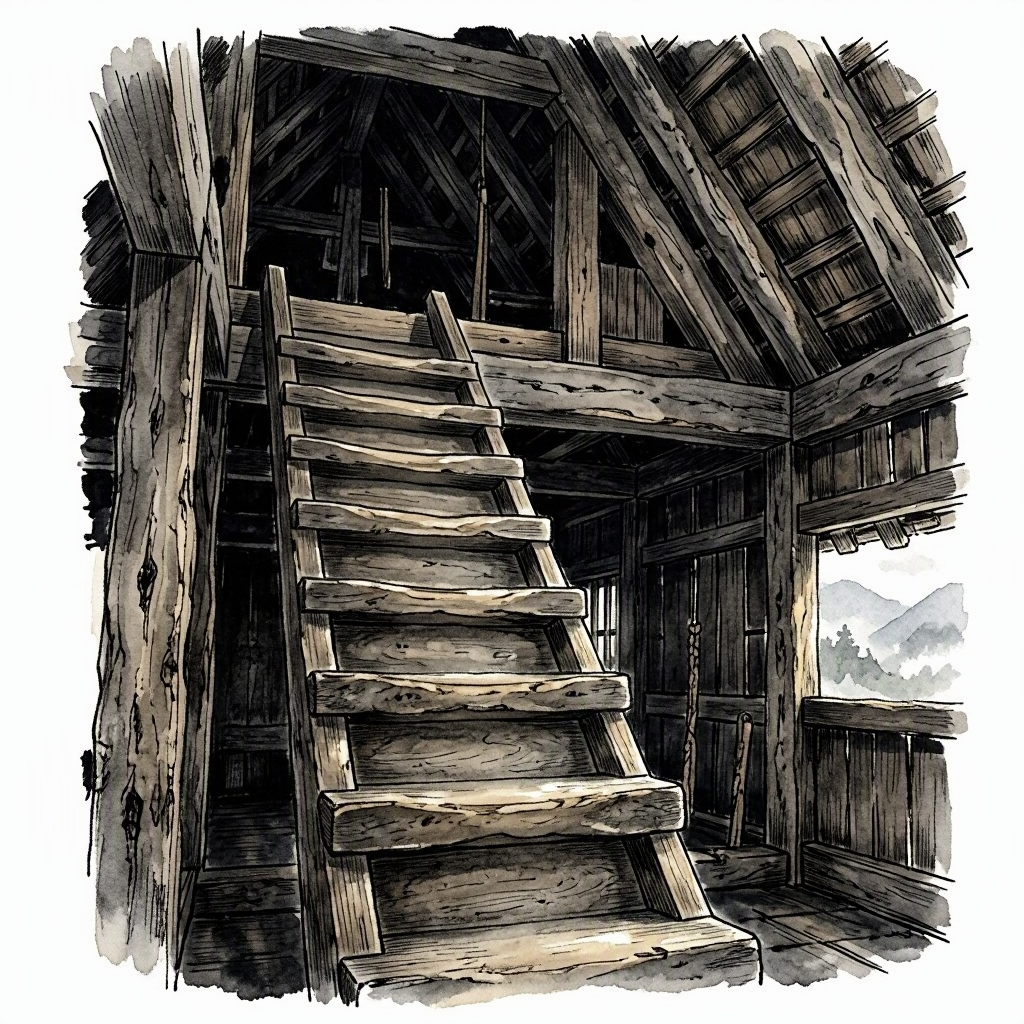
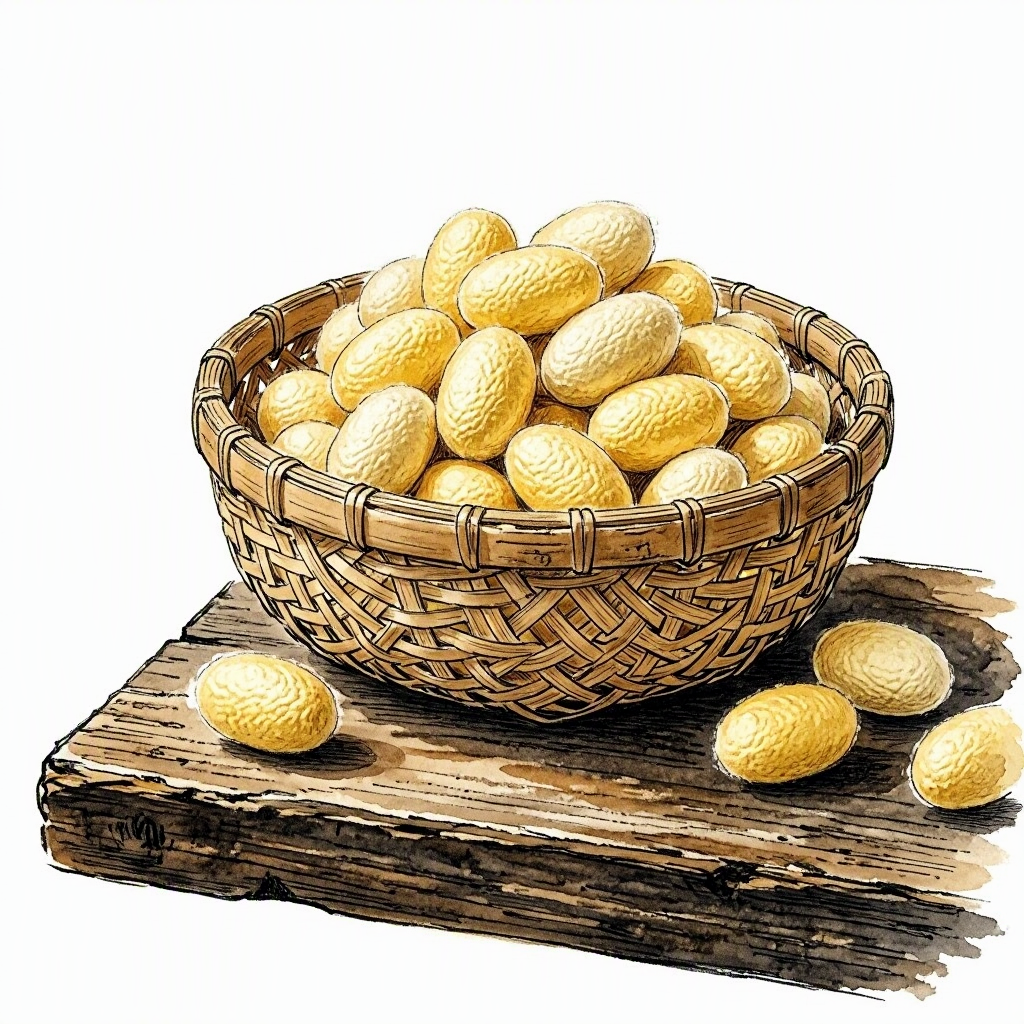
The stairs to the second floor are not stairs — they are a ladder, almost vertical, the steps worn to concavities by generations of feet. I climbed carefully, holding the beams. Upstairs, the ceiling follows the roof itself: if you stand, you are standing directly under the thatch. The second floor was where the Wada family kept their silkworms. Sericulture built this village — not tourism, not even the gunpowder trade that first made the family wealthy. Mulberry leaves were fed to silkworms on trays, the cocoons harvested and sold, the silk spun on looms in this very attic. The official page explains that silkworms are still bred here in July and August, to show visitors the process.
A window at the far end of the attic gives you the second great view of the village — lower than Shiroyama, closer to the roofs, the perspective of someone who lives here and looks out from their own work. I stood at that window for a long time. The rain had not let up. From inside the thatch, the sound was different again: muffled, distant, like a waterfall heard from inside a cave. The Shogawa was still moving, the crows were still on the same roof, and I was inside one of the houses I had been circling for days, learning what the photographs do not show: the smell, the dark, the worn steps, the quiet work of staying warm through a mountain winter.
I put my shoes back on at the door and stepped out into the rain. The village looked the same and looked completely changed. I had been inside the thatch. I knew what it sounded like now.
The thatchers and the painter
Hamada Taisuke — a Japanese painter whose sliding-door fusuma works decorate Myozenji Temple at the southern edge of Ogimachi. The temple's interior panels, painted in the traditional Nihonga style, depict mountain landscapes that frame the valley outside — art echoing the view it sits within. Hamada is not a household name even in Japan, but his work in this small mountain temple gives the gassho hall a dimension the tourist photos never catch: the painted mountains of the fusuma, and beyond the open door, the real ones.
Eizaku Tanaka, 26, is a gassho-zukuri thatcher born and raised in Shirakawa-go, part of a small cohort of young craftspeople keeping the thatching tradition alive. Replacing a single gassho roof costs several million yen and requires skills that take a decade to learn: the angle of the cut, the density of the layering, the right grass from the mountain slopes. Tanaka belongs to the generation that chose to stay — a choice that matters when the average age of Japanese thatchers is over sixty. The village is not a museum; it is a place where people still decide, every day, to keep doing hard, ancient work.
The Wada House itself, as a National Important Cultural Property, represents the third pillar of Shirakawa-go's cultural preservation: the decision to keep these houses lived in, not frozen. The irori may be cold in September, but it will burn again in winter. The family still lives here. The boundary between museum and home is deliberately blurred.
What the village makes
Hida sake from Koshi no Shizuku Brewery — a regional sake from the Hida region, available at the Iijima Shrine roadside station and at Shop Kataribe (452 Ogimachi, just past the suspension bridge from the Seseragi parking lot). Shop Kataribe also carries local sweets and folk crafts, including straw ornaments shaped like gassho roofs — small enough to carry, and a reminder of the thatching craft.
Washi paper goods are sold at several village shops: notebooks, cards, and small folding screens made from handmade Japanese paper. The paper-making tradition is not native to Shirakawa-go but has been adopted by local artisans who now demonstrate it for visitors.
Silk scarves and silk soap — a direct line from the sericulture that built this valley's economy. The silk goods sold at the craft shops are made from cocoons raised in these very attics (or attics just like them), and the soap uses sericin, the protein silk filaments are coated in, said to be good for the skin. It is not a luxury product; it is what a community that used to live by the silkworm now makes to keep its economy alive.
Gohei mochi — grilled rice cakes brushed with walnut miso — is sold at several stalls around the village, including one near the Wada House entrance. On a rainy day, the smell of it toasting under a wooden awning is the village's most reliable warmth.
The grass and the next hands
The General Incorporated Foundation Shirakawa-go World Heritage Site Gassho Style Preservation Trust does not only rethatch roofs. It also trains the next generation of thatchers — young craftspeople like Eizaku Tanaka and Yuta Kuroki — by subsidising apprenticeships and securing the supply of kaya grass from the mountain slopes around the village. The grass itself is an agricultural product, cultivated on land that would otherwise revert to forest; cutting it keeps the meadows open, which preserves biodiversity. The foundation's work is one donation, three outcomes: a trained thatcher, a thatched roof, a mountain meadow that stays alive.
The village office carries information on how to contribute, and the trust operates transparently through its official channels.
Inside the thatch
Rain on thatch is not rain on tile. It sifts, not strikes.
The hearth is cold but the ashes know.
A ladder worn by four hundred years of climbing to silk.
From the attic window the village is a roof and the roof is the world.
The crows did not move. They knew where the dry was.
And I, who had only ever looked from the outside, stood in the dark and understood nothing and everything.