The month before the festival
This is my fifth time in Shirakawa-go, and I am learning what I missed on the first four: that this village is not a museum frozen in amber but a living community that swells and recedes with the seasons. On earlier visits I walked the same paths as everyone — the viewpoint above the paddies, the Wada house with its vast hearth, the museum of tools — and I mistook the stillness for permanence. A Japanese village that looks unchanged is the one whose changes are too slow for a tourist to notice.

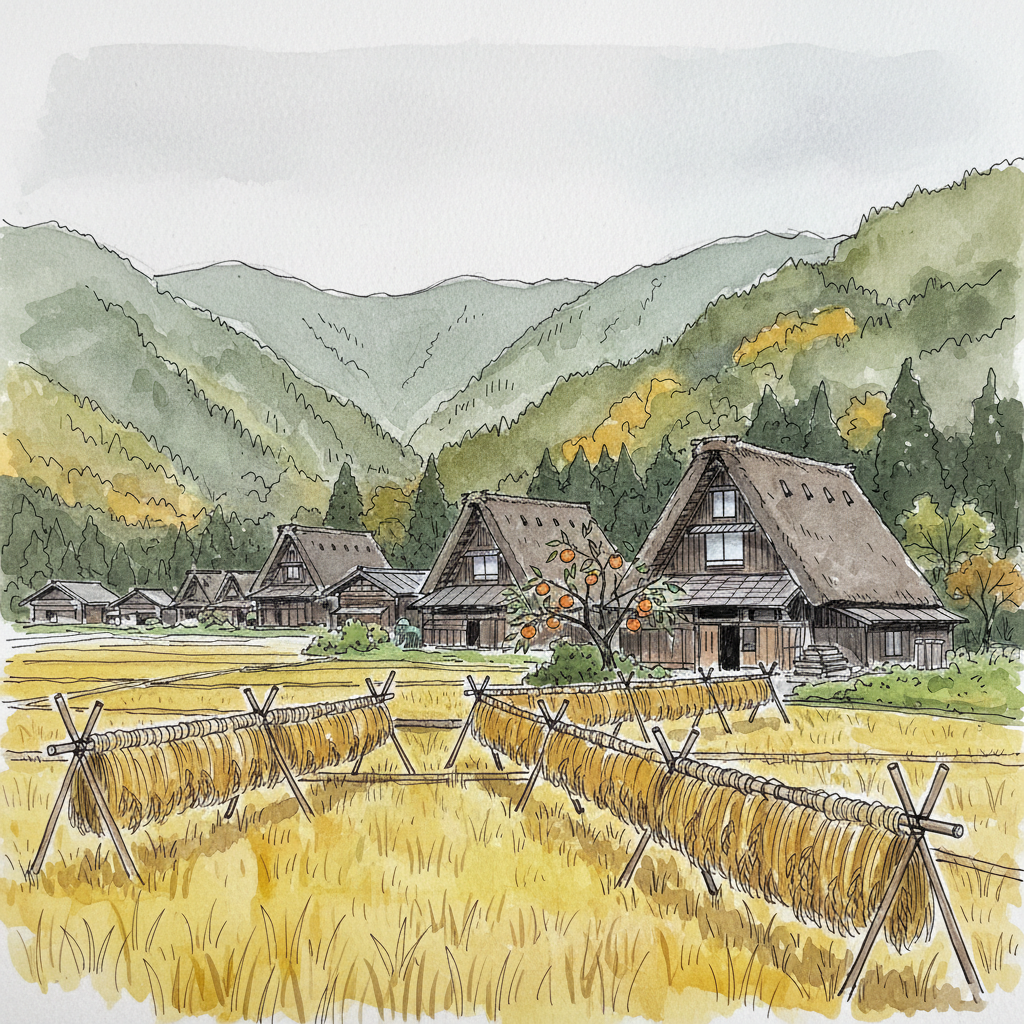
But September is the hinge. The rice that was luminous green in August has turned a heavy gold, and in the fields around Ogimachi the stalks are being cut and tied into sheaves that hang upside down from wooden frames, drying like bells that have not yet rung. The air smells of cut grass and the particular quiet of a valley where work is happening out of sight. The overcast sky has held a low grey lid all day, and the mountains — the Hakusan range to the west — have taken on the bruised purple of early autumn, with the first patches of yellow appearing on the upper slopes like rust on green iron.

It is the Doburoku Festival that has changed everything for me. Not the festival itself — that is still two weeks away, running October 14 through 19 across three Hachiman shrines — but the preparations for it. I learned from the village's own website that rehearsals begin a full month in advance. Adults and children practice the lion dances, the folk songs, the processions that will circle the village on the days themselves. At least one person from every family helps. And so, walking past a closed farmhouse door this morning, I heard it: the clack of wooden geta on tatami, a drum counting time from somewhere deep inside the thatch, and then the unmistakable wail of a shinobue flute — a single penetrating note that hung in the damp air and made the tourists on the main path stop and look at each other.
That sound — a lion dance rehearsing behind closed doors — told me more about this place than any of the open-house museums ever did. The village is not preserving its culture for display; it is living it, and the display we see is just the part that happens to fall in daylight. The Doburoku tradition goes back over a thousand years — the milky, unfiltered sake that gives the festival its name is brewed every January on the grounds of Shirakawa Hachiman Shrine and then offered to the mountain gods in gratitude for the harvest. It is a festival of thanks, not of show. The rice I see being hung to dry will be part of that offering. The people rehearsing behind that door will be the ones carrying the mikoshi through the village.
I stood on the path in the drizzle and tried to imagine the scene on October 14: the procession emerging from the shrine gates, the lion mask appearing through the autumn leaves, the folk songs rising over the rice fields I am looking at now, already stripped. A thousand years of this same rhythm — plant, grow, harvest, thank. The tourists come for the thatched roofs; the village makes its roof, year after year, to house the festival underneath.
.jpg)
On the walk back I passed an old woman laying out persimmons on a bamboo tray on her veranda — they hung like paper lanterns in the grey light, each one a small orange sun. She caught me looking and smiled with her eyes. She knows. The festival is coming.
The three shrines at the heart of the harvest
The Doburoku Festival happens not at one location but across three separate Hachiman shrines over six days — a staggered pilgrimage through the valley. Shirakawa Hachiman Shrine, the main venue, sits just south of the Ogimachi settlement, a modest wooden structure surrounded by cryptomeria trees that must have stood there for centuries before the first frame house was built. From the shrine grounds you can see the gassho roofs of the village below, the rice fields between them, and the mountains rising behind. It is a view that has not changed since the shrine was founded. The festival reaches it on October 14–15, then moves to Hatogaya Hachiman Shrine on Route 156 on October 16–17, and finishes at Iijima Hachiman Shrine near the roadside station on October 18–19.
Each day follows the same ancient rhythm: Shinto rituals at 8 a.m., a divine procession through the surrounding area at 9, the doburoku offering at 3 in the afternoon, then folk singing, lion dances at 7, and local entertainment into the night. The schedule tells you everything: this is a village that works through the day and celebrates through the dusk. The doburoku itself — the pulpy, unrefined sake that tastes nothing like the clear sake you buy in bottles — is brewed every January in a storehouse on the Shirakawa Hachiman Shrine grounds. It is not sold. It is given. Visitors receive a cup in exchange for a donation, and the cup may be refilled; the village trusts you to know your limit. The festival website politely asks that drivers abstain entirely, and temporary parking lots are arranged.
What I find moving is the community involvement. Rehearsals have been running for weeks already — the drum I heard this morning was one of them. Every family sends at least one member to help with preparations or to perform. The lion dances (shishimai), the folk songs, the mikoshi procession — these are not professional performances. They are the village's own children and grandparents, shopkeepers and farmers, each playing a part that their own parents and grandparents played before them.
Doburoku and what grows in season
Doburoku is the obvious treasure of this season, but it cannot be bought anywhere — it is only made once a year for the shrine offering, and the cups distributed during the festival are the only way to taste it. What you can find year-round, and what I have been eating all week, is the local food centred on Hida beef and soba, both raised and grown in this valley.
Gassho (2495-3 Ogimachi) is a restaurant and souvenir shop near the Seseragi parking lot that serves Hida beef, soba, and tochimochi zenzai — a sweet red-bean soup with mochi and horse-chestnut dumplings, one of the region's autumn specialties. The name means 'hands joined in prayer,' the same gesture the gassho roofs are named for. Hakusuien (354 Ogimachi, two minutes from the bus terminal) is a 47-year-old institution serving local set meals with Hida produce — soba, pickled red turnips, and beef. It seats 120, which tells you how many people pass through this valley each day.
But the real product of this season is invisible: the rice itself, drying on frames in every second field. Shirakawa-go grows its own rice in terraced paddies carved into the valley floor between the farmhouses. The village's connection to its own food is not ornamental — these fields feed the families whose roofs we photograph. The golden sheaves on poles are not a photo opportunity; they are next year's life.
For a portable taste of this season, look for tochimochi — mochi pounded with horse chestnuts — sold at souvenir counters around the village. It is dense, nutty, faintly sweet, nothing like the factory-made mochi you find in city convenience stores. It tastes of the mountain.
Preserving the thatch that shelters a culture
The gassho-zukuri farmhouses that draw visitors from across the world are not government property — they are privately owned, lived in, and maintained by families whose ancestors built them. A thatched roof of this size requires replacement every 30–40 years, a process that costs several million yen and involves the entire village working in a system of mutual aid called yui. But the burden on individual owners is immense.
The Shirakawa-go World Heritage Site Gassho Style Preservation Trust is a general incorporated foundation based in Ogimachi that provides subsidies for maintenance costs, conducts research on preservation techniques, and supports the village's efforts to keep the gassho houses standing as living homes rather than museum pieces. If you have ever stood under one of those roofs and marvelled at the craft, the Trust is the quiet organisation that helps make sure the craft survives one more generation.
Consider making a donation to the Trust — even a small one — to help ease the cost of re-thatching for the families who still live under these roofs. Your yen goes directly to keeping the houses heated, repaired, and inhabited, which is the only way a living heritage stays alive.
The month of clear sake
The month of doburoku
Somewhere inside a closed house a drum is counting. I stop on the wet road.
The rice hangs from the frame as if the field had turned upside down and the roots were bells.
Knausgaard writes of August that every summer carries its own autumn inside it like a stone.
Here the stone is this: a thousand-year-old sweetness offered to gods who do not drink.
A woman on a veranda lays persimmons in a row. They shine. They shine like small furnaces in the half-light.
I do not know what I am supposed to do with this gratitude that has no festival of its own.
I stand on the path. The drum goes on counting.