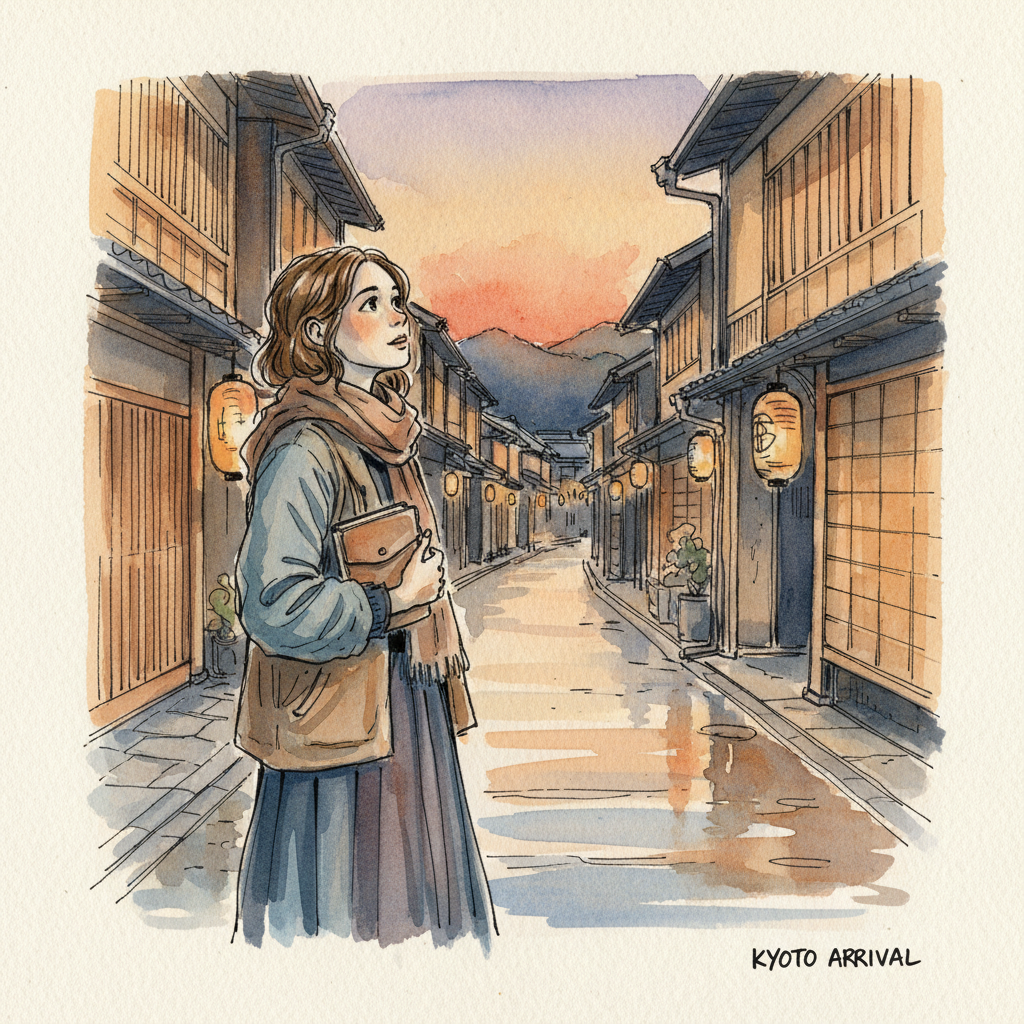
Above and below
The fog sat low over the valley on my last morning, so thick the roofs of the nearest houses were only dark shapes in the white. I had spent two days looking at things — the roofs, the interiors, the festival preparations — and I realised I had not yet looked at the shape of the place itself. What holds Shirakawa-go together is the valley, and the valley is best seen from above.
Ink vignette of a weathered wooden signpost with Japanese and English text reading 'Shiroyama Observation Deck' and an arrow, moss on the post, forest path behind
The Shiroyama trail begins just beyond Wada House, where a wooden signpost points uphill through the trees. It is not a strenuous climb — fifteen minutes at most, the path switching back through a grove of cedar and bamboo grass, the sound of the Shogawa receding as you rise. The fog began to thin as I climbed, and by the time I reached the observation deck the valley was opening below me like a hand uncurling.
The village from above is a different thing entirely from the village at street level. From the ground, the gassho houses stand apart, each one distinct, separated by gardens and rice fields and the winding lanes. From Shiroyama they compress into a single dense pattern: a scatter of dark triangular roofs clustered on the valley floor, the Shogawa river a silver thread curving around them, the rice terraces rising in stepped rectangles on the far slope. The mountains close in on every side — not the distant blue shapes of postcards, but close enough to see the texture of the forest, the darker green of the cedars against the lighter green of the beech, and here and there, just beginning, a single tree of orange or red. The autumn colour has not arrived properly yet — it is still three or four weeks away — but the first scouts are already there, scattered through the canopy like signals.
Ink vignette of a small carved wooden bird on a workshop shelf, the wood pale and smooth with visible grain, soft shadows behind
I stood at the railing longer than I planned, watching the fog drift in and out of the valley, opening and closing the view like a shutter. A busload of tourists arrived, took their photographs, and left again within seven minutes. I counted. I stayed until the next bus came, and then I stayed after that, until the fog came back and the village below dissolved into white and I could no longer tell where the roofs ended and the river began.
Coming down the trail, I took a different route — not the main path but a narrower one that someone had worn through the bamboo grass on the southern slope. It emerged not at Wada House but at the back of a small wooden building I had passed every day without entering. A hand-painted sign hung beside the door: Kokichi Hori — Woodwork. The door was open. Inside, a man in his seventies sat at a low workbench, a block of pale wood in his hands, a knife moving in short precise strokes. He was carving a bird — a small thing, not much bigger than my thumb, its wings folded, its head turned slightly as if listening. The shavings piled around his feet were the colour of honey. He did not look up when I entered. He finished the stroke he was making, set the knife down, and only then nodded at me, once, and said something in Japanese that might have been a greeting or might have been a comment on the fog. I bought the bird. He wrapped it in washi paper with the same quiet economy he had used to carve it, and I walked back through the village with the small weight of it in my pocket, the last day done and my hand closing around it every few minutes to make sure it was still there.
The hands that hold the valley
Shirakawa-go's preservation is usually told through roofs and UNESCO designations, but the other story — equally old, equally fragile — lives in the village's craft traditions. The official village website lists several: hide-zaiku (maple-strip weaving), the carving of hiiragi and yew wood, the making of straw goods and bamboo baskets. These are not performances for tourists. They are skills passed through families, practised in back rooms and garden sheds, and they are disappearing because there is no more economic reason for them.
Kokichi Hori is one of the few remaining woodcarvers working full-time in the village. His speciality is yew and wisteria — woods that grow in the surrounding mountains and have been used for household objects in the Hida region for centuries. Yew is dense and pale, almost white when freshly cut, darkening to honey over years; wisteria is twisted and unpredictable, each piece carrying the grain of the vine it grew from. He makes small animals, sake cups, hairpins, chopstick rests — objects small enough to hold in one hand, carved with the unhurried precision of someone who has been making the same gestures for forty years.
The craft is called hida no takumi — the skill of Hida — and it belongs to the same landscape that produced the gassho roofs. The same mountains that supplied the timber and thatch for the houses supplied the wood for their bowls, their tools, their children's toys. A village that keeps its roofs but loses its crafters is a village that has become a museum. The woodcarver with wood-shavings on his floor is the proof that it is not a museum yet.
Nearby, Myozen-ji Temple stands at the southern edge of Ogimachi, a gassho-style building that houses a small museum of the temple's history. Its grounds are quiet, shaded by old cryptomeria, and from its garden you can look up at the same mountains that supply the woodcarver's material. It is worth the walk past the main tourist circuit — a reminder that this valley was a religious community before it was a tourist destination.
What the woodcarver's hands leave behind
Ink vignette of a small ceramic bottle and cup on a wooden table, the bottle labelled with a handwritten character, warm light from a window
The most honest souvenirs in Shirakawa-go are the ones that cannot be mass-produced. Kokichi Hori's small wooden carvings — birds, cups, chopstick rests — are sold from his workshop near the southern end of Ogimachi, wrapped in washi paper, each one a single afternoon's work. There is no website, no mail order, no credit card machine. You arrive, you choose, you pay cash, you leave with something made by hands that have been making the same motions since before the village was a World Heritage site.
For edible souvenirs, the village's own products tell the same story of a place living off its own resources. Miyama Ishi Tofu is pressed so firm it can be tied with string without breaking — made from Toyama soybeans and the spring water of Mount Hakusan, available at the roadside stalls near Seseragi Park. Grandma's Gohei Mochi is sold at several stalls in the village: skewered rice cakes made from Shirakawa-go Koshihikari rice, glazed with walnut miso, grilled over charcoal until the edges crisp. Yuigokoro is the village's only local sake, brewed on request by a distillery in neighbouring Hida because Shirakawa-go has no brewery of its own — a sweet, smooth sake sold only within the village. And at the Shiroyamakan inn, you can buy the same grilled magnolia-leaf miso they have served at breakfast for over a century.
Keeping the craft alive
The preservation of Shirakawa-go is not only about roofs — it is about the skills that keep the village alive as something other than a photograph. The General Incorporated Foundation Shirakawa-go World Heritage Site Gassho Style Preservation Trust supports the entire ecosystem: the thatchers, the carpenters, the farmers who grow kaya grass, and, by extension, the woodcarvers and artisans whose work depends on the same village economy. A donation to the trust is a gift to the craftspeople too, because a UNESCO village that can afford to keep its craftsmen busy is a village that remains a real place — one where a man can still make a living carving birds from yew wood on a Tuesday morning.
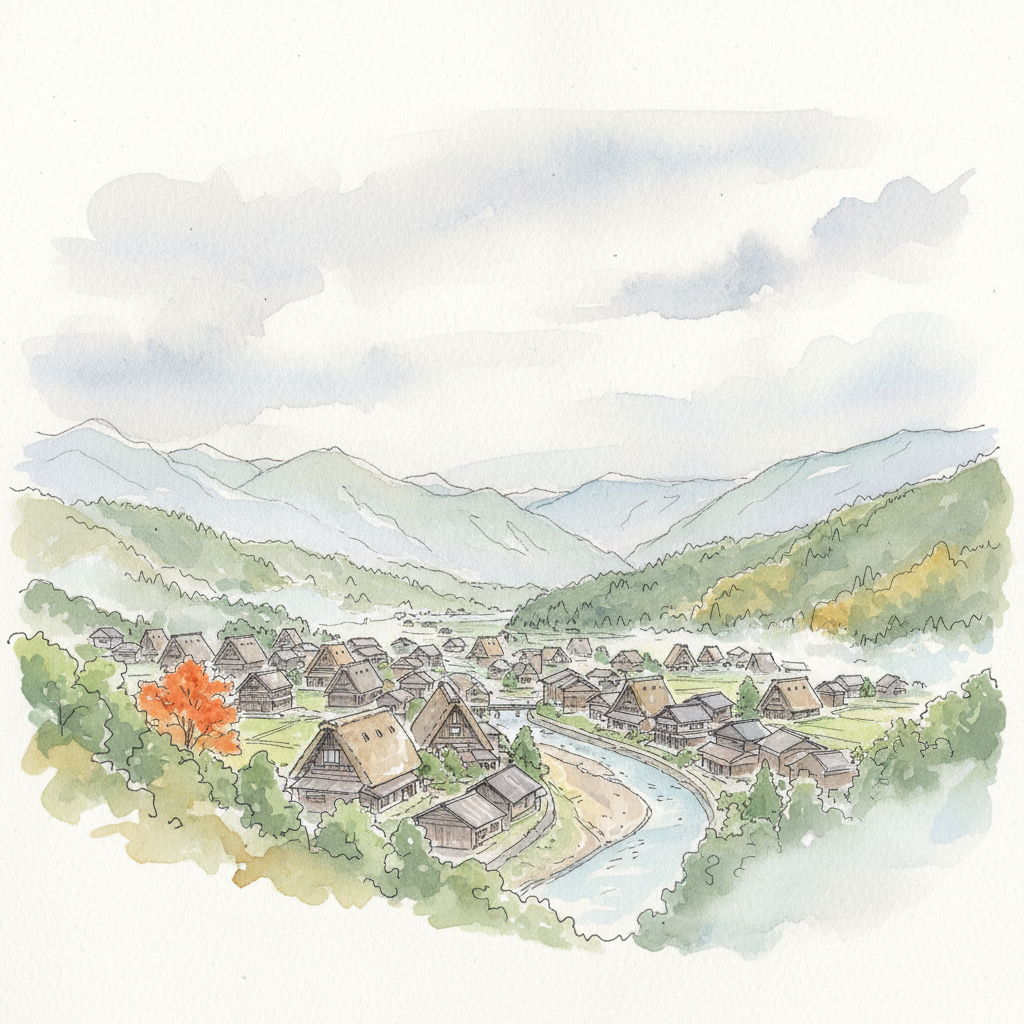
The view from Shiroyama
The village from above is not the village.
It is a diagram of itself — the roofs triangles, the river a line, the rice terraces rectangles laid on the mountain's flank like a child's drawing of steps.
From above, the people disappear. Their work becomes invisible. The woman lifting the rice pole at seven in the morning is not a person from up here; she is a principle of cultivation, a shape that repeats across the valley.
But I had been below. I had seen her face. I had seen the woodcarver's hands.
And so the view from above was not a view of a village. It was a view of everything I had been wrong about the first time I came here, when I thought beauty was something you could take in one look from a hill.
— After Karl Ove Knausgaard, who wrote that distance is a form of forgetting, and that to truly see you must stand close enough to smell the work.