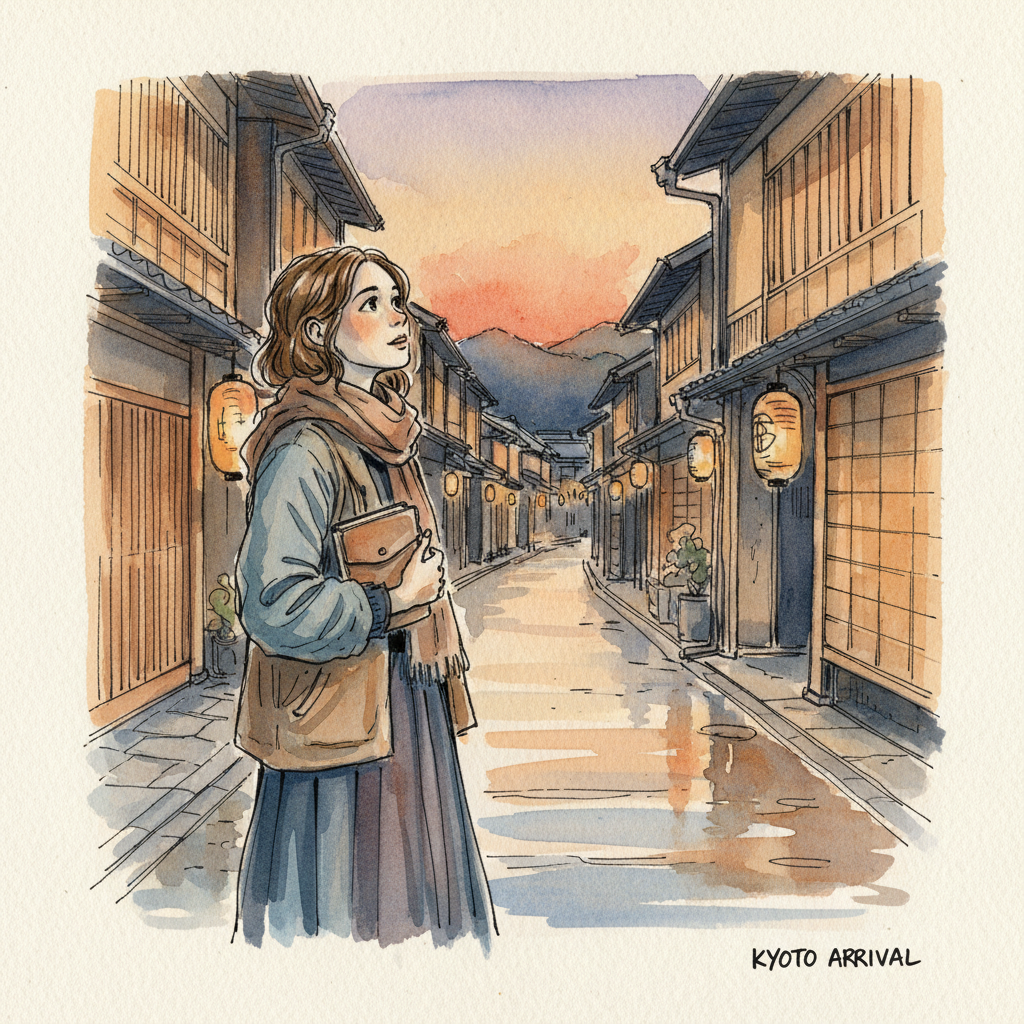
The road to Gokayama
The bus from Shirakawa-go climbs out of the Ogimachi basin and winds north along the Shogawa River valley, the road narrowing as the mountains close in on both sides. The gassho roofs dwindle behind you, and after forty-five minutes the bus crosses into Toyama Prefecture and stops at a small sign that says Ainokura-guchi. A five-minute walk down a lane between rice fields, and you are in a different world.
Ainokura has twenty gassho houses where Shirakawa-go has a hundred and thirteen. The village sits in a narrower valley, steeper on both sides, the houses scattered along a single lane that follows the contour of the hill. No tour buses. No queue at the viewpoint. An old woman hangs a futon over a second-floor railing. A cat sleeps on the thatch of a wall — a patch of grey against the brown, utterly indifferent to everything.
The silence here is of a different order: not the absence of noise, but the presence of the mountains, so close you can hear the wind moving through the cedars on the ridge.
The village is divided by a small stream that comes down from Mount Hakusan, invisible from here but present in every stone and every wooden footbridge. The houses face south, away from the north wind, just as they do in Shirakawa-go, but here the feeling is more intimate. The roofs are lower, the lanes narrower, the gardens more private. This is not a show village. People watch you from their windows with the mild curiosity of those whose home has become a landmark without their quite agreeing to it.

I walked the lane to the far end, past the washi workshop and the folk museum, past a persimmon tree so heavy with fruit that a branch had been propped up with a wooden pole. The autumn colour has not properly arrived — just a hint of yellow in the maples, a single red leaf on a mountain cherry. But the air carries the same golden edge I felt in Shirakawa-go, the feeling of a season on the verge.
At the end of the lane a path climbs to the observation point, and from there you see the whole Ainokura valley: the twenty thatched roofs arranged like a hand of cards across the green, the Shogawa visible in glimpses through the trees, and beyond it the mountains rising in layered blues and greys towards a ridge that hides Toyama Bay.
Ainokura is the quiet half of the UNESCO site. It is what Shirakawa-go must have looked like forty years ago, before the world found it. And arriving here on a wet September afternoon, I felt a kind of relief — the feeling of stepping into the quieter room, where nothing demands your attention and everything rewards it.
Paper, harvest, and a folk song in the next valley
The great craft of Gokayama is washi — handmade paper from the fibres of the kozo (paper mulberry) tree, beaten and sifted through a bamboo screen in water so cold your knuckles ache by noon. Gokayama washi is part of a tradition that UNESCO inscribed on its Representative List of Intangible Cultural Heritage in 2025, one of the oldest continuous craft practices in Japan. The Gokayama Washi Paper Making Experience Hall sits in a gassho house at the edge of Ainokura, and you can watch the papermakers at work or try it yourself — dipping the screen, lifting it level, letting the water run off until the fibres knit themselves into a sheet that will be pressed, dried on wooden boards, and finally peeled away in the morning.
The Ainokura Folk Museum, housed in another gassho building, shows what life in this valley looked like before the world discovered it: the tools for sericulture, the charcoal braziers, the straw rain capes worn by travellers crossing the mountains on foot. Upstairs, photographs from the 1950s show a village almost indistinguishable from the one that existed in the Edo period.
And today — September 26 — is the second day of the Kokiriko Festival at Hakusan Shrine in nearby Kaminashi, a few valleys over. The festival is one of Japan's oldest folk song and dance traditions, performed with bamboo percussion (the sasara) and flute, the dancers moving in slow circles to prayers for the harvest. I could not reach Kaminashi on foot, but from the observation point above Ainokura I thought I heard the faint pulse of a drum carried on the wind — though it might have been my imagination, wanting it to be real.
Paper, bamboo, and what comes from the mountain

The Traditional Industry Center in Ainokura sells what the valley still makes by hand. The star is the washi itself — notebooks, postcards, lamp shades, sheets of handmade paper in every shade from cream to deep indigo, each one slightly different, the fibres visible when you hold it to the light. The papermakers use natural dyes from indigo and persimmon tannin, the same colours that stain the mountains in autumn.
Alongside the paper you find the other crafts of Gokayama: straw sandals (waraji) that were once the only footwear that could grip a snowy mountain path; bamboo baskets in shapes that have not changed in three centuries; small wooden combs carved from yew and cherry, the teeth cut one at a time with a saw no wider than a fingernail. Everything is small and honest and made by someone who learned the skill from their parents. There is no packaging. The price is written on a slip of washi tape.
For eating, the village's tiny Shimashima Cafe serves coffee in hand-thrown cups and a set lunch of sansai (mountain vegetables) with local rice. The restaurant at Goyomon — a gassho house converted to an inn — does dinner for non-guests by reservation, serving Shogawa-grown soba and freshwater char grilled over the irori, and I have heard it is the best meal in the Gokayama valley.
Keeping a roof on the quiet twenty
The preservation of Gokayama's gassho houses is governed by the same principle as Shirakawa-go's — yui, the tradition of mutual aid where the whole community shows up for a rethatching. But Gokayama's population is smaller and older, and the burden falls harder on fewer shoulders. The Ainokura Gassho Village Preservation Society works alongside the Shirakawa-go trust to maintain the roofs, manage the parking revenue that funds repairs, and support the craftspeople whose skills are as endangered as the architecture. Their office is in the village, and they welcome donations and volunteers.
Supporting the Gassho Style Preservation Trust (the same organisation that keeps the roofs on in Shirakawa-go) or the Gokayama tourism office helps both valleys. A donation means a village that stays alive, not a village that stays pretty.
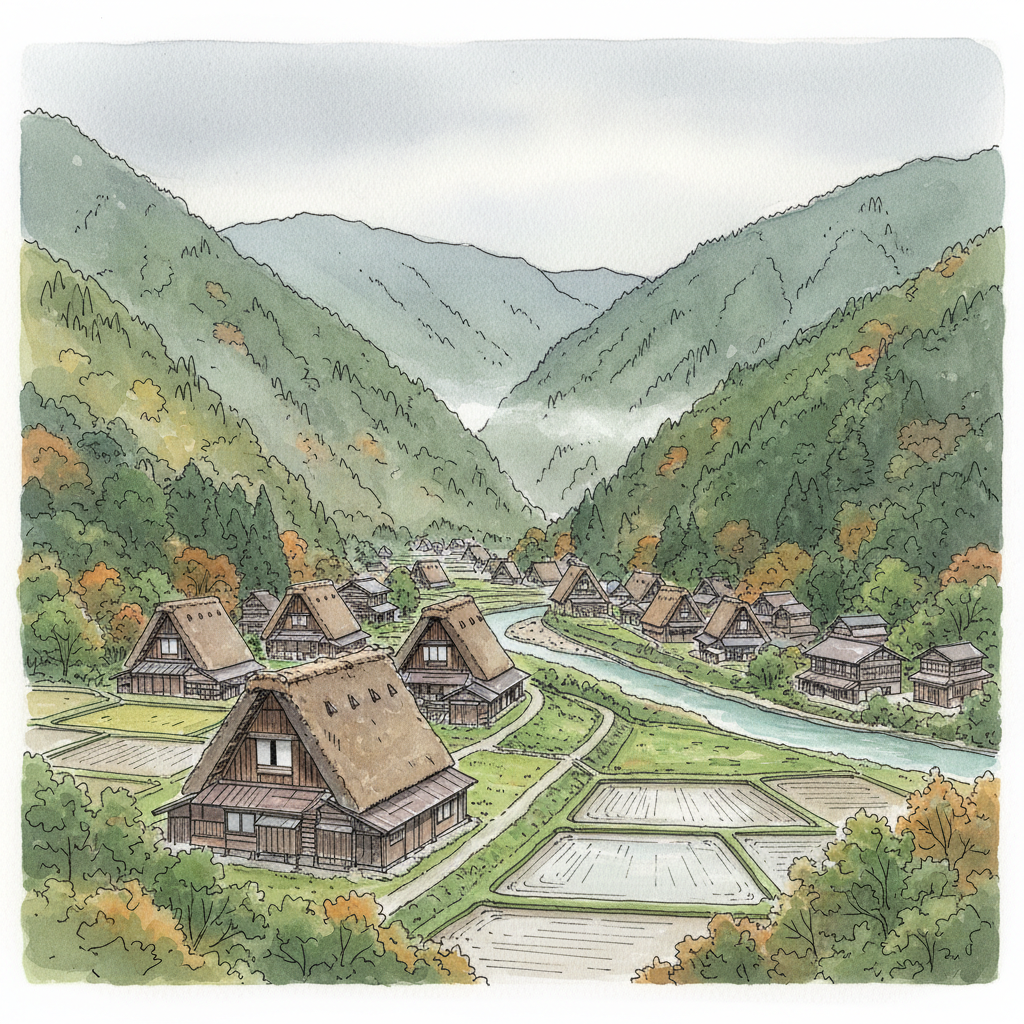
Ainokura
Only twenty roofs.
The others are in the next valley, called beautiful, photographed from every angle.
Here the bus comes five times a day. The old woman hangs a futon over the second-floor railing with the same hands she used to make washi this morning.
The persimmon branch that was propped up with a pole has not dropped a single fruit, though the autumn wind has been testing it for weeks.
I walked to the end of the lane and found no more lane. Just the mountain, its cedars, the sound of a stream that has been running along this same stone bed since before anyone built a roof over anything.
I stood there until I was cold. Then I walked back. The cat was still asleep on the thatch.