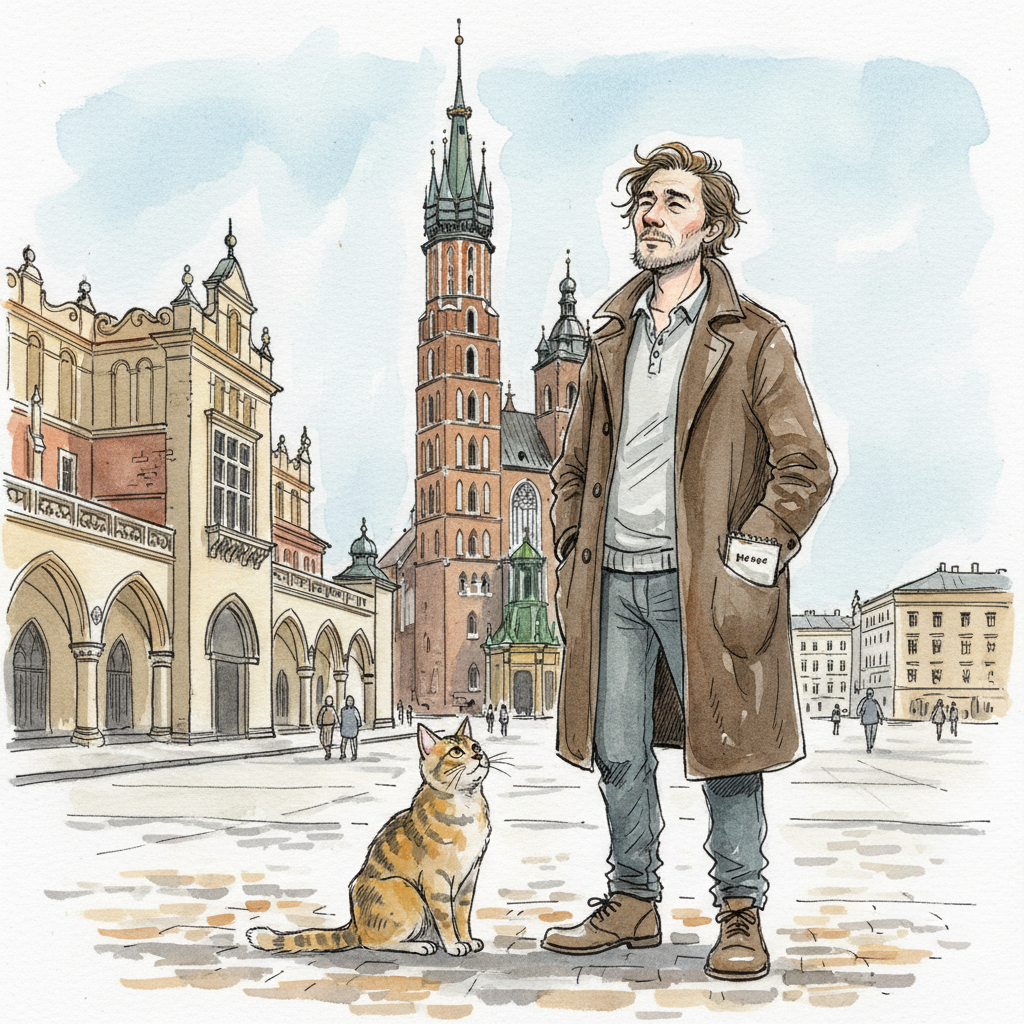
Day 6 Plac Centralny in the October mist October 13, 2026
The city they built as a weapon
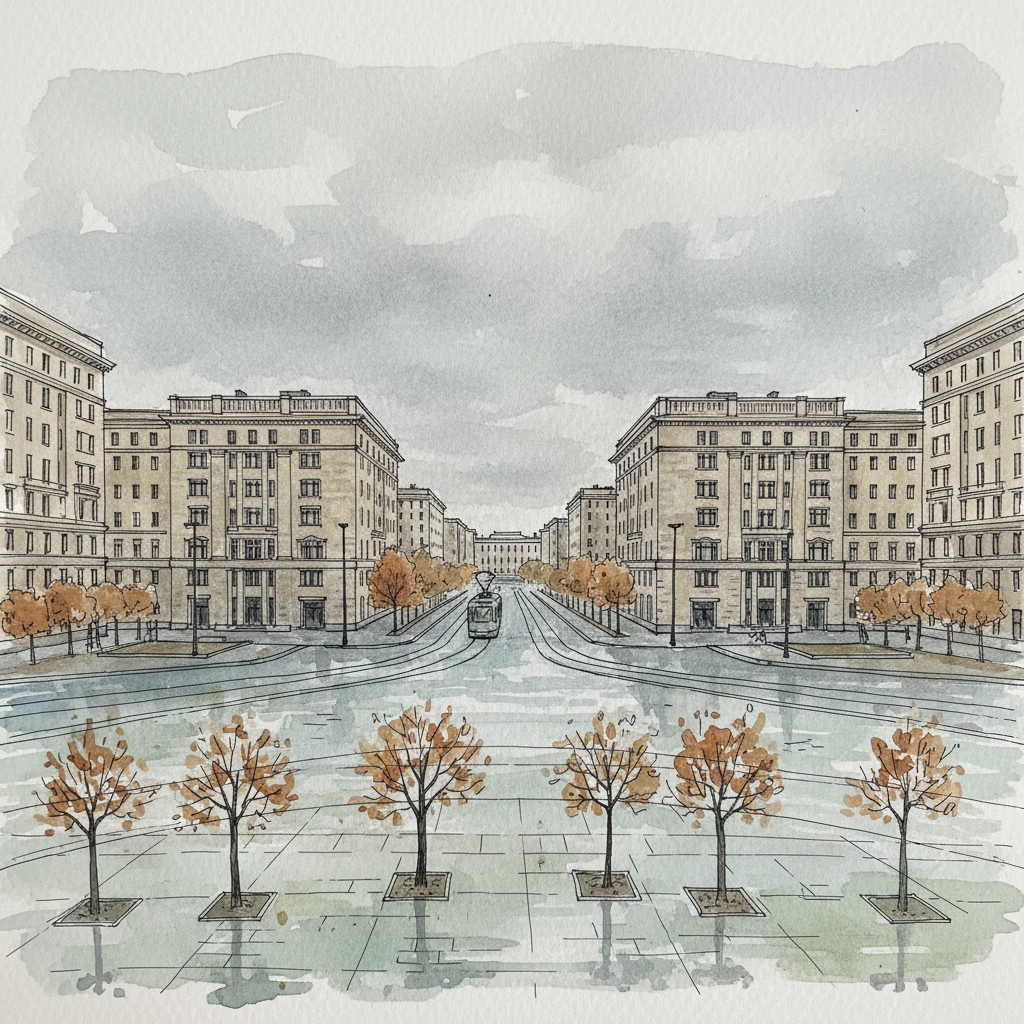
Tram 4 from Plac Wszystkich Świętych runs east for 25 minutes. The old town drops away, the river crosses underneath, and then the buildings stop being Gothic or Baroque or Secession and start being symmetrical. Five-storey limestone blocks in perfect formation. Wide avenues radiating from a centre like a compass rose. No medieval mess, no centuries of accretion — just one idea, laid down in 1949 and left to stand.
Nowa Huta was designed as an ideological counterweight to Kraków's Catholic, bourgeois soul: a model socialist city where the working class would live in modern apartments with running water, green courtyards, schools, cinemas and a culture palace, all built around the Lenin Steelworks. The scale is the first thing you notice at Plac Centralny — a vast semi-circular plaza with boulevards shooting off like spokes. It was renamed after Ronald Reagan in 2004 but everyone still calls it Plac Centralny, and the symmetry still does what it was built to do: makes you feel like a small part of something larger.
Aleja Róż — Avenue of the Roses — runs north from the square, wide as a runway, lined with the district's signature apartment blocks and the rose beds that give it its name. In October the roses are gone but the avenue's geometry holds: the street hierarchy, the generous pavements, the way every building faces the next one across the same distance. It was designed to resemble Haussmann's Paris, they say, and there are moments — the proportions, the long view down a straight line — when you can almost see what they were reaching for.

The full walk from Plac Centralny to the Arka Pana church takes about twenty minutes down Aleja Jana Pawła II, past the district's cultural centre and the old cinema. Free paper maps are available at the Nowa Huta Museum information desk, but the street grid is simple once you orient yourself from the square. The best light for photography comes in the late afternoon, when the low sun catches the limestone facades and the friezes — Soviet-inspired decorative bands above the windows, details you would miss if you were not looking up.
There are no ticket booths and no opening hours. The whole district is open air, lived in, working. Tram back costs 4.60 PLN.
The church that should not be here
There was one thing missing from the original design of Nowa Huta: a church. The omission was deliberate — a socialist paradise had no room for religion. But as early as 1952, residents petitioned for one. They placed a wooden cross near Plac Teatralny in 1957. Every attempt to build was blocked, then withdrawn, then blocked again.
On April 27, 1960, when authorities came to remove the cross, the residents of Nowa Huta rose in protest. The militia met them with violence. The 1960 Nowa Huta protests became a symbol of Polish resistance before Solidarity, before the 1980s, before any of it seemed possible.
.jpg)
Permission was finally secured in 1965 — credited to the intervention of Archbishop Karol Wojtyła, the future Pope John Paul II. The Church of Our Lady Queen of Poland — known universally as Arka Pana, the Lord's Ark — was built between 1967 and 1977 by volunteers, with no government assistance, over nine years. The architect was Wojciech Pietrzyk, and the design was deliberately shaped like a ship: an elongated oval plan, slanting concrete walls, a roof like a hull, and a 70-metre mast-like cross. The exterior is clad in round river stones, giving it a texture like a boat run aground and smoothed by the current. You can see echoes of Le Corbusier's Ronchamp in the sculptural form, but it is bigger, rougher, and earned in a way Ronchamp was not. The cornerstone was laid by Wojtyła on May 18, 1969, using a stone from St. Peter's Basilica.
It stands at 1 Obrońców Krzyża Street — Defender of the Cross Street — a name chosen with full knowledge of what it meant. The fact that the church is still active and appears on Kraków's tourist maps alongside the steelworks — this all feels, on a quiet October afternoon, like the ending the planners in 1949 did not write.
What to eat in the planned city
On the corner of Plac Centralny, Bar Mleczny Centralny (Osiedle Centrum C 1) serves the kind of lunch that built this district: a bowl of żurek, pierogi ruskie, a cutlet with potatoes and a compote for under 20 PLN. A proper Polish milk bar unchanged by time — the same tiled floors, the same tray system, the same elderly regulars reading the paper over tomato soup. Cash only, no menu in English, and nobody hurries you.
If you need coffee while you are here, Klubokawiarnia Ludowa (al. Róż 2) has a terrace overlooking the avenue and a clientele of students and pensioners in equal measure. Café Nowa Księgarnia (al. Róż 7) doubles as a bookshop — good for a flat white and a browse through Polish publishers you will not find in the Old Town.
For something to take home: the Nowa Huta Museum (os. Słoneczne 16, 17 PLN entry) sells reprints of old PRL-era posters, enamel pins and communist-era memorabilia. But the museum itself is worth visiting for the permanent exhibition on the district's construction — how 100,000 people were moved here, what their apartments looked like, how the steelworks shaped everything. If you skip the museum, the free thing to bring home is the memory of the tram ride back into the old city, watching the symmetry dissolve back into medieval chaos.
The ideal city
They drew a perfect circle on the map and filled it with straight lines. The streets were planned before the buildings, the buildings before the people, the people before their consent.
How long does an idea last when it is poured into concrete and the concrete outlasts the idea?
The roses were planted along the avenue so that workers walking home would smell something beautiful before they opened their doors.
The roses are still there. The workers come home to different doors now.
What survives in a planned city is not the plan. It is what people built because the plan forgot them.