The other side of the river
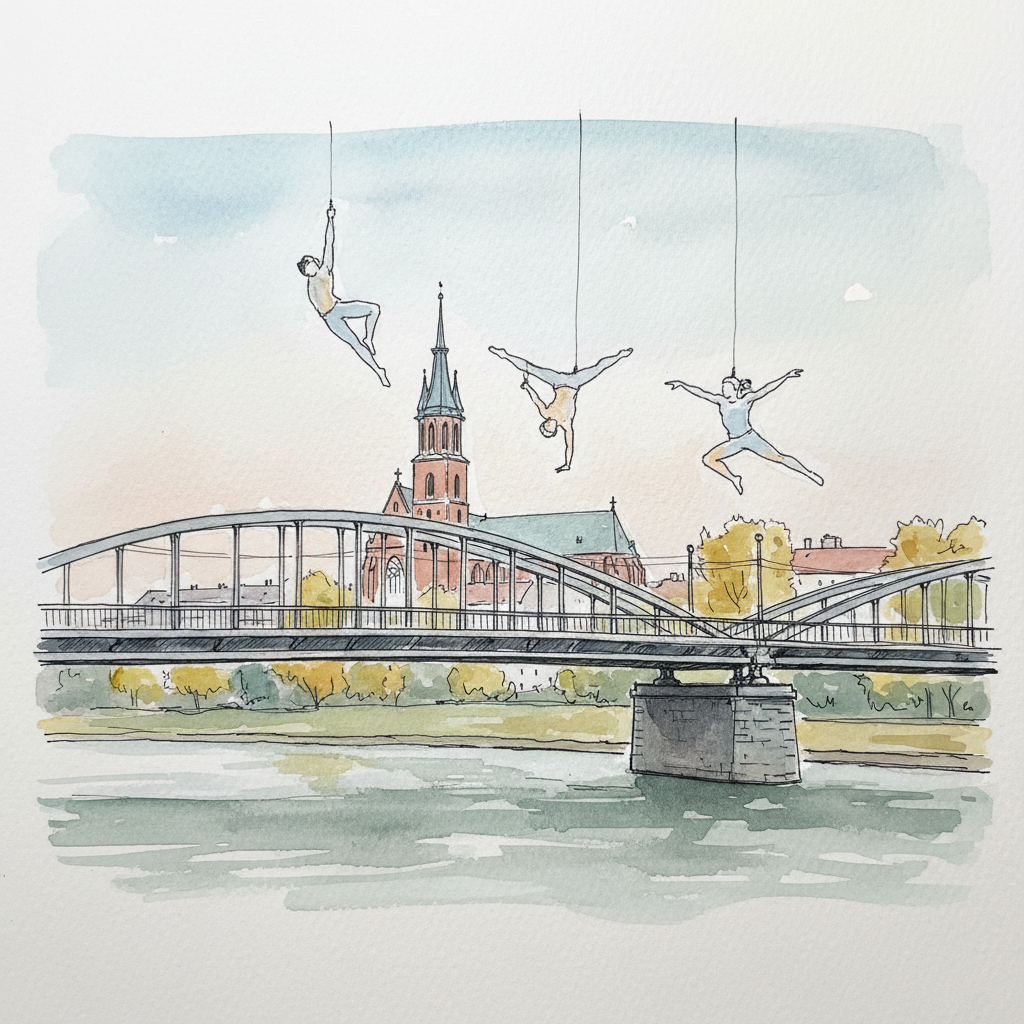
The Father Bernatek Footbridge connects Kazimierz to Podgórze the way a sentence connects two clauses: with a pause, a breath, a shift in meaning. I crossed it on a mild October morning with the Vistula sliding grey-green below and three acrobat sculptures frozen mid-somersault above the steel arch — Jerzy Kędziora's figures, bronze people suspended by nothing, caught in the act of getting from one place to the next by way of the air.
_Town_Hall_of_the_former_City_of_Podg%C3%B3rze,_1_Podg%C3%B3rski_Market_Square,_Krak%C3%B3w,_Poland.jpg)
Podgórze was an independent city once. Established by the Austrians in 1784 as the Free Royal City of Podgórze, it had its own charter, its own market square — triangular, not rectangular like Kraków's — its own town hall (Renaissance Revival, 1838–1844, rebuilt in the 1890s), and its own church. St. Joseph's dominates Rynek Podgórski with an 80-metre spire in red brick, designed by Jan Sas-Zubrzycki in what the Poles call Vistula Gothic: a nationalist neo-Gothic that borrows from St. Mary's Basilica but gives it something heavier, more earthbound. The square itself was quiet. A few people sat on benches eating zapiekanka from the corner stand. No horse carriages, no selfie sticks. It felt like Kraków had forgotten it had a twin city sitting on the other bank all this time.
I walked up Lasota Hill to the Krakus Mound — the largest prehistoric mound in Poland, believed to hold the bones of the legendary Prince Krakus himself. From the top the whole city opens like a map: the Old Town's towers, Kazimierz's red roofs, the curve of the river, the steelworks in Nowa Huta on the far horizon. A vantage point that costs nothing but the climb.
.jpg)
Back down on Nadwiślańska I found Ambalaż Café on the fourth floor of the Cricoteka building — a converted power station that now houses the archive of Tadeusz Kantor's theatre work, though I'm here for the coffee and the view, not the gallery. Floor-to-ceiling windows frame the Vistula, the footbridge I'd just crossed, and the rooftops of Kazimierz. I ordered a flat white and a slice of something with apple. It arrived on a ceramic plate and I sat and watched the light move across the river and thought: this is what Podgórze has — not the grand old town's crowds, but its own quiet, its own skyline, its own reasons for having been a city all by itself.
Art where you least expect it
The acrobat sculptures on the Father Bernatek Footbridge are by Jerzy Kędziora, a Polish sculptor who specialises in figures suspended in impossible positions. They're unlabelled and unexplained — you catch them out of the corner of your eye on your way across the river. The bridge itself (designed by Autorska Pracownia Projektowo-Plastyczna prof. Andrzeja Gettera, opened 2010) won architectural awards and replaced an old road bridge, but the sculptures are what make it memorable. On the Podgórze side, Cricoteka occupies a former municipal power station from the early 20th century, its industrial shell kept intact and topped with a contemporary glass extension — a building that does what Podgórze itself does: wear a new life over an old skeleton without pretending.
Shopping on the right bank
On Nadwiślańska 11, Rzeczy Same is a concept store that stocks Polish design and craft in single copies — ceramics, textiles, lamps, clothing, all made in Poland by independent makers and young designers. The shop assistants know the story behind every piece, which is half the pleasure. Deeper into Podgórze on ul. Kącik 8, Lucky Vintage is a proper rummage — racks of second-hand coats, handbags, Polish sweaters, and the odd 1970s lampshade. The kind of place where nobody hurries you and you leave with something you didn't know you needed.
Suspended
The bridge holds nothing but its own shape and the weight of people passing.
The acrobats above it hold nothing but air and the shape of people passing.
Two cities face each other across water like two people who have said everything and now stand in the silence.
How long to become a place? Podgórze took 131 years as a city before they folded it into Kraków and now it barely remembers it was ever separate.
But the mound on the hill remembers. The mound was here before either city. The mound remembers when there was nothing but earth and sky and a single prince who became a hill.