
The walk to the root bridge
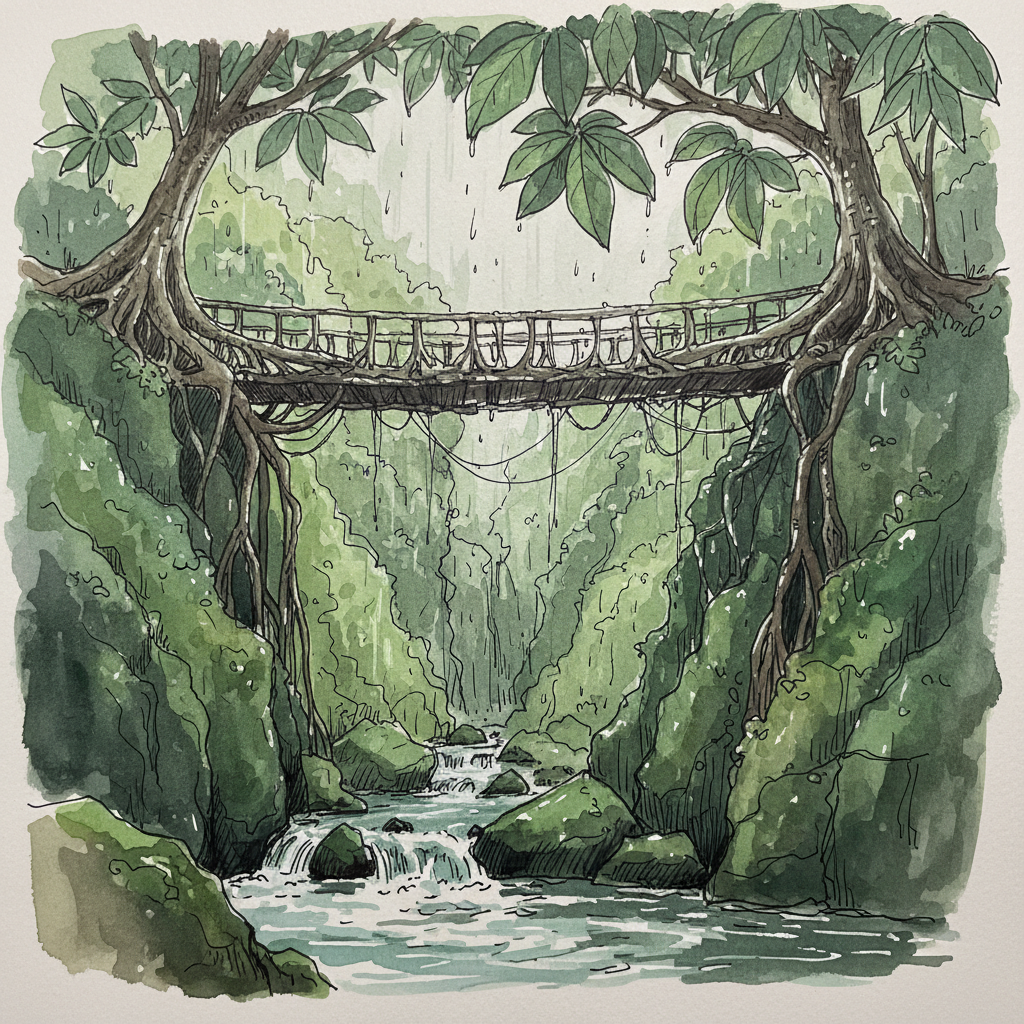
Today I walked east through steady rain toward a living root bridge. The Khasi don't build across these monsoon rivers — they coax. A Ficus elastica, its aerial roots trained over a century into a crossing that grows stronger with each wet season. The rain falls on the canopy above and the river runs grey below, and between them a village threads a path on something that was never dead lumber.

The root does not rot. That is the genius of it — while every wooden bridge in these hills softens and collapses within years, a ficus root turns water into strength. The more it rains, the more it grows. A bridge that eats the weather.
Stitched borders and grown crossings
Two craft traditions, one patient. In Mustoh village, also in East Khasi Hills, women have embroidered Khneng — meaning 'border' in Khasi — for nearly 200 years. Precise geometric borders stitched in rhythmic patterns drawn from the flora and fauna around them. This September, Air India Express began featuring it on seat covers as part of their #TalesOfIndia initiative, carrying a Khasi village's borders across the country.
Meanwhile the living root bridges — there are dozens scattered through these hills — are being documented by UNDP as both living infrastructure and cultural heritage, a technology the Khasi have refined for generations without a single blueprint.
Root Law
The tree does not know it is building a bridge. It feels a branch grow heavy, sends a root down to meet the water. A hundred years of this. The bridge does not remember being a sapling.
The rain does not know it is falling on a bridge that will outlive the hands that trained it. It has been falling for longer.
Everything here is patient. The moss on the root. The root on the bamboo. The village that began this work in a century whose name they no longer say aloud.