The city that bathes
The train from Takamatsu crosses the plain of Kagawa and then the mountains begin — not the dramatic gorge walls of Iya but the rounded, pine-covered hills of central Shikoku, tunnel after tunnel, until the land opens again onto the Dogo Plain and the Seto Inland Sea flashes silver to the north. Two hours from Takamatsu and I was in Matsuyama, the largest city on Shikoku, a place that has been a destination for so long the first mention of its hot spring appears in the Man'yōshū, the oldest existing collection of Japanese poetry, compiled around 759.
The contrast with Iya Valley could hardly be sharper.

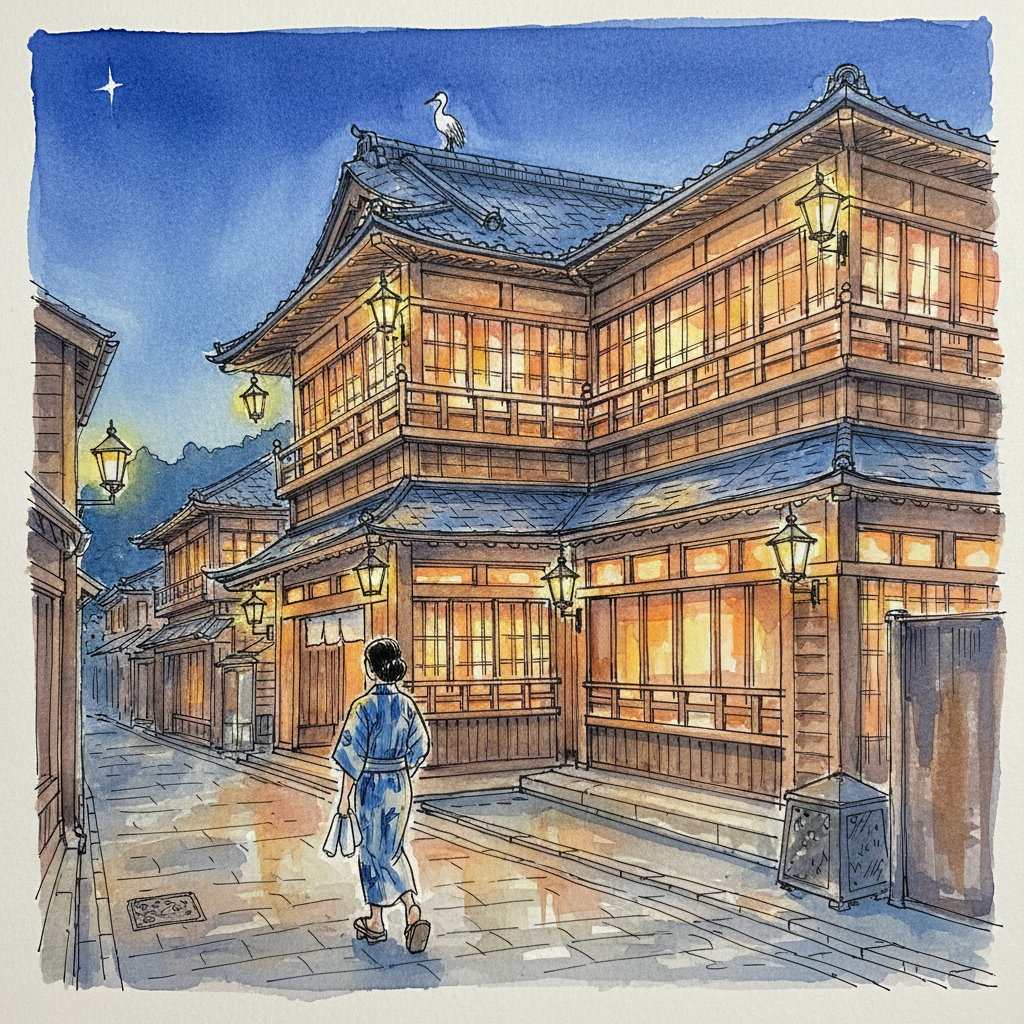
I arrived at the Dogo Onsen district on the city's eastern edge, and the streets were full of people in yukata — families, couples, single travellers — shuffling between bathhouses and restaurants in the early evening, their wooden geta clacking on the pavement. A woman in a blue yukata with a crane pattern walked past carrying a towel and a small plastic bucket, heading for the Honkan, the main bathhouse building. She was not a tourist. She lived somewhere nearby and this was her Tuesday bath. That is the difference: Iya is a place you visit; Dogo Onsen is a place you live in.
The Honkan itself is an architectural paradox — a three-storey wooden bathhouse built in 1894 in a style that borrows from both Japanese castle architecture and the Western Meiji love of verandas and gas lamps. A white heron perches on the roof ridge in tile, the same bird that, according to legend, led a traveller to the spring a thousand years ago. Inside, the main bath, the Kami no Yu, is divided into two levels of tatami sitting room above the bath floor, with a painted ceiling and a shop selling Botchan souvenirs. Natsume Sōseki, who taught at the middle school in Matsuyama in 1895, came here often, and his novel Botchan gives the bathhouse the kind of literary immortality that few public buildings ever earn. The character Botchan — the young, lonely Tokyoite — finds in the bathhouse the only place in the provincial city that does not make him feel exiled.
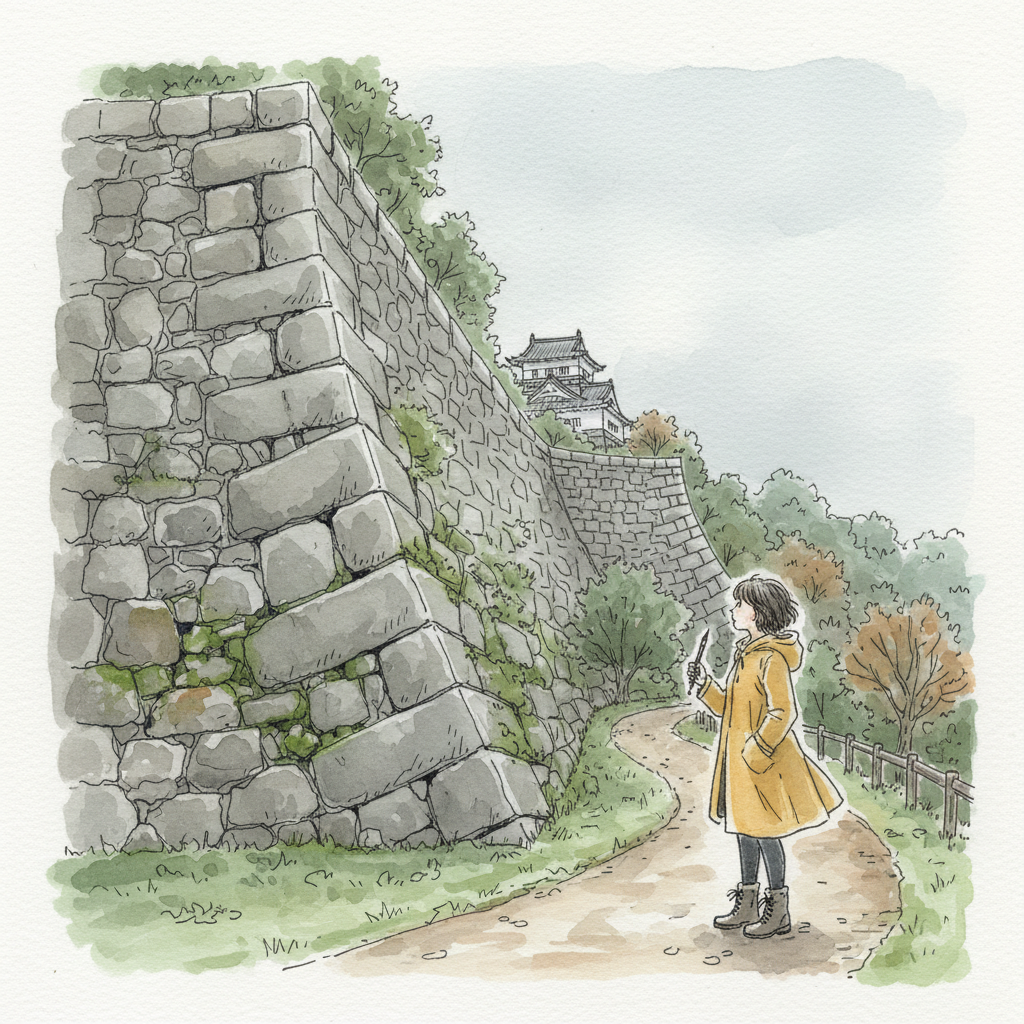
I climbed Katsuyama hill afterward, up the ropeway to Matsuyama Castle. The castle was begun in 1602 by Katō Yoshiaki, a daimyō rewarded for his service at the Battle of Sekigahara, and finished in the 1620s. Its main keep is one of the few original Edo-period castle keeps still standing in Japan. I say 'still standing,' but it is not the original: the first keep was struck by lightning and burned in 1784, and the current one was rebuilt in the mid-19th century on the same stone base. From the top of the keep the city spreads out below — the roofs of Dogo, the port, the islands of the Seto Inland Sea, and, on a clear day like today, the faint silhouette of the Shikoku Mountains to the south where I had been two days before.
The novelist and his bath

Natsume Sōseki is the presiding spirit of Matsuyama, and Dogo Onsen is his monument, but the connection is more interesting than a simple literary pilgrimage. Sōseki spent a single year in Matsuyama — 1895 — as a teacher at what is now Matsuyama Middle School. He was 28, newly returned from studying in London, unhappy, lonely, and suffering from what would now be diagnosed as depression. The protagonist of Botchan, published in 1906, shares these circumstances: a young Tokyo intellectual exiled to the provinces. The bathhouse becomes the one place where the city makes sense. 'The only thing I like about Matsuyama is the hot spring,' the narrator says, and you hear Sōseki's own voice in that line.
The Shiki Museum, named after the haiku poet Masaoka Shiki, sits a short walk from the Honkan. Shiki was Sōseki's friend — they roomed together briefly in Tokyo — and he too spent time in Matsuyama. The museum holds manuscripts, letters, and first editions, including original drafts of Botchan and Shiki's haiku notebooks. It is a small museum, the kind where you can stand alone in a room with a glass case and read a letter written by hand 130 years ago.
At the Museum of Art, Ehime, two exhibitions are on now. Jimmy Onishi's Hometown, running from October 3 to November 8, is a collection of paintings by the Ehime-born artist whose work explores regional identity through a contemporary lens — landscapes that are both specific and imagined. From October 10 to December 13, Collection Exhibition III: From Painting to Mass Media traces how artistic imagery moved from canvas to print, photography, and digital formats through the 20th century. Both exhibitions cost ¥330 for adults (Museum of Art, Ehime, closed Mondays, open 9:30–17:00).
Sea bream and mikan

Ehime is known across Japan for two things: mikan (mandarin oranges) and taimeshi (sea bream rice). The oranges grow on the sunny hillsides above the Seto Inland Sea, reaching their peak sweetness in the winter months. The taimeshi — a whole sea bream cooked with rice in a dashi broth, the fish's head and tail curling over the edges of the pot — is served at restaurants across the city, priced around ¥2,000–¥3,500 depending on the grade of the fish. The rice absorbs the flavour of the broth and the fish simultaneously, and the meat is eaten separately, flaked off the bone with chopsticks.
Jakoten is a humbler local staple — a fried fish cake made from minced small fish (usually horse mackerel or sardines), pressed into blocks and sliced. It is served on its own with soy sauce or dropped into noodle soups. Goshiki somen — five-colour noodles — is another Matsuyama specialty: long, thin wheat noodles in five colours (white, green, pink, yellow, and brown), traditionally eaten cold in summer but also served in hot broth as the weather cools.
Tobe-yaki, the pottery of nearby Tobe, is one of the most respected ceramics traditions in western Japan — a thick, hand-thrown stoneware with a distinctive celadon or iron-brown glaze, fired at high temperatures. Tobe is a thirty-minute bus ride from central Matsuyama, and the pottery district has workshops where you can watch the throwers at work. A single Tobe teacup costs around ¥1,500–¥3,000 at the kiln's shop.
The food drive at the city's heart
Matsuyama City runs a food drive programme — the same model as the one in Takamatsu but run by the city itself. Unopened, shelf-stable food is collected at permanent drop-off corners at supermarkets across the city (the prefecture lists locations on its website), and distributed through food bank organisations to children's cafeterias and welfare groups. The city also lends food drive sets — collection boxes, banners, posters — to schools, companies, and neighbourhood associations for their own drives, free of charge. If you are visiting and have a sealed bag of rice or a can of vegetables that you bought and did not use, the drop boxes at the supermarkets are a way to leave something behind that a child in the city will eat this week.
The water that keeps time
The spring rose before the bathhouse, before the castle, before the poem that names the spring in the oldest book of Japanese poems.
The water has been underground longer than the island has been called Shikoku.
When Natsume Sōseki sat in the Kami no Yu in 1895, the chlorine content of the water was the same as it is today: 48.6° Celsius, pH 8.0, flowing up through a fracture in the granite that split open before humans arrived.
A woman in a blue yukata carries a plastic bucket and a hand towel, and the water she will sit in is the same water Prince Shōtoku sat in fourteen centuries ago.
The geta clack on the pavement. The heron on the roof ridge does not move. It has watched this happen before.
— the temperature and pH of Dōgo Onsen are documented on the prefecture's official site; the Man'yōshū reference is historical.