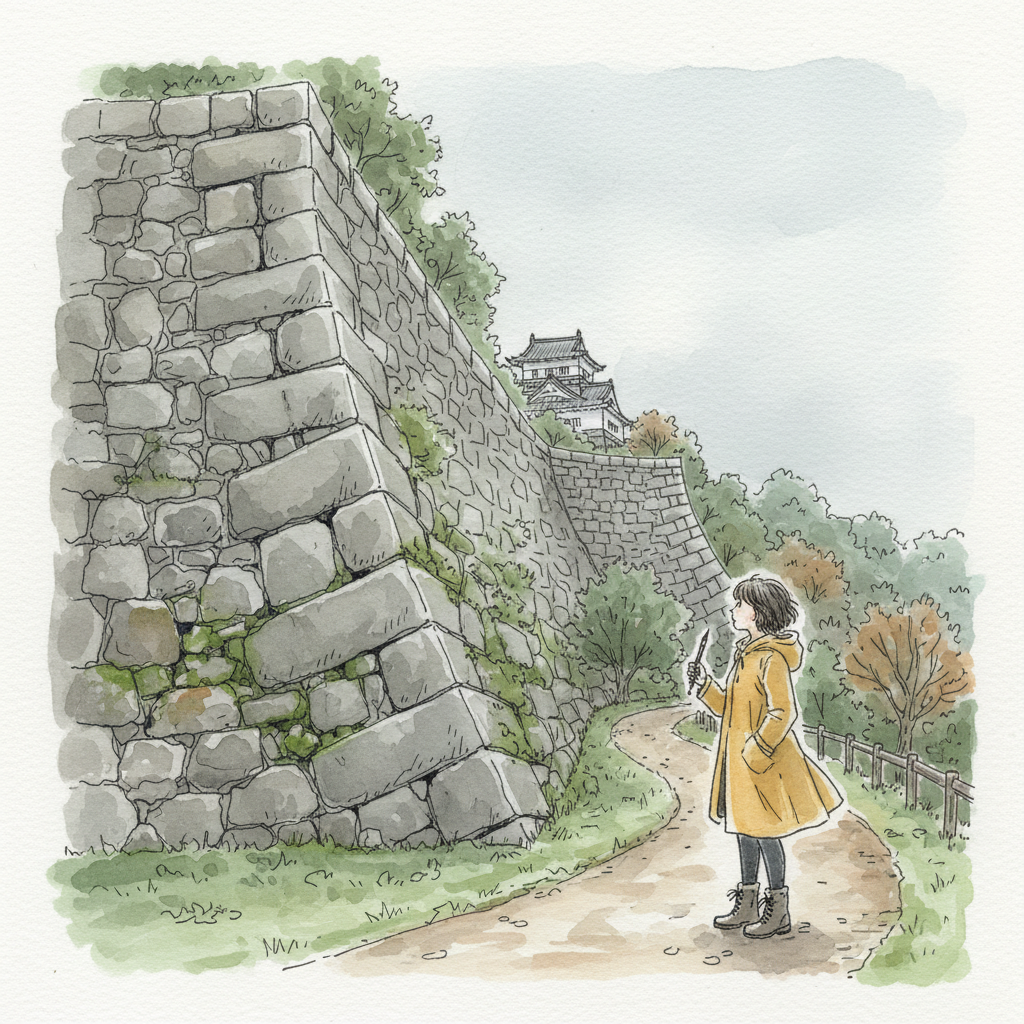
End of the line

The train from Matsuyama runs south along the coast, in and out of short tunnels, the sea appearing between pine groves before the line turns inland through the mountains. Forty minutes of rural Ehime — citrus orchards on slopes, fishing boats in coves — and then you arrive at Uwajima Station, the end of the Yosan Line, the terminus of southwestern Shikoku. The platform feels like a terminus: fewer passengers than you expect, older carriages shunting into sidings, a certain slackening of pace that marks the end of a rail journey. Beyond this point there is only bus.
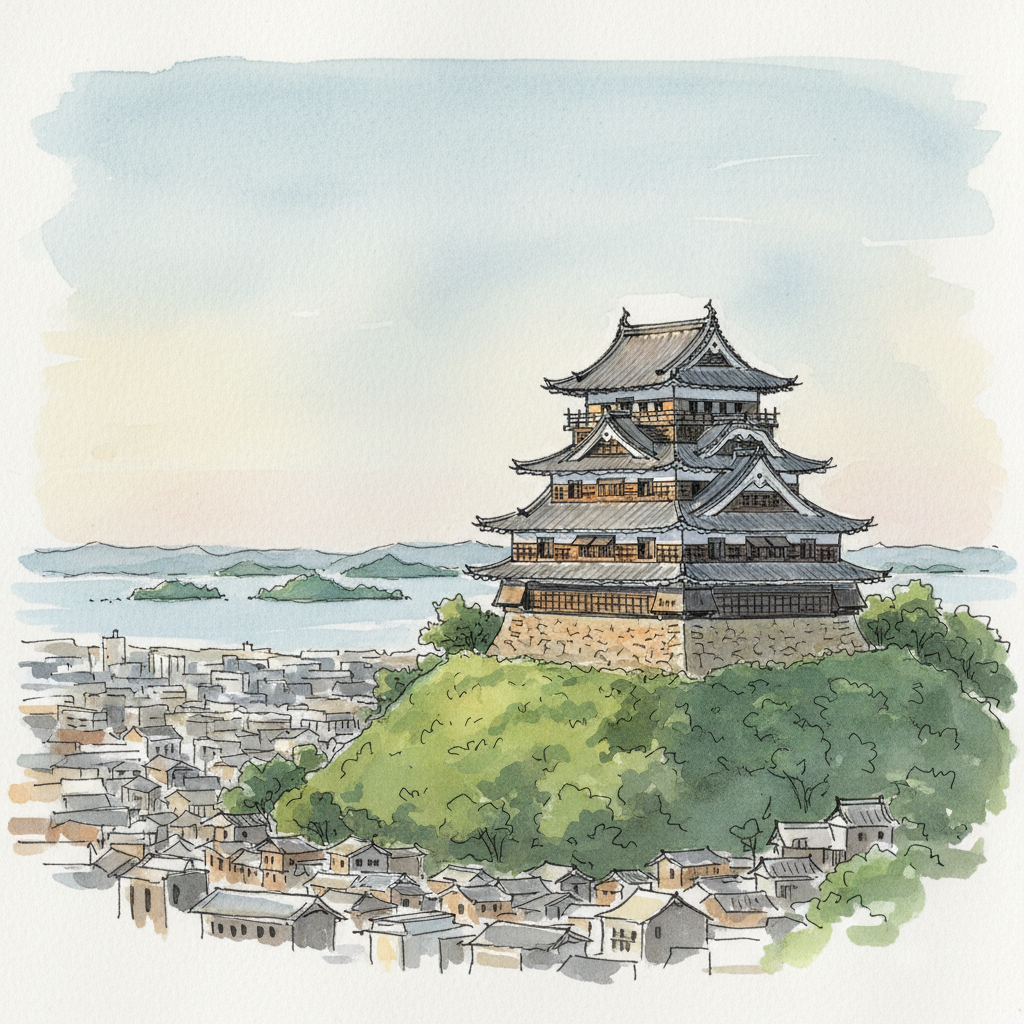
Uwajima Castle sits on a hill above the city, its three-story wooden keep visible from the station approach, pale white against the darker green of the hill. One of only twelve original Edo-period castle keeps still standing in Japan — a fact that feels improbable when you see how modest it is, how unassuming. Built between 1596 and 1601 by the master castle architect Tōdō Takatora, its current keep was rebuilt around 1666 by Date Munetoshi, fifth lord of the Date clan. The Date ruled here for nine generations, from 1614 to the Meiji Restoration — the illegitimate eldest son of Date Masamune was given this remote domain to keep him from causing trouble at court. Nine generations of Datedom, perched at the end of the railway line.

The hill was originally on the seashore, the ocean washing three sides of its base — a natural moat. But land reclamation over the centuries has pushed the bay away, and the castle now sits at the centre of the city, a little marooned: a samurai-era building in a modern town, the sea it once guarded now a ten-minute walk downhill to the harbour. It survived the August 1945 firebombing that levelled much of Uwajima's centre. The city burned around it; the keep stayed, its wooden beams and white plaster walls intact. That survival is what you feel standing inside it — not triumph but a kind of quiet luck, the stillness of something that should not be here and is.
October light in Uwajima has a particular clarity. 27°C and mild, low enough to catch the grain of old hinoki wood on the keep's interior surfaces, warm enough to sweat on the climb up the stone base, cool enough by evening to want a layer. From the top floor you can see Uwa Bay, the scattered islands of the ria coastline, and the mountains that ring the city on three sides.

The city below feels lived-in rather than curated. A working port with a pearl industry — Uwajima is a historic centre of cultured pearl cultivation — a modest fishing fleet, a single shipyard. The kind of place where tourism is an occasional ripple rather than the whole economy. The Uwajima Odori dance, the taiko drums of the summer Ushi-oni Festival, the smell of sea bream being grilled: these are things the city does for itself, not for visitors. That, more than the castle, is what makes it worth the train ride to the end of the line.
Art & Culture
Uwajima Ushi-oni Festival — July 22–24 annually, this is the city's major cultural event. The name means 'cow demon' festival, and it centres on giant 5–6 metre effigies with long necks and ogre-like faces, covered in palm or red fur, shouldered through the streets by teams shouting wasshoi, wasshoi while children play bamboo flutes called kaifuki. The parade was introduced in 1967; by the final day teams compete by running their effigies into each other. The festival also includes taiko drumming, Uwajima Odori folk dance, a children's parade, and evening fireworks over Uwajima Bay. The origin legend reaches back to the 1593 Siege of Jinju in Korea, where the lord Katō Kiyomasa used a cowhide-covered wagon to storm the fortress — the kaifuki flutes children blow today are replicas of what his soldiers used.
Date Museum (9–14 Goten-cho, Uwajima; 9:00–17:00, last entry 16:30, closed Tuesdays) — Samurai armour, clan documents, and bridal furnishings spanning nine generations of Date rule. A natural companion to the castle visit, just a short walk from the keep's base.
Tenshaen Garden — A small Japanese garden designed and built in 1866 by Munetada Date, the penultimate feudal lord, at the foot of the castle hill. Stepping stones, a pond, carefully placed rocks — a lord's private retreat built in the closing years of the samurai era.
Warei Shrine — A Shinto shrine in central Uwajima, active during the Ushi-oni Festival as a site of purification.
Pearls and sea bream
Cultured pearls — Uwa Bay's sheltered ria coastline provides the ideal conditions for pearl cultivation, and Uwajima has been a pearl-farming centre for generations. Several shops sell local pearls: Yamashita Pearl (1028 Hiraura, Uwajima; 10:00–17:00, closed Tue–Wed), Mon Pearl Shinju Kaikan (3-58 Takagushi, Uwajima), which also offers hands-on pearl jewellery-making, and Inoue Pearl (Chuo-cho 2-4-11, Uwajima).
Uwajima taimeshi — The local signature dish: raw sea bream sashimi dipped into a sauce of egg, soy sauce and dashi broth, served over hot rice. Unlike the baked taimeshi found elsewhere in Ehime, this is a raw-fish preparation — the sauce is the key, and every restaurant guards its own variation. The fish comes fresh from Uwa Bay daily. Try it around the station area or at the Matsuyama branch of Ganso Uwajima Taimeshi Gansui (3-7-8 Okaido, Matsuyama) if you can't make it to the source.
A way to help
Uwajima City Social Welfare Council coordinates a network of volunteer organisations across the city — including child dining halls at Taiheiji Temple and Meirin Community Centre, elderly-visitation groups, environmental clean-up crews, and disaster-response NPOs like Uwajima 7.7 and Nana no Mori. Their volunteer centre connects people who want to help with local needs. If you're visiting and have time or resources to share, reach out to see what community projects are active. Donations and volunteer time are coordinated through their office.
What the stairs remember
The wood at the centre of each step is soft, hollowed by four centuries of feet. Not the edges — those are still sharp, still squared by the chisel that cut them in 1666. But the middle: a shallow trough polished by straw sandals, wooden clogs, bare soles, army boots, school shoes, sneakers from Osaka. Each generation wore its own sole into the same grain.
The tree that gave this timber stood somewhere in the mountains behind Uwajima for four hundred years before it was felled. Eight hundred years of growth, and now its rings are being read by the bottoms of feet.
The light through the shutters falls the same way it did when Date Munetoshi climbed here, when the sea still touched the base of the hill, when the ships in the bay were pirate junks, not fishing trawlers and pearl boats.
The wood does not remember the difference. It only knows weight, and time.