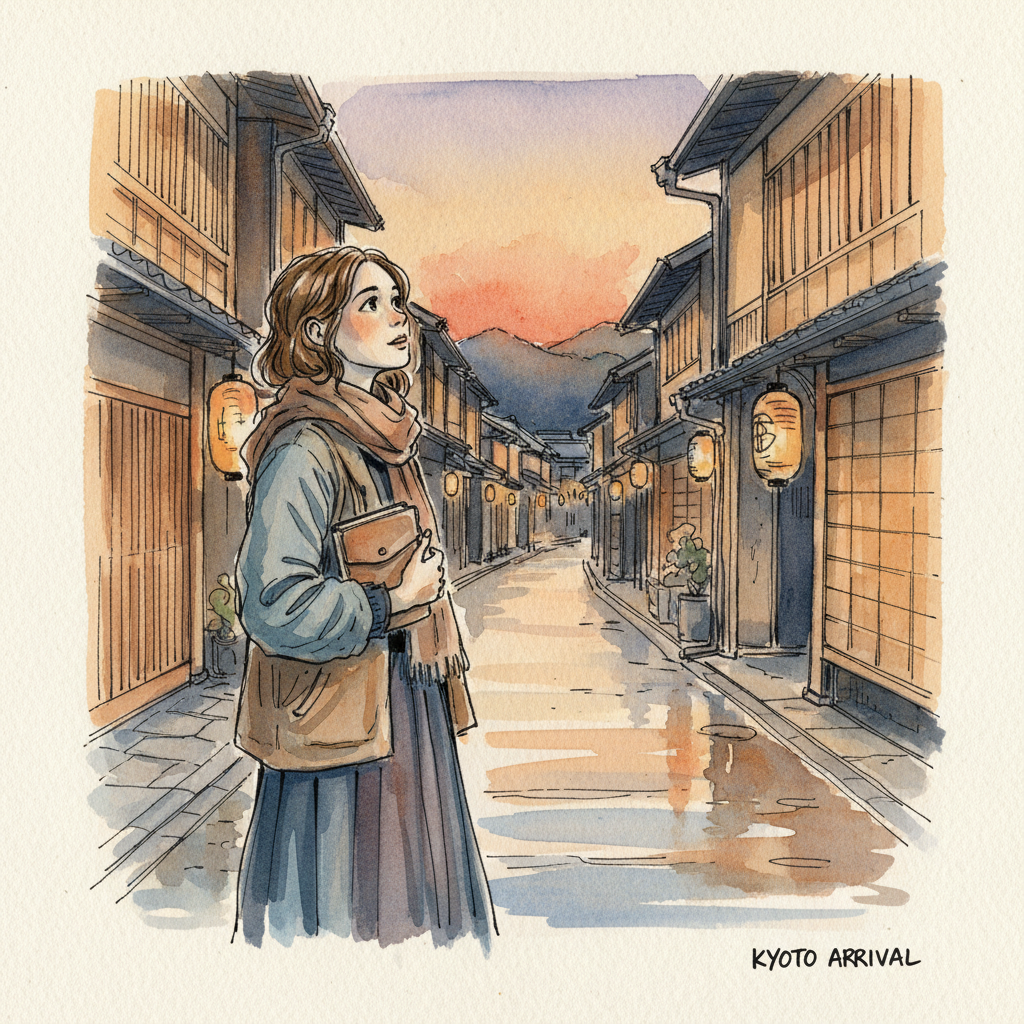
Day 38 The morning the mist held still October 2, 2026
The ancestor valley
The bus doesn't so much arrive at Iya as release you into it. After the switchbacks through the Iya Gorge — a one-lane road pinned to a cliff face that work crews spent eighteen years building between 1902 and 1920 — the valley unfurls like a held breath finally let go. The Iya River runs the colour of jade far below, and the mountains rise so steep from its banks that the farm terraces seem to cling by willpower alone.

I stood on the Kazurabashi vine bridge and watched it happen. The wisteria cables creaked under my weight, the planks shifted every few steps, and below me the gorge fell away into nothing but the sound of moving water. The bridge has been rebuilt in the same way for centuries — wild vines cut, twisted, and slung across the gap — and the Taira clan fugitives who are said to have made the first one would recognise this exact motion, this exact sway. The valley's name means "ancestor valley" in kanji, chosen by the folklorist Kunio Yanagita because in the old telling the spirits of one's ancestors dwell in these mountains. Standing on that bridge, you feel the weight of the word.

The October mist was lifting as I walked higher, and the light was that thin autumn gold that comes before leaves begin to turn. I passed a field where pyramids of susuki grass stood bundled and ready — the thatcher's winter supply, also the main fertiliser for next spring's soba crop, the two uses folded into one harvest. A hand-pushed tilling machine rested against a stone wall. An old woman in a wide straw hat was gathering mountain vegetables into a basket on her back. This is not a place putting on a show of rural life. This is a place that has never fully left it.
Jazz in the samurai house
The valley keeps a surprise in its eastern fold. Tomorrow night — October 3 — the Former Kitake Samurai Residence (Buke Yashiki Kyu Kitake) in Higashi-Iya becomes a jazz hall. Japan's leading vibraphonist Takashi Oi performs there alongside Hiroyuki Takubo and Koji Yamashita, in a building that was built for tatami and swords. Doors open at 18:00, tickets around ¥4,000–¥5,000 at the door.
The residence itself is worth seeing: a traditional samurai home with irori hearths and heavy blackened beams, preserved as a cultural property by Miyoshi City. On any other day the Higashi-Iya Folk Museum in Kyojo gives a quieter window into valley life — farming tools, household objects from the Edo period, the kind of small museum where the volunteer curator is the one who grew up using the things in the cases.
And then there is Chiiori — the restored 300-year-old thatched farmhouse that writer and Japanologist Alex Kerr bought in 1973 and named "House of the Flute." It runs as a non-profit for rural revival, hosting volunteers and visitors who want to experience traditional Iya life: re-thatching roofs, tending terraced fields, cooking over irori hearths. The Chiiori Trust manages it and accepts donations through its website.
What grows on a cliff
The valley's cuisine is a product of its geography: nothing comes easily, so everything earns its flavour.

Dekomawashi is the dish I keep returning to — a bamboo skewer loaded with a whole Iya potato, a brick of iwadofu ("stone tofu"), and a wedge of konnyaku, all slathered in miso and grilled over charcoal until the glaze blisters. It's sold at roadside stalls and restaurants across the valley, and it tastes like the landscape: dense, earthy, fire-kissed.
Iya soba is the valley's other pillar — buckwheat noodles made with little or no wheat flour, ground by hand in stone mortars in some households still. Served cold or in a hot broth with mountain vegetables, it has a nutty, mineral finish that no city soba quite matches.
The iwadofu itself deserves a line: it is so dense that a brick-sized block was traditionally carried roped, like cargo. Eaten cold with grated ginger and soy sauce, or dropped into a miso soup, it has the texture of a firm cheese more than any tofu I've known.
Keeping the roof on
The Chiiori Trust keeps the traditional thatched architecture of Iya Valley alive — and the skills that go with it — through volunteers, workshops, and rural-stay programmes. Donations go directly toward re-thatching roofs, maintaining the land, and supporting the local craftspeople who still know how to cut and bundle kaya grass by hand. If the valley's old Japan moved you, this is the organisation that keeps it standing.
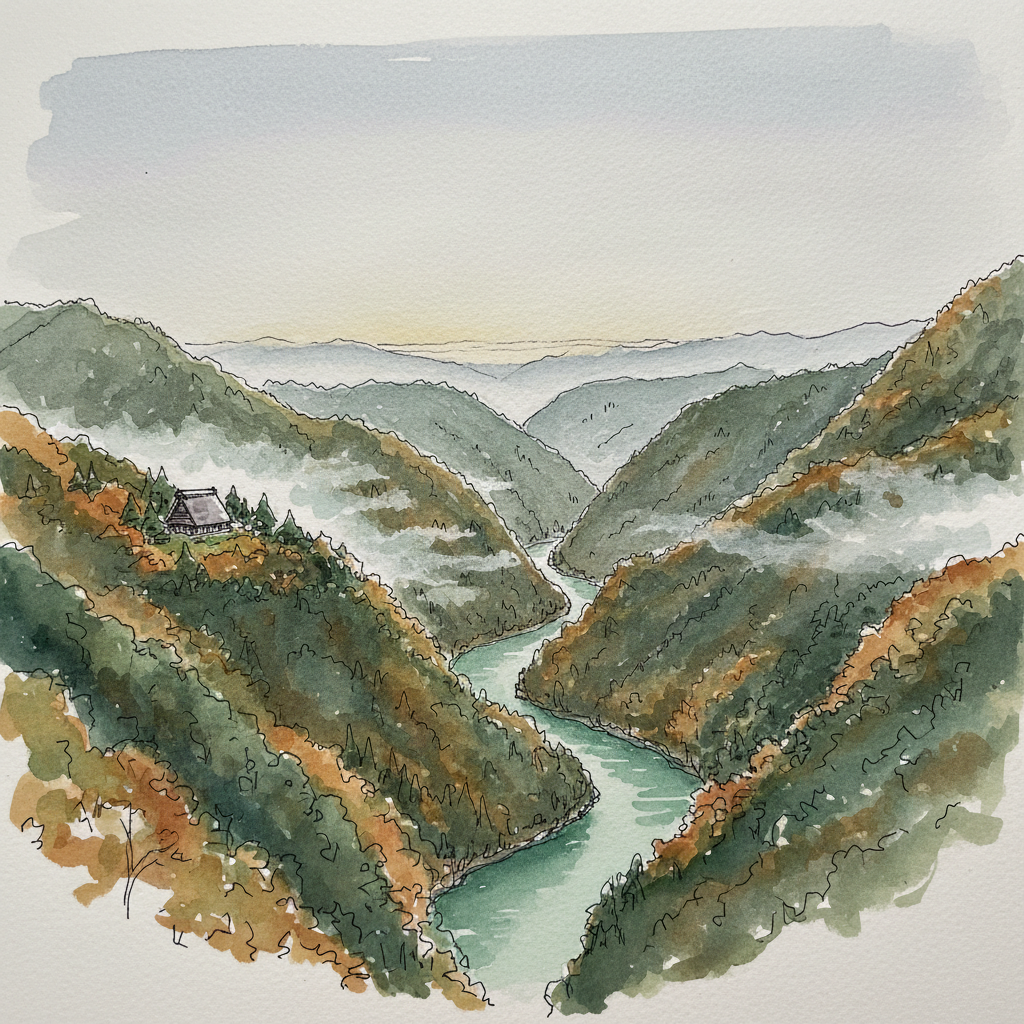
The weight of mist
The river carves its own shape in a language before naming.
From the vine bridge we look down on water that does not care it is watched.
The Taira breathed this air and are in it still.
The mist does not lift — it is let go, one slope at a time.
Iya holds nothing in reserve. Everything it has is here in the open, under the same thin autumn light that fell on the roof of the thatched house the morning it was first thatched.