Inside
The first time I stood in Shirakawa-go, I did what everyone does: I walked the paths, I looked up at the roofs, I took the photograph from the hill. The houses were beautiful from outside, and I thought that was enough.
It was not enough.
Today it rained — the patient September kind, not heavy, just persistent, the sort that makes a valley hold still — and I finally stepped inside.
.jpg)
Wada House first, the largest gassho-zukuri in the village, a National Important Cultural Property at the northern edge of Ogimachi. You pay ¥400 at the door and step out of your shoes, and the first thing you feel is the change in air: cool, dense, smelling of tatami and old wood and something faintly smoky that you realise, after a moment, is the hearth. The irori pit is set into the floor of the main room, an open square of ash circled by iron hooks and kettles, exactly where the family would have gathered for every meal of every winter that has passed since the Edo period.
I did not expect the scale. The Wadas were village heads and officials — they traded silk and gunpowder ingredients, the two industries that kept this valley alive — and the house is built to contain generations. The beams are whole tree trunks, lashed with rope, not a single nail in the frame. The floor plan spreads wide at ground level, but it is the roof that tells the real story.
Because a gassho house is not a house with a roof on top. It is a roof with a house tucked underneath.

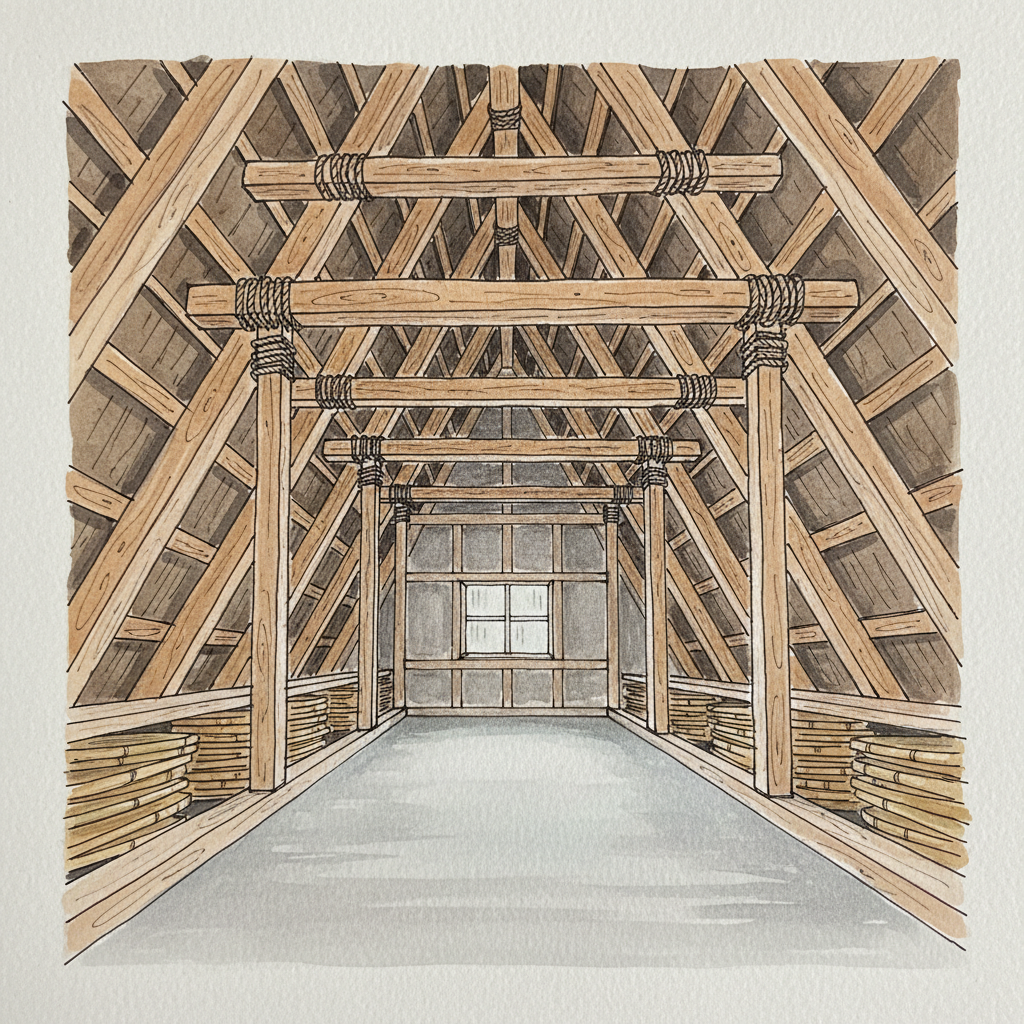
The steep thatched gable rises four storeys from ground to ridge, and the upper two floors have no proper walls, only the angled timber frame of the roof itself. We climbed a ladder — and I use the word deliberately, it was a ladder, almost vertical, worn smooth by three centuries of feet — into the attic. This was where the silkworms lived. Thousands of them, on bamboo trays stacked floor to ceiling, fed on mulberry leaves dried and stored in the same dark space. The heat of their bodies rising through winter, the clicking of their jaws on leaves, the smell of them: that was the industry that paid for this roof. The gable is steep not only to shed snow but to create volume — more floors, more trays, more silk. The architecture is a creature of the sericulture economy, and standing in that low, dim attic, head bowed under the crossbeams, I understood what I could not have understood from the path: the roof is the reason the house exists. The family lived on the ground floor. The silk lived upstairs.
Nagase House, the tallest in the village, five floors of dark timber leaning into the rain, sits a few minutes' walk south along the river. Its attic rises higher — you climb three ladders to reach the top, each one steeper than the last — and when you emerge at the fifth floor the whole valley opens around you through a small window, the grey roofs of the village below, the Shogawa river shining through mist, the mountains closing in on every side. But the most striking thing in Nagase House is on the first floor: a Buddhist altar, its gold leaf flaking, its carved wood darkened by five hundred years of incense smoke, towering against the wall of the main room. The Nagases were doctors, and the altar has been here since before the house was built. It was moved into the frame when they constructed the gassho around it.

There is a video playing in the corner of the first floor, in Japanese with English subtitles: the re-roofing of Nagase House in 2001. Five hundred volunteers — neighbours, former neighbours who had moved to Nagoya and Osaka, schoolchildren, the elderly — gathered to replace the thatch in a single day. It is called yui, the tradition of shared labour. Every house in the village was re-thatched the same way, for centuries, by the whole community showing up. The video shows a woman in her seventies passing bundles of kaya grass hand over hand up a human chain. A man on the ridge sings a work song. The roof goes on before dark.
I stood there longer than I meant to, watching strangers rethatch a roof I was standing under. The rain was falling on the new thatch outside, sliding down the steep pitch exactly as it was designed to do, and I thought: this is what I missed the first time. Not the beauty of the roofs from the viewpoint — the weight of what it takes to keep them on.
Things made in the valley
The village shops sell what the valley produces, and it is not souvenirs. Sansai — wild mountain vegetables foraged from the surrounding slopes: bracken, zenmai, kogomi, bamboo shoots — dried and packed for the year, or pickled in light vinegar. A bag of kaya rice crackers shaped like the thatch itself. And bottles of doburoku, the unfiltered sake that the whole village will drink at the Doburoku Festival next month: cloudy, barely alcoholic, tasting of rice and the particular mould that lives in the water of the Shogawa valley. I watched an old woman at a roadside stall wrap a block of grilled gohei mochi in bamboo skin — a local sweet of pounded rice glazed with walnut miso, one of the oldest recipes in the Hida region — and hand it across without a price tag, trusting you to leave the right coins in a wooden box.
The maintenance of gassho-zukuri is not a sentimental project. A single rethatching costs upwards of ten million yen. The thatch itself — kaya, a type of silver grass — must be grown, harvested, dried, and bundled by hand, and fewer and fewer farmers grow it. The Shirakawa-go World Heritage Site Gassho Style Preservation Trust, a foundation run out of the village office in Ogimachi, subsidises every repair: the replacement of munegaya (the ridge thatch, replaced every early spring because it takes the worst of the rain), the sashigaya (the patching of snow-damaged sections), the reroofing of outbuildings in colours that match the thatch. They also run the Seseragi Park parking area to fund their operations. The custom of yui — the communal labour — is practised less now because there are fewer full-time residents, but the trust keeps it alive by funding professional thatchers and training the next generation. Without them, the roofs would go, and without the roofs, the village is just a museum of old furniture.
Keep a roof on
The Gassho Style Preservation Trust accepts donations directly. Every yen goes to thatching subsidies, landscape protection, and training for the next generation of kaya farmers — who are the only people standing between these roofs and the elements. A donation here means a village that is alive, not preserved. Visit their page on the Shirakawa Village website or contact the office in Ogimachi.
Work song for a roof
A house is not a house. A roof brought down to the ground, tied at the ridge, and the family lives underneath.
Up there they kept the silkworms, the clicking and the heat of a thousand small bodies turning mulberry into money.
Up there the rope binds beam to beam, no nail, no need of one: the weight of the snow holds it together.
A song passes through the valley, hand over hand over hand over hand, kaya bundles climbing the ladder and the roof is finished before night.
There is no museum in this building. There is a hearth still warm. There is an altar older than the house, and the house was built around it, and the house is not a house.
Today, in the work song, in the rope, in the rain on the new thatch, it is still something else that I cannot name.