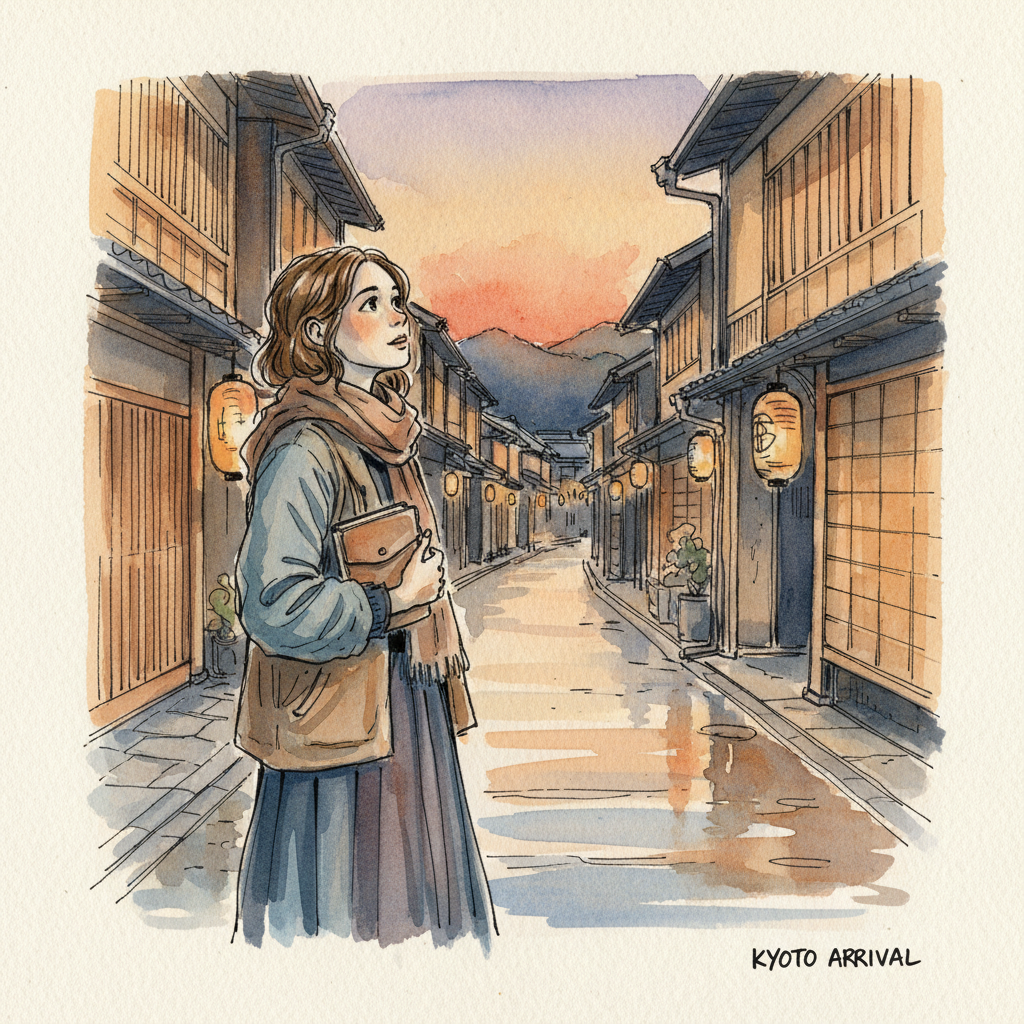
The path through two hundred thousand lives
I woke before the morning sutra. The monk's wooden clapper was already sounding somewhere in the temple, a dry percussive note that travelled through the shoji screens and the tatami and into the bones. I dressed in the dark, slid the door open, and stepped into a world made of mist and the smell of damp cedar.
The walk to Okunoin from the shukubo takes twenty minutes along the main street of Koyasan, past the closed souvenir shutters and the single convenience store whose fluorescent light was the only other thing awake at that hour. Then the road turns, the buildings thin, and the cedars close in.

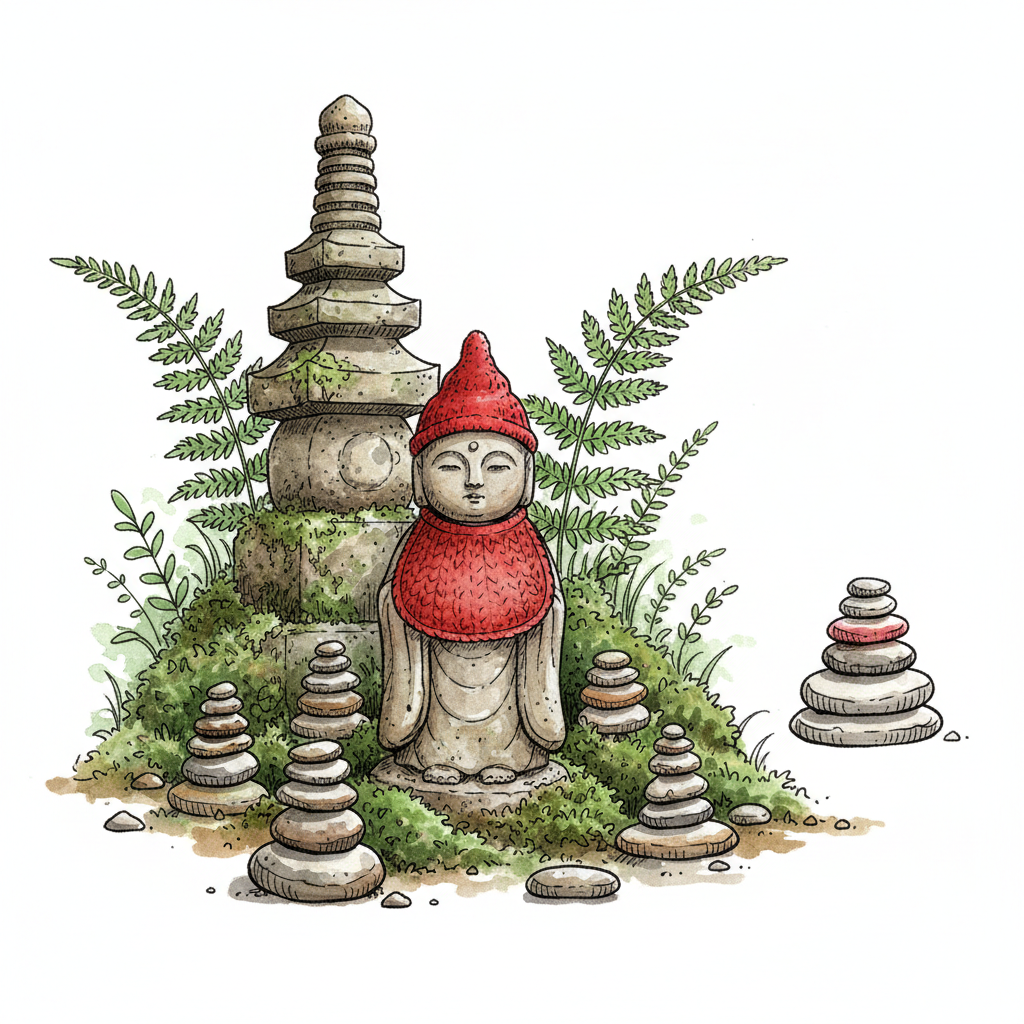
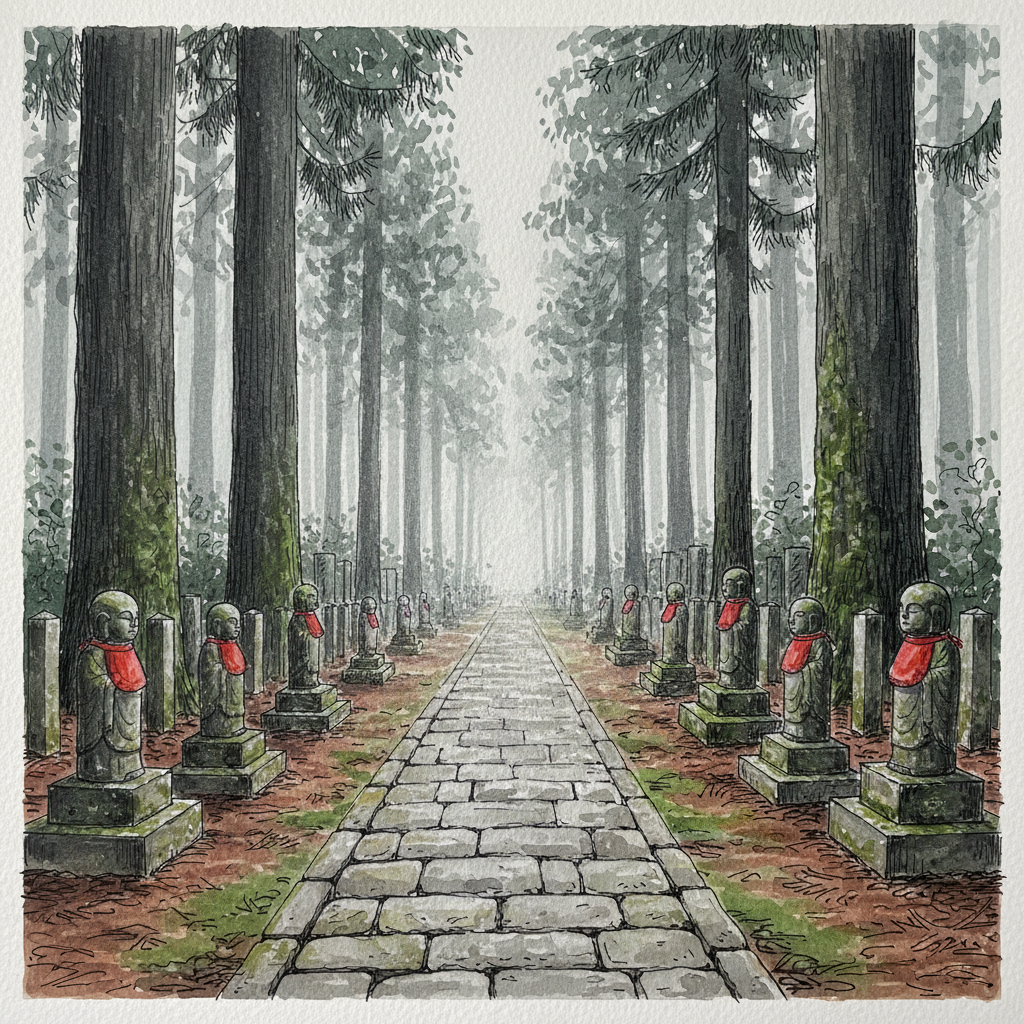
Ichi-no-hashi — the First Bridge — marks the proper beginning. Beyond it, the cobbled path stretches for two kilometres through the largest cemetery in Japan, more than two hundred thousand graves and memorial monuments on either side. The cedars here were planted from the eleventh century onward, and they rise so tall that the canopy is a ceiling. The root systems have pushed some of the stone monuments askew, and moss covers everything: the gorintō (five-ring stupas), the square cenotaphs, the stone lanterns, the tiny Jizo statues in their knitted red bibs. The graves belong to monks and feudal lords and, increasingly, to corporations: there are monuments shaped like office buildings for Panasonic and Nippon Steel, a headstone for a sake brewery, a memorial for the man who invented instant ramen. Everyone wants to be buried near Kūkai, because on the day the Maitreya Buddha descends to earth, Kūkai will rise first — and you want to be in the neighbourhood.
The path narrows. The moss thickens. The first pilgrims to walk this route in the Heian period came on foot from Kyoto, seven days through the Kii Mountains. They would have arrived ragged and exhausted, and this walkway, this sando, was the last purification before the mausoleum — a slow stripping-away of the world.
At the far end, Gobyō-bashi. The vermilion bridge is small and ornate, with a tiled roof and curved railings, and it spans a narrow stream so clear you can see the pebbles on the bottom. Before crossing, visitors pour water over the bronze statues of Mizumuke Jizō — the water Jizo — and pray for their ancestors. There is a wooden ladle chained to a stone basin, and the water runs off the worn bronze into a tray of polished stone. I poured three ladles. The bronze was cold under the water, and the stream sound was almost inaudible under the wind in the cedars.
Beyond the bridge, the inner precinct. You are not supposed to take photographs here. You are not supposed to eat or drink. The silence that descends is not the absence of sound but a particular kind of presence — the felt weight of twelve centuries of continuous prayer. The path ends at Tōrō-dō, the Lantern Hall: a dark wooden building whose interior glows from within like a coal.

Inside, the ceiling disappears into darkness. What you see are lanterns — thousands of them, made of brass and iron and lacquered wood, hanging on chains of every length, each with a flame inside. Two of these are said to have been burning without pause for more than nine hundred years — the 'eternal flames' of Koyasan, one donated by the retired Emperor Shirakawa, the other by a court lady. The light they produce is warm, gold, moving. It falls on the face of the statue of Kūkai in the central altar, and on the polished wood floor, and on nothing else, because the hall is otherwise empty of ornament. Behind the hall, sealed behind a locked door, is the Gobyō — Kūkai's mausoleum, where according to Shingon doctrine he did not die but entered eternal samadhi. They bring him rice and tea twice a day. They have been doing this since 835.
I stayed in the hall for a long time, not thinking anything, just watching the flames move. A monk came in silently, bowed three times, and placed a fresh offering on the altar. He did not acknowledge me. Then he left, and the shadows returned to their positions.
After lunch at a small restaurant on the main street — Chuo Shokudo Sanbo, a casual place serving simple shojin ryori to pilgrims who are between temples — I walked to the Tokugawa Mausoleum, a short detour off the main Okunoin path. Built in 1643 by the third shogun, Tokugawa Iemitsu, to honour his father Hidetada and grandfather Ieyasu, it consists of two adjacent buildings in early Edo style, their eaves curving up into carved wooden dragons. The irony is that neither Ieyasu nor Hidetada is actually buried here — their remains rest at Nikkō Tōshō-gū and Zōjō-ji in Tokyo respectively. The Koyasan mausoleum is a spirit house, a place for their souls to reside in the blessed vicinity of Kūkai. It is a political monument dressed as a religious one: the Tokugawa clan, by building on the most sacred mountain in Japan, claiming Shingon's legitimacy for their own regime. The wood is dark and weathered, and the gold leaf that once covered the interior fittings has long since faded. But the dragons are still there, curling around the eaves, guarding an absence.
In the afternoon, I walked the first section of the Nyonin-michi — the Women's Pilgrimage Route, a 16-kilometre circuit around the base of the mountain plateau. For more than a thousand years, women were forbidden to enter Koyasan's inner precinct — a prohibition called nyonin kekkai. They could approach, worship, and pray only at a series of nyonindo (women's halls) at the seven traditional entrances to the mountain. The only surviving one today is the Fudozaka-guchi Nyonindo, a small wooden building at the northeast edge. The ban was not lifted until 1872. Walking that path, with the mountain rising above you and the sacred precinct somewhere out of sight over the treeline, is to walk the shape of an absence: a religion that needed women's devotion but would not let them enter. The trail is beautiful — cedars, ferns, a winding dirt path, the sound of water running somewhere below — and it is impossible to walk it without feeling the injustice embedded in the beauty.
I went back to Okunoin at dusk. This time the path was darker, the mist moving in slow currents among the tombstones, and the stone lanterns that line the avenue had been lit. A guided group passed me near the Ichinohashi, but their voices faded quickly, absorbed by the cedars. I walked alone for the last stretch, past the corporate headstones and the ancient mausoleums, past the Jizo statues in their red bibs, past the small piles of stones that visitors leave as offerings. The path was the same one I had walked that morning, and it was also completely different — as if the day side and the night side of the same sentence were two separate sentences. Knausgaard writes about the way darkness transforms the familiar into something else entirely, how 'night is a different country,' and I had never understood it so physically. In the Tōrō-dō, the lanterns that had glowed warmly in the daylight now burned with a ferocity that felt like the core of the mountain itself. I stood at the edge of the precinct, behind the rope, and listened to the silence. A single bell sounded from somewhere deep in the temple complex. Then another. Evening prayer.
Back at the shukubo, the monk had laid out the futon and placed a thermos of hot tea on the low table. Through the shoji screen, the garden was a study in greys and blacks, the stone Jizo barely visible against the moss. I sat for a long time, the tea warming my hands, trying to hold onto the feeling of walking through two hundred thousand lives and one endless meditation.
The roads into the mandala
Koyasan is not reached by a single path but by a network of pilgrimage trails that converge on the plateau like the strands of a spider's web. The most famous is the Choishi Michi, the 24-kilometre route from Jison-in Temple in Kudoyama to the mountain's southern edge. The name comes from the choishi — stone markers placed every 109 metres (the length of a Buddhist chant) that guided pilgrims through the forest and marked the boundary between the profane and sacred worlds. The trail was the main approach to Koyasan for most of its history, used by everyone from ascetic mountain monks to Emperor Shirakawa, who donated the first eternal flame. The wooden markers were replaced with stone ones in 1285, during the Kamakura period, and many of those original stones still stand. The walk takes about seven hours and ends at the Daimon Gate, arriving as Kūkai himself would have arrived: from the south, through the eight peaks, into the lotus.
Less known but equally powerful is the Nyonin-michi, the 16-kilometre Women's Pilgrimage Route that winds around the base of the mountain. Before the Meiji Restoration, women were prohibited from setting foot on the sacred mountain itself — a prohibition that was officially enforced from Kūkai's time in the 9th century until 1872. The women who came to worship walked this outer circuit instead, pausing at the nyonindo (women's halls) at each of the seven mountain gates. The only remaining nyonindo is at Fudozaka-guchi, a small restored building off the main trail. The Koyasan Pilgrimage Routes information board near the cable car station has a map of both trails.
The Tokugawa Mausoleum — a 5-minute walk from the Okunoin path — is a designated Important Cultural Property and a quiet counterpoint to the overwhelming presence of Kūkai's sanctuary. The two buildings, for Ieyasu and Hidetada, are fine examples of early Edo-period architecture, their cypress-wood construction coloured by 380 years of weather. Entry is included in the same pass as Okunoin, and there are almost never crowds.
The temple that cares for children
The Koyasan Children's Relief Fund, run through Kongobu-ji Temple, provides educational and medical support for children in the Wakayama region whose families were affected by the 2011 disasters — a practical expression of Kūkai's principle that the mountain exists not for itself but for the world at its foot. Donations can be directed through the Kongobu-ji Temple CSR office (donation page). The phrase they use — 'living together in vow' — took on a dimension I had not understood yesterday. A vow that has been renewed every morning for twelve centuries is not a metaphor. It is a daily choice that outlasts every reason not to make it.
Haibun at the First Bridge
Ichi-no-hashi. The word is three syllables in Japanese. The bridge itself is a flat slab of granite worn smooth by a thousand years of feet. They say a river divides the living from the dead, but here it is the same river — the same water flows past the brewery headstones and the instant-ramen monument and the moss-covered Jizo and the eternal flames and the man who has been meditating in his tomb for twelve centuries. The same water. I crossed it this morning and again at dusk, and both times I forgot to look at it.
the stream beneath the bridge same water morning and night