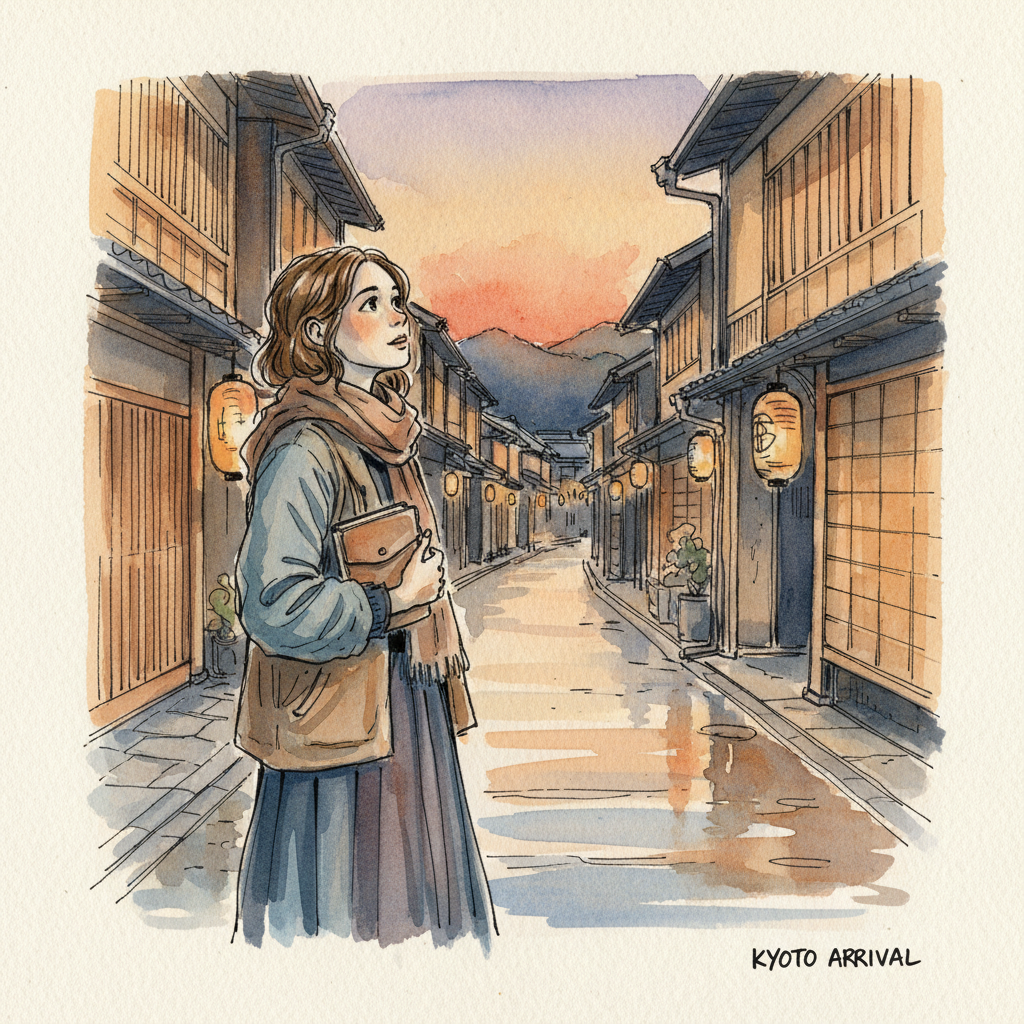
Arriving through the lotus peaks
The train from Yokohama to Osaka was three hours of gradual change — the urban density of Tokyo's sprawl thinning into the green foothills of the Kii Peninsula. From Namba Station I took the Nankai Koya Line, which narrows from a commuter railway into a mountain railway, the carriage emptying as the line climbs. Past Hashimoto the valleys close in, and the tunnels begin.

At Gokurakubashi Station — 'Paradise Bridge' — the railway ends and the cable car begins. The car climbs eight hundred metres in five minutes, and somewhere around the third minute the cloud layer arrives. There is a moment when the window goes from green forest to white nothing, and then the car punches through and you see it: a plateau of dark temple roofs spread across the top of a mountain, surrounded by eight peaks arranged like the petals of a lotus. Kūkai chose this shape — the eight peaks, the lotus formation — when he founded the monastery in 819. He spent years wandering Japan looking for the right place, and when he found this valley ringed by peaks, he knew it was the form of the mandala he had seen in his meditation.
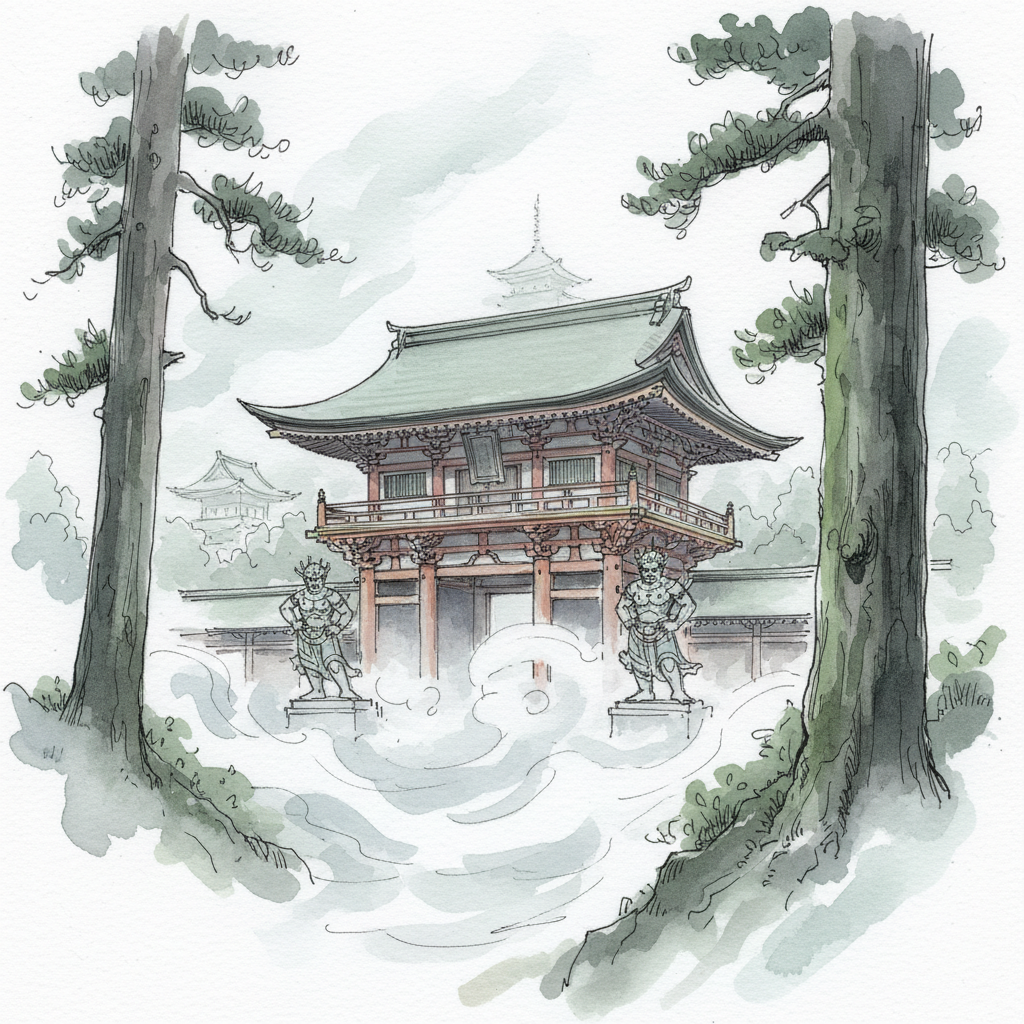
The gate that greets you after the bus from the cable car station is the Daimon — the Great Gate — a two-storey structure of dark timber and curved eaves that stands at the southern entrance to the sacred precinct. On either side, the Nio guardian figures loom in their muscle-bound fury, one mouth open for the first sound of the universe, the other closed for the last. The gate marks the boundary between the profane world and the sacred mountain, and it does the job: the moment you pass under it, the temperature drops another degree, and the sound of traffic from the town below is simply gone.
I checked into a shukubo — a temple lodging — on a side lane off the main street. The room is a tatami mat square with a sliding shoji screen looking onto a moss garden where a stone Jizo statue wears a red bib. A monk in a grey robe brought me hojicha and a small sweet, then left me to sit. The rule at a shukubo is that dinner is shojin ryori — the vegetarian cuisine developed by monks over centuries — and I ate it alone in my room: miso soup with mountain vegetables, sesame tofu the consistency of silken custard, tempura of lotus root and shiso leaf, a tiny dish of pickled plum. Each course arrived in ceramic vessels that the monk placed on the low table with both hands, and I understood that the meal itself was practice.
After dinner I walked back toward the center of the town, past the darkened souvenir shops and the evening light of a convenience store — the one concession the sacred mountain makes to the modern world. The mist was thickening, moving in slow currents between the cedar trunks, and the Konpon Daito pagoda loomed out of it — 48.5 metres of vermilion wood and gilded spire, built at the exact centre of the mandala that Kūkai designed to cover all of Japan. In Shingon doctrine, this pagoda IS the centre of everything: the point where the cosmic Buddha Dainichi Nyorai radiates the universe into existence. At dusk, with mist softening its edges, it looked less like a building and more like something that had always been there, that had grown out of the mountain the way the cedars did.
Tomorrow I will walk the cedar avenue to Okunoin — Kūkai's mausoleum, a kilometre of gravestones and moss-covered Jizo statues lining the oldest and largest cemetery in Japan, where Kūkai is said not to have died but to have entered eternal meditation, and where they have been bringing him food every morning for twelve centuries. But for tonight I sit on the engawa of my temple room and watch the mist move between the branches of a cedar that was already a century old when Kūkai first climbed this mountain.
Treasures in the mist
The Reihokan Museum beside Kongobuji is currently hosting the 46th Grand Treasure Exhibition, "Masterpieces of Koyasan — A Grand Gathering of Treasures from Kongobu-ji Temple" — a display that brings together scrolls, sculptures, and ritual implements from across the temple complex's twelve centuries of history. The museum's permanent collection holds more than twenty thousand items, including several designated National Treasures and Important Cultural Properties. The autumn exhibition, "Mount Koya and the Toyotomi Family" — already announced on the museum's 2026 calendar — picks up the thread of Koyasan's patronage by the great warrior clan who unified Japan.
For anyone planning a visit in the coming weeks, the autumn season at Koyasan brings a remarkable cluster of limited-time events. The Kongobuji Okuden Special Viewing runs October 24 to November 10, when the normally-closed inner sanctuary opens to the public — a chance to see the sliding-door paintings by artist Kori Ishizaki and the seated image of Kobo Daishi himself (event page). Koyasan's Autumn Leaves and Night Illuminations illuminate Danjo Garan from October 20 to November 15. And at Okunoin, the Mando-e festival on October 1–3 fills the Lantern Hall with the light of thousands of candles, a ritual dedicated to honouring ancestors and Kūkai's ceaseless meditation.
Sesame, silk, and cypress
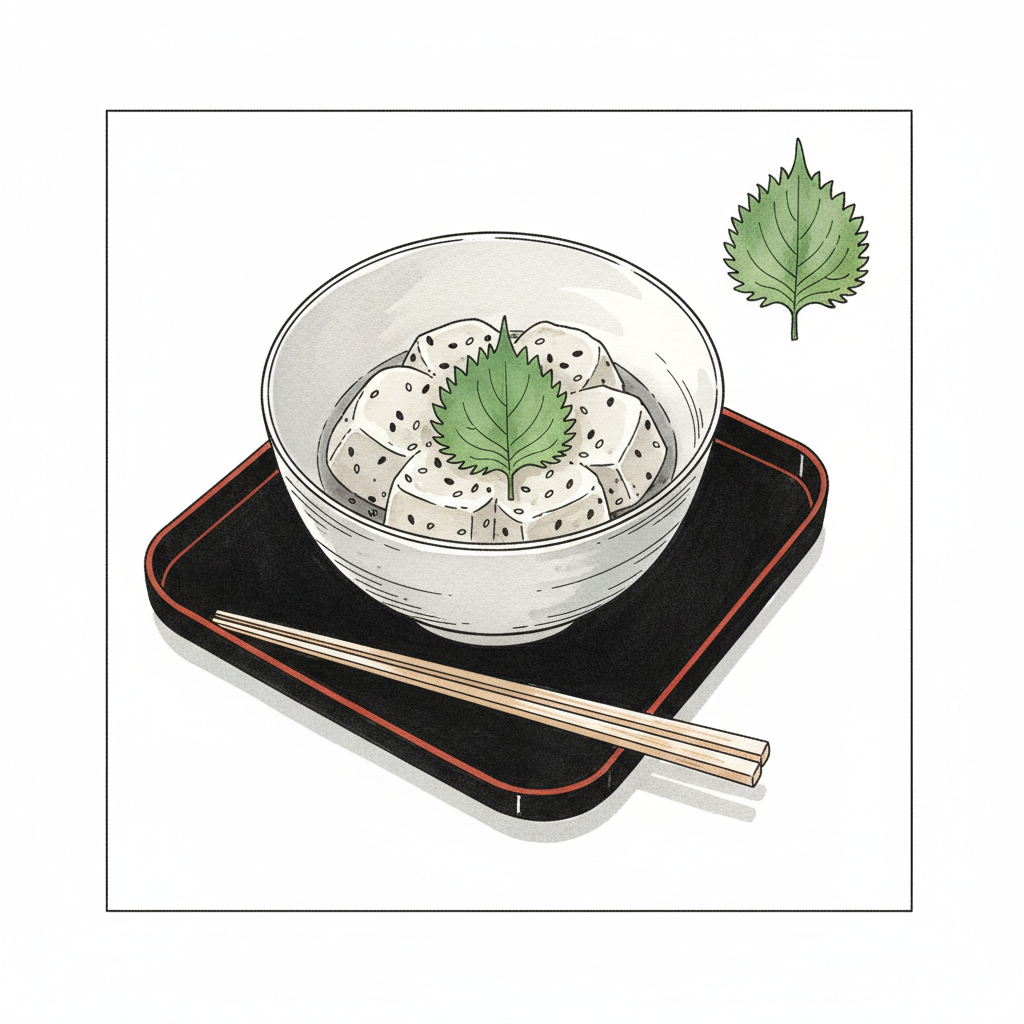
The thing to take home from Koyasan is goma dofu — sesame tofu, which is not actually tofu but a rich, silken pudding made from ground sesame and kudzu starch. It is found in every temple kitchen and every souvenir shop, and it tastes of roasted sesame and mountain water. The confectioners also press yakimochi, a grilled mochi with sweet bean paste wrapped in a persimmon leaf — the leaf preserves the rice cake and gives it a faint, tannic fragrance.
For something more permanent, the wider Koya region produces Kishu Koya Kumiko wood joinery — a traditional craft of assembling small strips of hinoki cypress into geometric lattice patterns without nails, used in temple ceilings and fusuma panels. And Koyaguchi pile-textile (saiori) — a thick woven fabric traditionally used for monk's robes and work clothes — has been revived by local workshops and turned into bags, scarves, and coasters with a warmth that polyester cannot fake. The shop Origin on the main street carries saiori pieces in natural indigo and persimmon-dyed browns.
Living together in vow
Kongobu-ji's CSR programs encompass disaster relief, guide-dog training support, and foster parent programs — rooted in Kūkai's vision that the monastery exists not for itself but for the society that surrounds it. Donations can be directed through the temple's CSR page. They call it 'living together in vow' — a phrase that stays with you on a mountain where every meal, every prayer, every bowl of tea is offered first to someone who has been meditating in a tomb for twelve centuries.
The mountain that is also a mandala
At evening the monk brings hojicha in a handless cup.
This is what Kūkai meant: not the mandala's geometry but the bowl warm in both hands, mist moving through cedars, the wooden clapper calling evening prayer across the mountain.
In Summer, Knausgaard writes: "When we lived without a garden we did not have that looking out." And I understand.
Through the shoji screen a Jizo statue in a red bib — the moss asking nothing.
The centre of the mandala is a pagoda in the mist: one light in the second storey smaller than a hand from here.