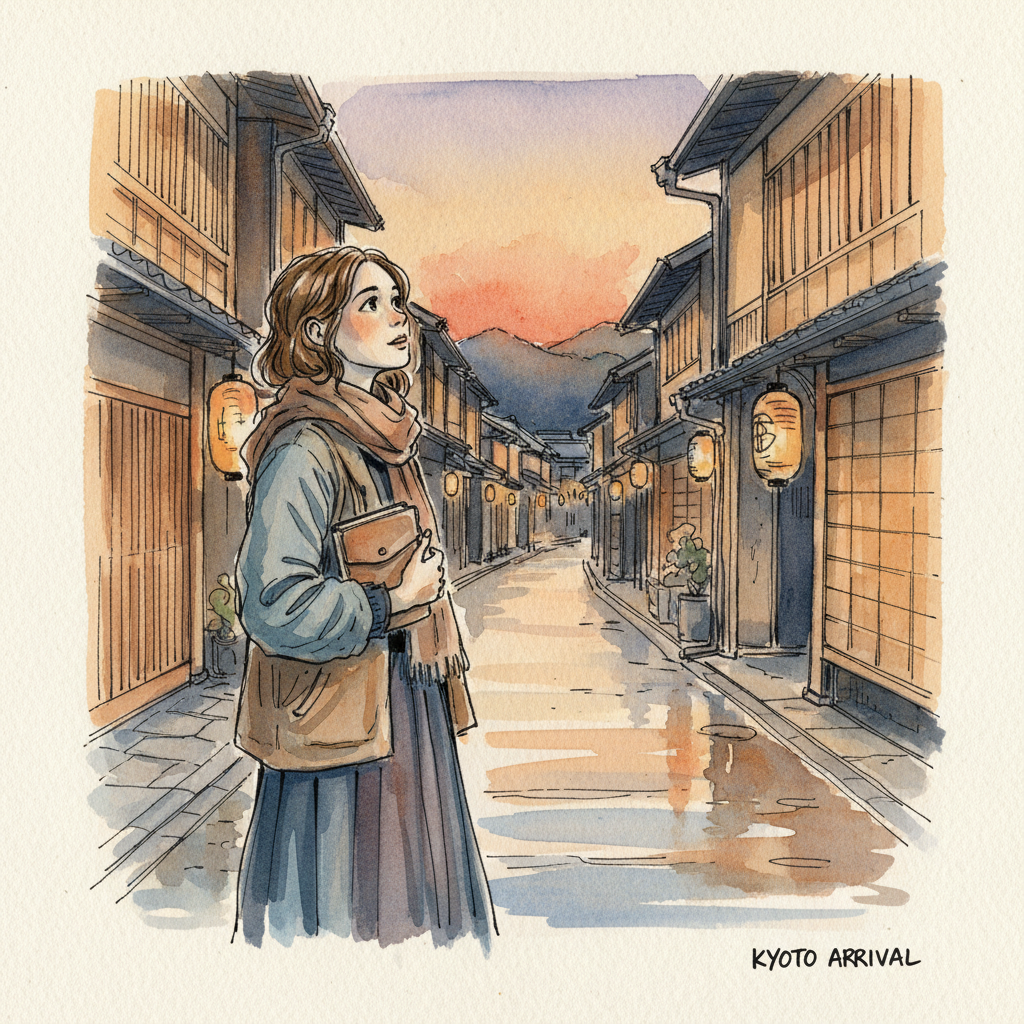
Through the garden, past the samurai, into the market

I began at Kenroku-en before the morning crowd, when the air was still damp from overnight rain and the gardeners were sweeping the paths. The garden opened its gates at seven, and for the first hour I shared it with hardly anyone — a few photographers with tripods, an old man doing tai chi by Hisago Pond, a pair of groundskeepers in wide-brimmed hats raking the gravel with wooden teeth. The garden is 25 acres of deliberate perfection, developed over two centuries by the Maeda clan, its name meaning "garden of six attributes" — the six qualities a classical Chinese garden must possess to be complete: spaciousness, seclusion, artifice, antiquity, watercourses, and panoramas. Kenroku-en is the only garden in Japan said to possess all six at once.
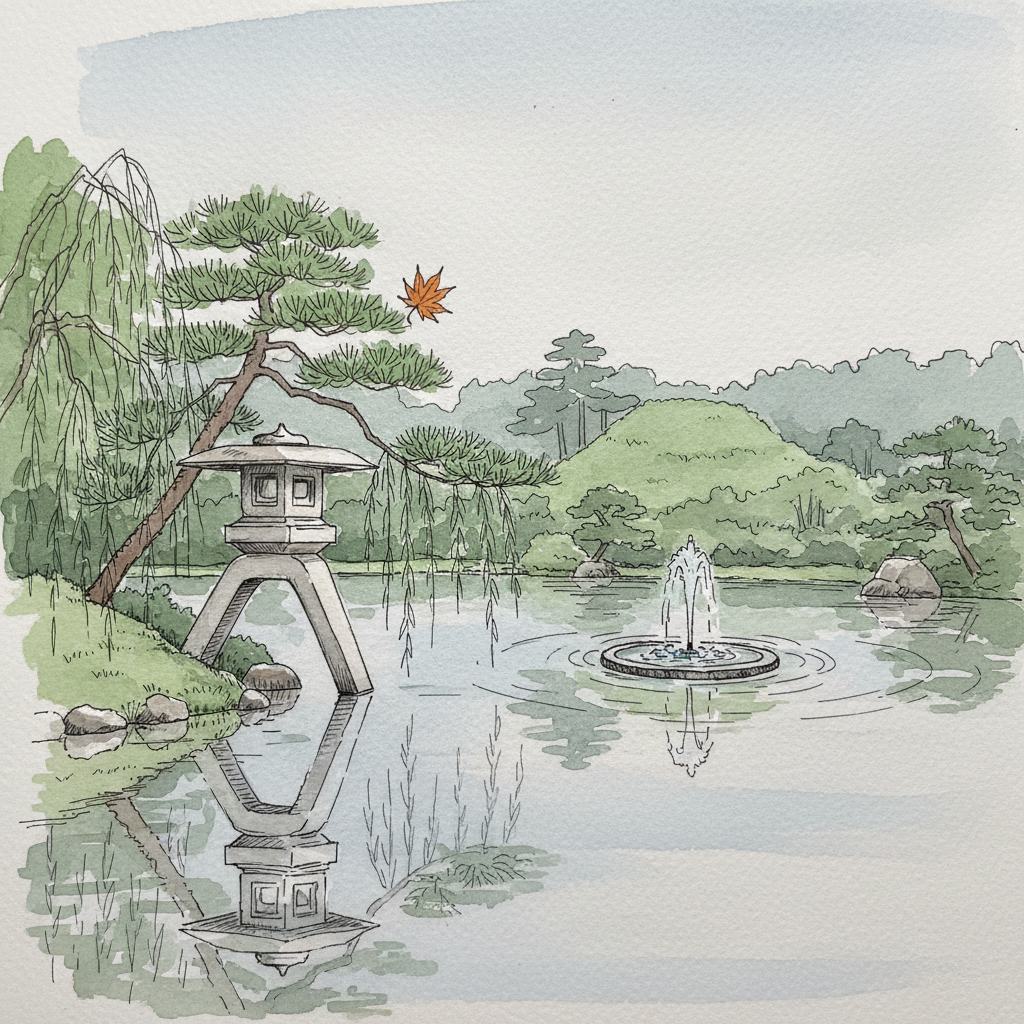
I walked the circuit clockwise, from the Neagari-no-matsu pine — propped on wooden crutches, its branches trained into a horizontal fan nearly 30 metres wide — past the Shigure-tei teahouse that miraculously survived the great fire of 1759, its roof tiles dark with moss. The Kotoji-tōrō stone lantern stood at the edge of Kasumi Pond, its two legs planted like a person standing in water, the only lantern of its kind in Japan. I sat on a bench for twenty minutes watching a grey heron fish the shallows. Every five minutes a koi surfaced, broke the mirror of the pond, and the heron stared at the rings until they stopped.
Just west of the garden I crossed into Kanazawa Castle Park through the Sanjūken Yagura gate, a massive wooden structure rebuilt in 2001 with hewn timber and earthen walls that smell of clay and cedar in the rain. The castle was occupied by the Maeda clan for 280 years with never a battle fought here — its military purpose was a formality; the real power of Kaga Domain was its wealth, second only to the shogun's. The castle's Ishikawa-mon gate, a National Important Cultural Property, is one of the few surviving original structures. From the Ishikawa-mon bridge you can look east across the outer moat and see the castle wall reflected in water as still as a mirror, and beyond it the green canopy of Kenroku-en rising like another wall.
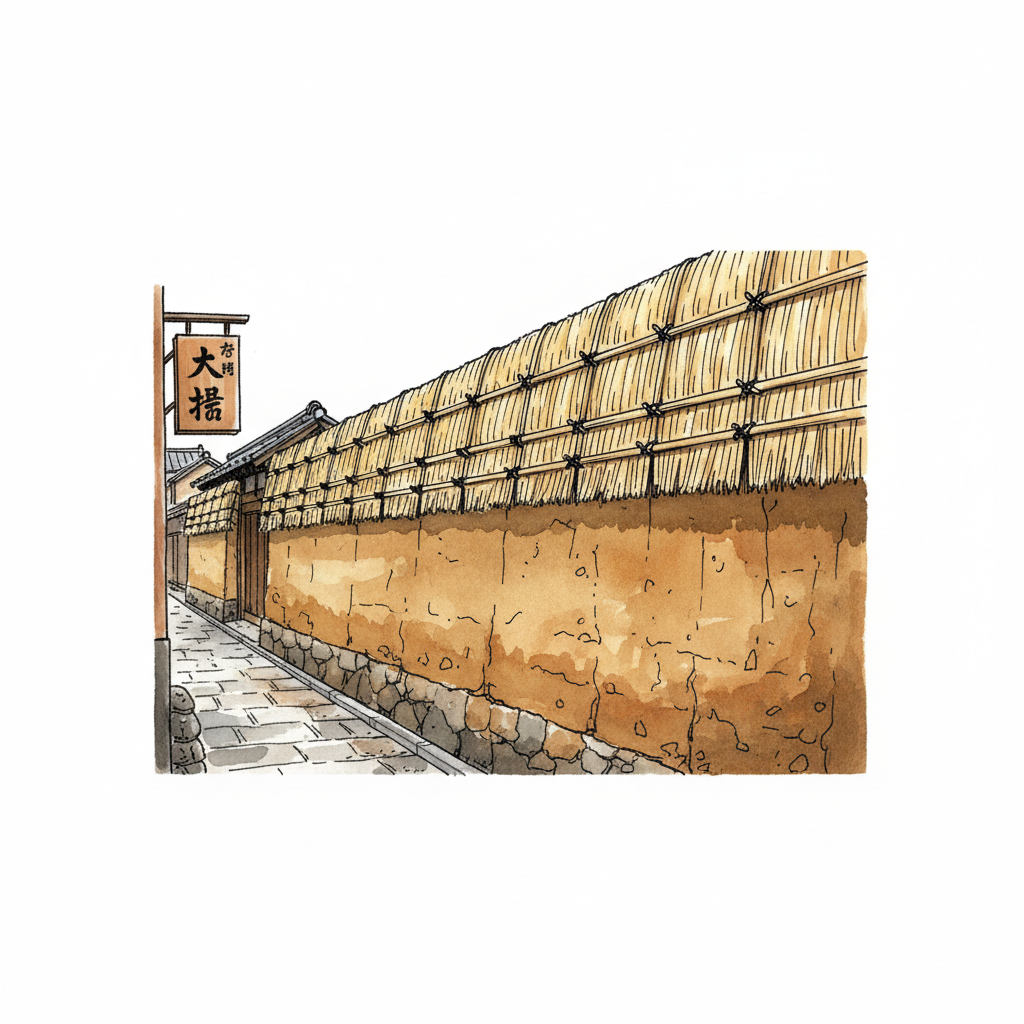
I walked south from the castle into Nagamachi, following the narrow canals that still carry water from the Tatsumi water channel built in 1632. The district's earthen walls — tsuchi-kabe — are covered in September with straw mats tied vertically against the coming frost, a protective layer that has been applied every autumn for four hundred years. The lanes are too narrow for cars, and in the quiet between rain showers you can hear water running behind the walls and a television playing somewhere through a paper window. The Nomura-ke residence at the heart of the district — admission ¥550, open 8:30–17:30 — is a restored samurai townhouse with a tiny garden at its rear so precise in its arrangement of stone, moss, and pruned maple that it generates a world in four square metres. Indoors, an armour stand holds an Edo-period suit of lacquered iron, and a wooden sword leans in the corner of what was the eldest son's study. The house was built in the 18th century and the family lived here until the end of the samurai era. You walk through on tatami slippers and the floorboards creak at the same pitch they did in 1740.

In the late afternoon, when the cloud broke and a wedge of sun appeared, I walked east to Omicho Market — Kanazawa's kitchen since the Edo period, a covered arcade of 170-odd stalls selling everything from live crabs to hand-painted chopsticks. The market is shaped roughly like a cross, two long covered streets intersecting at a central junction where the smell of grilled nodoguro (blackthroat seaperch) and roasting chestnuts mixes with the wet-paper smell of the fish stalls. I ate a kaisendon at a counter with five seats — a bowl of vinegared rice topped with chopped raw tuna, shrimp, sea urchin, salmon roe, and two kinds of crab, the colours graded from pale pink to deep orange to cream. The man next to me, a local in a Kanazawa Hawks cap, ate his with his eyes closed.
The market will close for the day around five, but I lingered until the fishmongers were hosing down their counters and a shopkeeper gave me a peeled mikan (mandarin) on my way out. 'Otsukaresama,' she said — "you must be tired" — the phrase for when the work is done. The whole city says it to each other at the end of the day, and I heard it on every street corner walking home past the shuttered ochaya, the dark windows of Higashi Chaya, the copper rain chains still running water from the morning's rain. September in Kanazawa is humid and soft and nobody hurries.
You will stand where I stood, soon enough. The garden will still be perfect. The samurai walls will still be waiting for winter. The market will have the same crab. The city remembers its manners even when nobody is watching.
What's on this week and next
Kanazawa JAZZ Street 2026 — September 18–21, all over central Kanazawa. The city's annual jazz festival, now in its 30th year. Headliners include Christian McBride & Ursa Major (Sept 21 at Hokkoku Shimbun Akabane Hall, ¥9,000 advance) and Toshiki Soejima (Sept 20, same venue, ¥7,000). There's a free Eve Reception Live on Sept 18 (17:00–21:00), a Student Big Band Carnival on Sept 19 (¥4,000–5,000), and free Street Corner Jazz performances scattered through the city. This is the weekend after you arrive—if you time it right, every cafe, plaza, and street corner in the city centre becomes a stage. Tickets available through the official website.
National Crafts Museum (3-2 Dewa-machi; 9:30–17:30, closed Mondays; ¥1,000 adults) — Independent Study for Kids and Grown-Ups: Wonderful Patterns² runs until September 23, an exhibition about pattern and repetition across Japanese craft traditions. The museum itself is worth a visit for its permanent collection of Kaga-yuzen silk dyeing, Kutani porcelain, and Wajima lacquerware — the whole range of Ishikawa's craft traditions in one building. Next exhibition, A Design Chronicle, opens October 9.
Kanazawa Noh Museum (1-2-25 Hirosaka; 10:00–18:00, closed Mondays; ¥310 adults) — The 18th Contemporary Noh Mask Art Exhibition runs September 11–23. An open-call exhibition of newly carved noh masks, blending traditional forms with contemporary interpretations. The museum itself is small but excellent — housed in a former sake warehouse, with a collection of masks and costumes spanning five centuries. You can try wearing a noh mask, which instantly teaches you how little you can see out of those tiny eye-slits.
21st Century Museum — I covered the permanent collection yesterday, but worth repeating: The Noto Series: Hitoshi Ushijima & Hiraki Sawa — With a Landscape runs through April 2027, and the museum is free in its outer ring if you want to just see Leandro Erlich's Swimming Pool from above without buying a gallery ticket.
Two disasters, one recovery
Ishikawa Prefecture has endured two major natural disasters in two years. The January 2024 Noto Peninsula earthquake (magnitude 7.6) devastated the northern coast, and in August 2026 record-breaking heavy rains flooded large parts of Ishikawa, Toyama, and Fukui prefectures. Recovery is ongoing on both fronts.
The Nippon Foundation — accepting donations for the August 2026 Ishikawa–Toyama–Fukui Heavy Rain Emergency Relief Fund until September 30, 2026. Donations support daily needs, NGO relief activities, and vulnerable residents. Donate via their official portal.
Japanese Red Cross Society — still operating Noto Peninsula earthquake relief programs, with donations going toward medical aid, shelter, and livelihood restoration in the hardest-hit areas.
These are the organisations already on the ground, with the infrastructure to deliver help where it's most needed.
Three things from Kanazawa
First: The lantern Two-legged stone lantern standing in the pond since the year my great-great-grandmother was not yet born.
You could say 'old' but the heron says 'steady' and steps around it into the deeper water.
Second: The tatami room The samurai's study is four mats and a window. His sword hangs in the alcove. Outside, a maple the size of a child bends its leaves toward the glass.
He sat here every afternoon waiting for the next order that never came. The order arrived two hundred years late.
Third: The market at closing A woman hands me a mandarin from a basket meant for the next day. 'Otsukaresama.' We are all tired.
The crab on the ice does not know it will be someone's dinner. The fisherman at the counter eats with his eyes closed.
What is a city but a long series of small kindnesses repeated until they become habits?