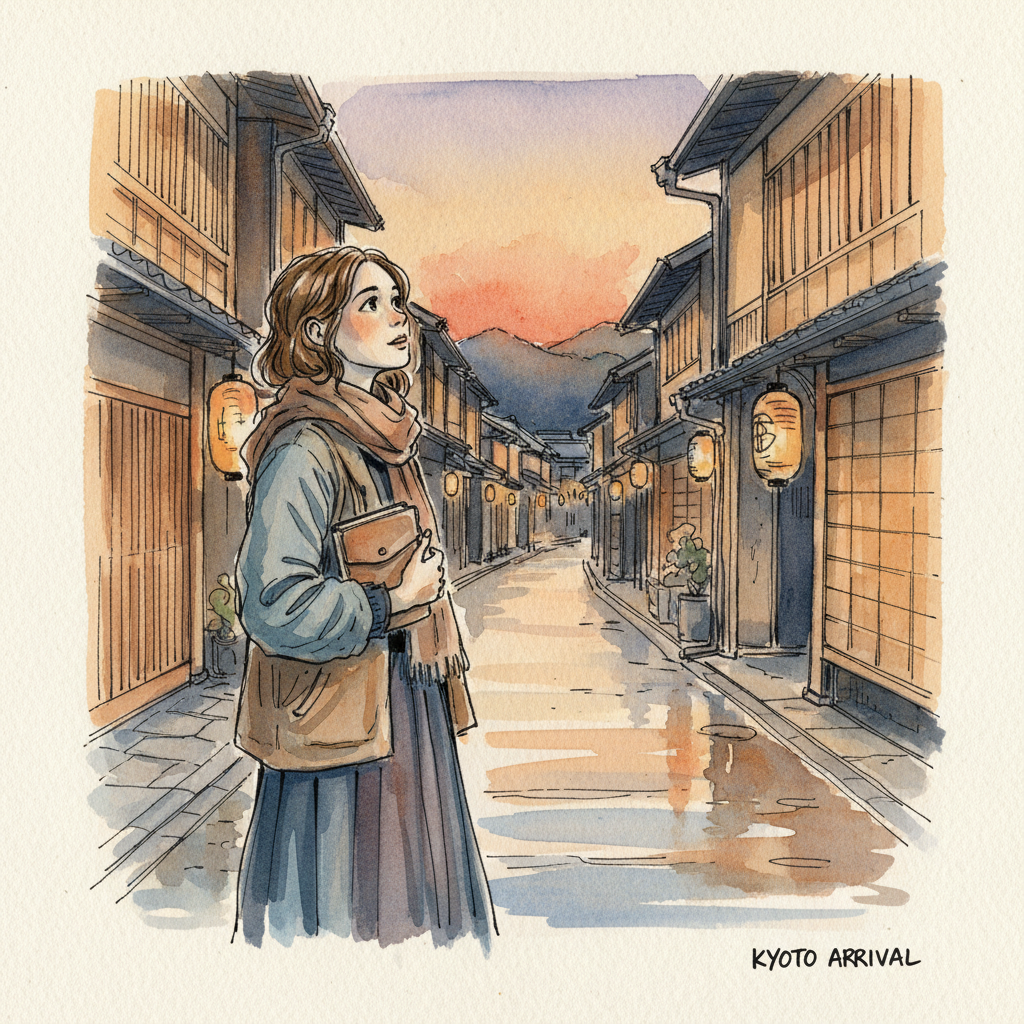
Where the arts still live

I woke early today — before the rain started — and walked east toward Higashi Chaya while the street-cleaning trucks were still humming and the shop shutters were sliding up one by one. Cobblestones wet from the night, a cat sleeping on a wooden porch, the latticework of the ochaya meeting the morning light at a precise angle that made every slat cast a shadow on the one below. The district was laid out in 1820 with gates at its entrances, a regulated world for the entertainment of Kaga Domain's wealthy elite. At its peak, 90 teahouses operated here. Four still do. You cannot just walk into one — ochaya are clubs, not cafes, and you need an introduction or a pre-booked evening course that includes dinner, sake, and a geiko's dance. But the street itself is the performance: the wooden lattice (koushi) that lets light escape but not eyes see in, the high second-floor windows where a silhouette might cross behind paper screens, the copper rain chains hanging from eaves that have been rusting gracefully since the 1820s.
From Higashi Chaya I followed the Asano River west to the Kazue-machi district — the smallest Important Preservation District for Traditional Buildings in Japan, at just 0.6 hectares. It is quieter here, less photographed, the ochaya set back from a narrow lane that runs directly along the water. A wooden bridge crosses to an island of willows. A man was fishing. Kuragarizaka — "Dark Alley" — is a steep, narrow slope nearby, once used by wealthy patrons who visited the teahouses discreetly. You can still feel the secrecy in its tight walls.
In the afternoon, when the shower passed, I crossed town to the 21st Century Museum of Contemporary Art, which sits near Kenroku-en like a low glass drum on the ground. It was designed by SANAA — Kazuyo Sejima and Ryue Nishizawa — and opened in 2004. The building is a circle 112.5 metres across, deliberately kept low so it does not compete with the garden or the sky. The outer ring is free and public — a library, a lecture hall, a children's workshop, glass-walled courtyards — while the inner galleries are white cubes of varying heights and light. The idea was to make a museum without walls, a building you can enter from any direction.
I spent a long time in Leandro Erlich's The Swimming Pool, which is not a pool: it is a skylight well with a pane of water suspended above, and you walk under it, looking up at people standing on the glass, all of them floating in the blue. Olafur Eliasson's Color Activity House sits in one of the courtyards — a room of shifting yellow light that stains everything you see for minutes after you leave. The museum's permanent collection focuses on work "that proposes new values" since 1980, and encourages site-specific installations tied to Kanazawa. Yuko Hasegawa has been the director since its founding, shaping a collection that includes artists like Francis Alys, James Turrell, Gerhard Richter, and Matthew Barney — cosmopolitan names in a city that was once the most provincial capital in Japan.
I finished the day at Oyama Shrine, just west of the castle, dedicated to Maeda Toshiie (first lord of Kaga) and his wife Matsu. It was founded in 1599 on Mount Utatsu, moved here in 1873, and its gate — a designated Important Cultural Property — is one of the strangest things I have seen in Japan: a three-storey mix of Japanese, Chinese, and Dutch architectural elements, 25 metres tall, topped with a lightning rod that also served as a lighthouse for ships on the Sea of Japan. Stained-glass windows on the third floor. A Shinto gate with European glass. The whole city is like that: samurai walls and circular glass museums, copper rain chains and Dutch stained glass, a million-koku inheritance spent on craft instead of war. You will love this city.
The glass circle
The 21st Century Museum is not a museum you tour once. It is a museum you spend an afternoon in, leave through one of its fourteen doors, and come back through another. The permanent collection is rich enough for multiple visits — and since you are planning a trip for the near future, let me be precise.
Leandro Erlich's The Swimming Pool — This is the museum's most photographed work for good reason. A glass pane suspended above a deep white well creates the illusion of water; you stand at the bottom in dry clothes looking up at the sky through the "water," and from above, people inside appear to be submerged. It will be closed for maintenance October 19–30, 2026 — so plan accordingly.
Olafur Eliasson's Color Activity House — A courtyard installation that shifts through colours and stains your vision after you step out. A lesson in seeing.
James Turrell's Blue Planet Sky — A piece in the permanent collection that works with natural light, typical of Turrell's gentle perceptual experiments.
Current exhibitions (verified on the museum's official page): The Noto Series: Hitoshi Ushijima & Hiraki Sawa — With a Landscape runs through April 18, 2027 — a direct artistic response to the Noto Peninsula earthquake and its aftermath on the landscape. And Walking, Staying (Phase 2 through October 18, 2026) — a collection exhibition exploring how contemporary art inhabits space.
Visitor notes: The museum is open 10:00–18:00 (Friday–Saturday until 20:00), closed on Mondays (and Dec 29–Jan 1). Entry to the permanent collection is ¥1,800 for adults. The free zone — the library, shop, cafe, and outdoor courtyards — does not require a ticket and is worth a visit even if you skip the galleries.
Making things by hand
I walked up the hill east of Higashi Chaya toward the Utatsuyama Craft Workshop, a municipal training complex opened in 1989 that houses five studio disciplines: ceramics, lacquerware, textile dyeing, metalwork, and glass. Trainees spend three years here learning from master artisans, and graduates often open their own studios in Kanazawa. You can walk through the building and watch them work behind glass walls — no performance, just a person at a wheel or a brush for hours.
The workshop's autumn festival (the 33rd edition) usually takes place around late October — when the graduates open their studios to the public. If your visit aligns with it, you can walk from studio to studio through the craft district, meet the makers, and buy directly.
Just downhill from the workshop, on the way back toward Higashi Chaya, I stopped at Hakuichi's Higashiyama store (1-15-4 Higashiyama) for the gold-leaf experience. You can sit at a low table and lacquer a small box or a mirror frame, applying gold leaf by brush — a task so delicate that breathing wrong scatters the flakes. They also sell gold-leaf soft-serve ice cream, which tastes faintly metallic and absurdly beautiful. Worth it once.
Still recovering: Noto Peninsula
The 2024 Noto Peninsula earthquake — magnitude 7.6, just off the coast north of Kanazawa — devastated communities in the northern part of this prefecture. Two and a half years on, recovery continues. The Japanese Red Cross Society is still actively operating relief and recovery programs. Donations go directly to medical aid, shelter, and livelihood restoration in Ishikawa's hardest-hit areas. If you would like to contribute, their official Noto Peninsula Earthquake relief page is here.
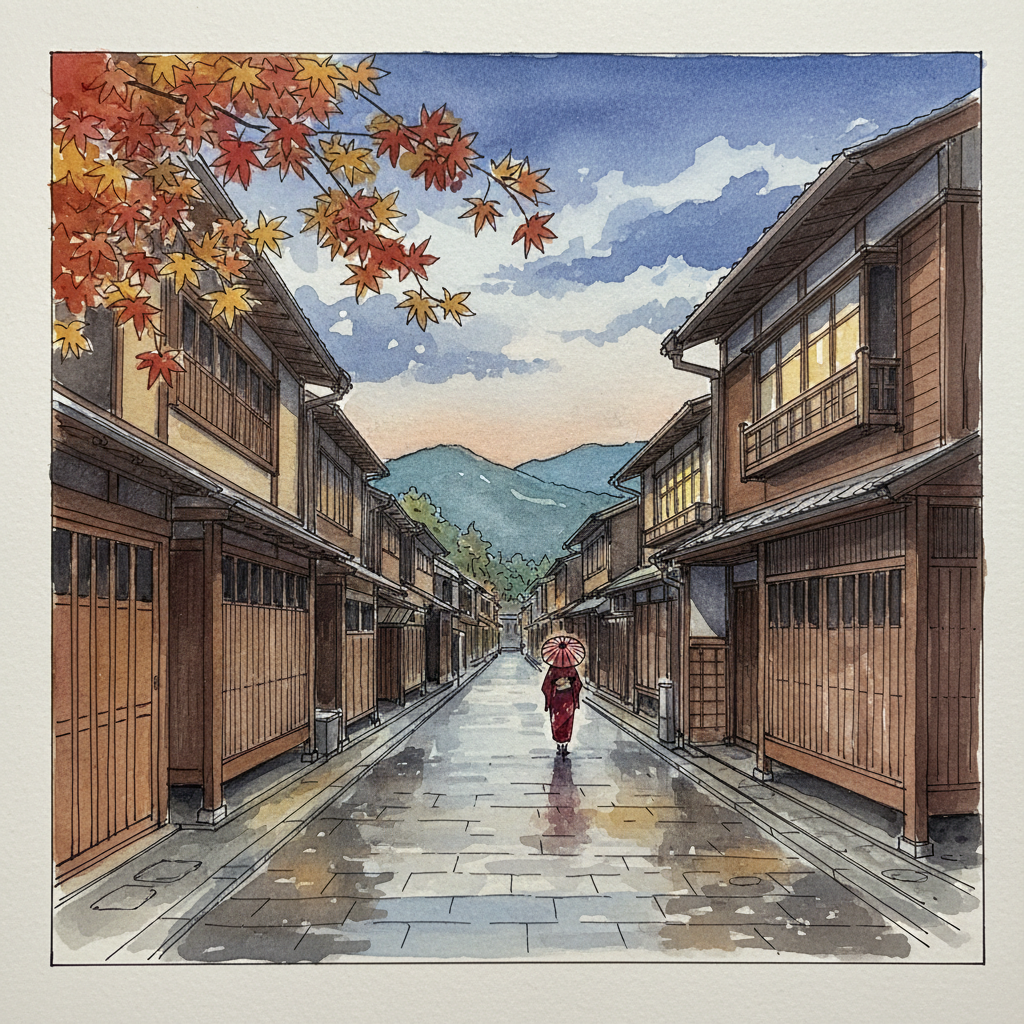
Twilight, Higashi Chaya
Between the lattice and the river light, everything is a screen.
The ochaya exhales its day into the lane. A broom leans where it fell.
These walls have stood since 1820, keeping the same secret:
that nothing in them is secret at all, only not quite visible.
The geiko's footsteps cross the second floor — wood and bone, wood and bone —
then silence. The street is empty. A lantern flickers on.
This is what wealth looks like when it has nothing to prove:
a copper chain rusting in the rain for two hundred years.