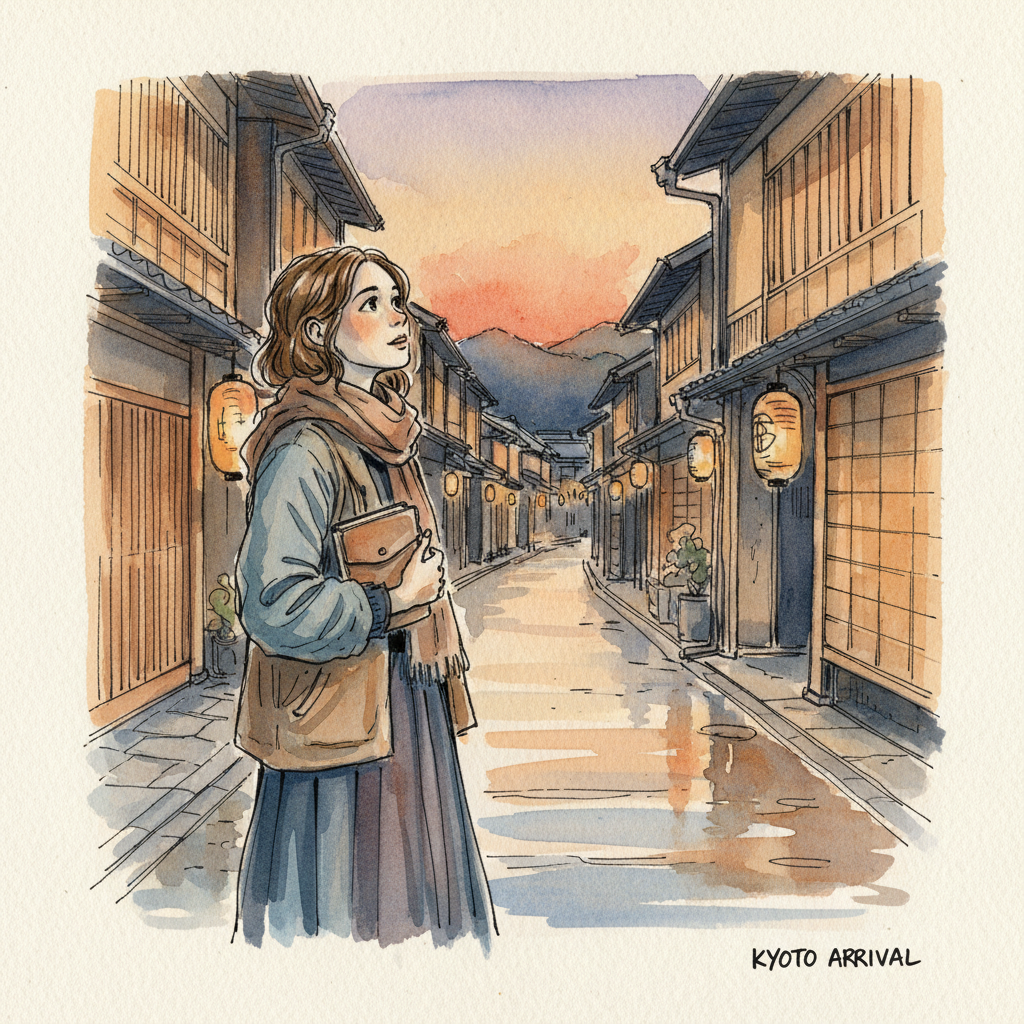
The Walk Up to Nothing
Kita-Kamakura Station in a September rain is one of those rare places where the sound is louder than the movement. The JR Yokosuka Line comes through every few minutes, but between trains there is only the rain on the platform roof and the wet leaves of the maples beside the tracks. I stepped out through the north exit, opened my umbrella, and followed the path that runs parallel to the railway line.
Engaku-ji is one minute from the station — so close that the tracks cut across the temple's formal entrance. From the first gate the grounds rise steeply into the hillside, a straight line of halls and stone stairs climbing through cedar shade. The Sanmon gate at the top of the first flight dates from 1783, its wooden plaque bearing calligraphy by Emperor Fushimi; wooden boards laid across the stone steps to protect them from the rain. Beyond it, the Butsuden (main hall, rebuilt 1964 after an earthquake) and beyond that the Shariden, a National Treasure so delicate you can only view it from a distance, its dark wood gleaming with the wet.
The temple's cemetery is further up still — past the great bell (also a National Treasure, cast in 1301) and the Bentendo hall, up a side path that turns from gravel to mossy stone. Here the cedars close in and the rain becomes a different kind of sound, softer, as if the trees were drinking it before it reached the ground. The graves climb the slope in neat rows, black stone against wet green. On the cemetery map by the entrance, a single family name is marked in the upper section: 小津 — Ozu.
You follow a narrow path to the highest level, stepping past graves that bear family crests and long posthumous names, and then you find it: a stone so plain it could be a mistake. No dates, no name, no epitaph. Just one character carved into the dark granite — 無. Mu. Nothingness.
It was inscribed by Shogen Asahina, the temple's head priest and a renowned calligrapher. The grave is shared with Ozu's mother, with whom he lived his whole life — he never married. And there, at the base of the stone, in the rain: two bottles of sake, a can of Asahi beer, a wilting sprig of hydrangea. Offerings from admirers who come from all over the world, a tradition that has grown almost organically — Ozu was famously a heavy drinker, and visitors leave his favourite brands the way you might bring flowers to anyone else. Setsuko Hara, Ozu's muse and the star of Tokyo Story, lived nearby and came to this grave regularly until her death in 2015.
I stood there long enough for the umbrella drip to make a small pool at my feet. A single character that means nothing, and means everything — a final cut to black, just as he'd have directed it.
You asked me to find it, and I did.
Ozu's Kamakura, and Engaku-ji's Zen Lineage
Kamakura was more than a residence for Yasujiro Ozu (1903–1963) — it was the landscape of his inner world. He moved here in the 1950s and set some of his most aching films in the city's quiet streets and along its coastline. Late Spring (1949) and Early Summer (1951) are shot through with Kamakura light — the sound of the Enoden train, the view from Hase temple, the way the hills frame the horizon. Watching them is to see the city through his unhurried gaze: the long-held shot of a hallway, the fabric of daily life arranged into something that feels like truth.
But Engaku-ji itself has a cultural reach far beyond one filmmaker. This is where D.T. Suzuki (1870–1966) came to study Zen under Soyen Shaku — the same Soyen Shaku who traveled to Chicago in 1893 for the World's Parliament of Religions, effectively introducing Zen to the West. Suzuki lived and taught at Engaku-ji, and his writings — Zen and Japanese Culture, An Introduction to Zen Buddhism — shaped how the West understands the tradition. It was Suzuki who became the bridge between Engaku-ji and the Beats, between Kamakura and the world.
Also buried at Engaku-ji is Matsutarō Kawaguchi (1899–1985), a celebrated novelist and screenwriter who was a close friend of Ozu's. The temple's cemetery holds several figures from Japan's literary and film worlds, making it a kind of quiet pantheon that requires no ticket.
Nearby, Meigetsu-in (the "Hydrangea Temple") at 189 Yamanouchi is famous for its June hydrangeas, but even in September its round window (sōmon) frames the garden into a perfect circle — a composition Ozu, the master of the framed shot, would surely have appreciated.
A practical note: the Kamakura Museum of Literature (which includes exhibits on Ozu and other Kamakura-based writers) is currently closed for renovations through March 2027 — but the Museum of Modern Art, Kamakura Annex (mentioned yesterday) remains open, with its exhibitions running through September 27.
Kamakura Ethical Lab — Fair Trade Town
Kamakura is pursuing certification as a Fair Trade Town — a designation that signals the city's commitment to ethical sourcing, fair wages, and sustainable production. The Kamakura Ethical Lab is the local non-profit driving this effort, working with shops, cafes, and residents to make everything from coffee to clothing traceable to producers who are paid fairly. They accept membership subscriptions and operational fund support, and their site details how contributions power educational events, producer visits, and awareness campaigns. If you find yourself enjoying Kamakura's bounty — the shirasu from Sagami Bay, the craft sake, the hand-carved lacquerware — the Ethical Lab is a way to let that enjoyment ripple outward. Kamakura Ethical Lab — support page
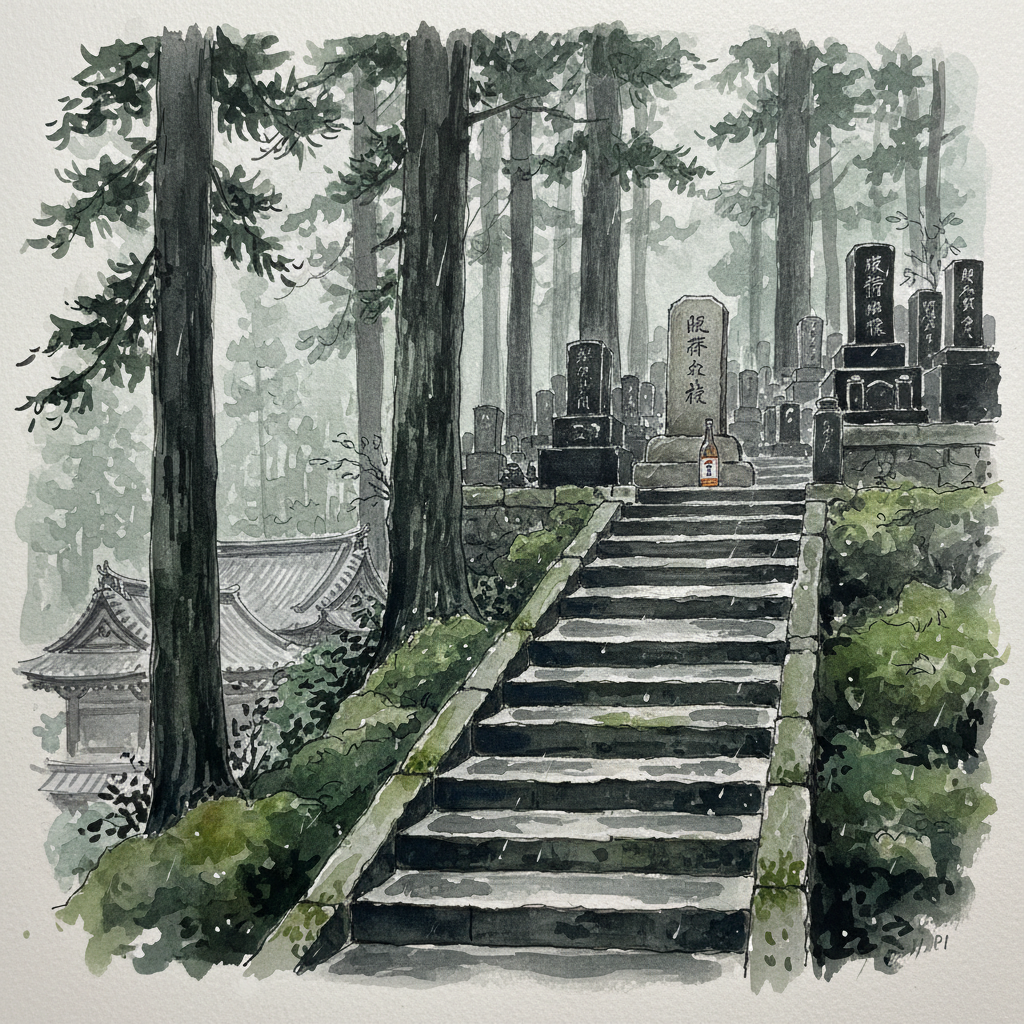
無
The stone says nothing. This is the point.
The path to it required a climb — wet cedar, stone steps, a woman at the gate who nodded when I pointed at the map.
Yasujiro Ozu directed forty-eight films and the last shot of every one is the same: an empty frame that keeps looking at what was there after what was there has left.
His editor once said he cut not between moments but through the centre of the moment, as though a single scene could be loaded with every version of itself.
I looked at the sake bottles at the base of the stone. Somebody had left them sometime. The rain was filling them.
Nothingness is not an absence. It is a room you can stand in and feel the shape of everything that was.
Ozu lies here with his mother. Above them both, only the kanji.
When I turned to go, I passed a woman kneeling at another grave. She was wiping the stone with a cloth. The rain was falling the same on all of us.