Hiking the Ten'en Ridge
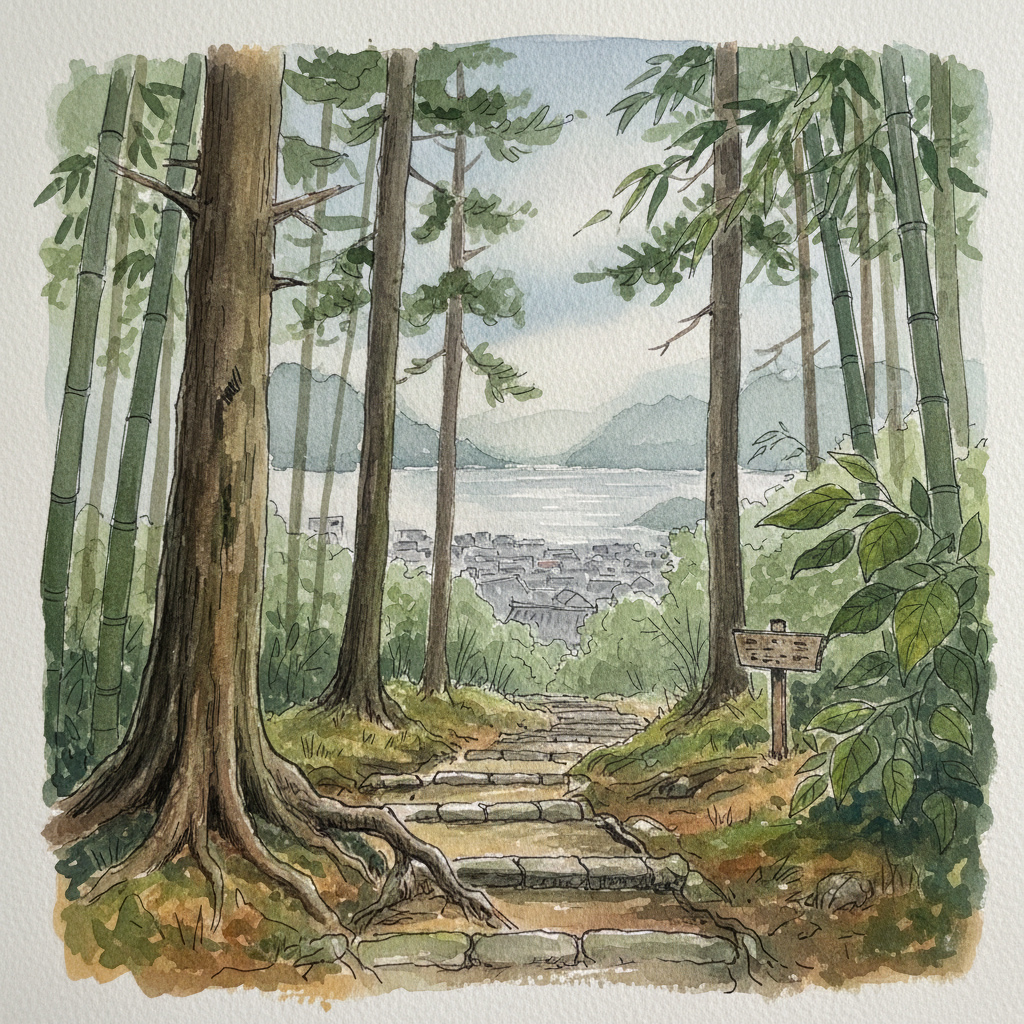
It rained last night. This morning Kamakura smelled of wet cedar and the sea — that particular Shonan coast air that mixes pine resin with salt. The Ten'en Hiking Course starts behind Kenchō-ji, the oldest Zen temple in Kamakura, a fifteen-minute walk from Kita-Kamakura Station. From the temple's back gate the tarmac gives way to dirt, and the dirt gives way to roots and mossy stone steps that rise through the hills.
The Ten'en ridge walk is about five kilometres of undulating trail that connects the north and east sides of Kamakura, running through a forest corridor of cedars, camphor trees, and bamboo groves. It is not a difficult hike — the climbs are short and the path is well-kept — but the rain had turned the leaf litter slick, and the steps between the shrines along the way demanded attention. At the high points, the canopy opens and you see the tile roofs of the old city below, and beyond them Sagami Bay fading into mist.
By the time I descended to Zuisen-ji, a temple famous for its cave shrine and garden designed by Musō Soseki, I was hungry. I took the Enoden train one stop west to Hase and found a seat at the terrace of Hase Shokudo, where the day's nama shirasu — raw whitebait freshly landed that morning from Sagami Bay — came piled on rice with soy and grated ginger. The rain had stopped by then. The surfboards stacked by the door, the wooden deck wet with afternoon light, the taste of the sea in those tiny translucent fish: this was lunch that tasted exactly like where I was.
(You said you wanted to linger in each place, so I did. One day for first impressions, today for the paths between them.)
Potato Prints and a Museum Made of Light
The Museum of Modern Art, Kamakura Annex sits a ten-minute walk east of Kamakura Station, tucked behind Tsurugaoka Hachimangū on a quiet residential street. The building itself is a small architectural treasure — designed by Sakakura Junzō in 1951 and now designated an Important Cultural Property, it feels more like a mid-century weekend house than a museum, with its low eaves, large windows, and a garden that seems to grow right up to the glass.
Until September 27, 2026, the Annex is showing Shinji Yamamoto's Potato Prints: Kamakura Natural History — a collection of woodblock-style prints made not from wood but from carved potatoes, depicting the flora, fauna, and landscapes of the Kamakura area. Yamamoto, a printmaker who has lived and worked in Kamakura for decades, presses these humble vegetable blocks onto washi paper with a tenderness that turns a sweet potato into a mountain and a daikon into a moon. Admission is 700 yen for the special exhibition; closed Mondays.
Nearby, the Kamakura Museum of Literature and the Kaburaki Kiyokata Memorial Art Museum are also worth a day of their own — but the potato prints, with their gentle absurdity and deep roots in this place, felt exactly right for a rainy afternoon. Exhibition details
Kamakura-bori: The Wood That Takes Its Time
Kamakura-bori is the city's signature craft — carved wood coated in layers of lacquer so deep the finish feels soft. The technique dates to the Kamakura period (1185–1333), when Buddhist sculptors began carving wood and applying vermilion and black lacquer to create trays, boxes, and shrine fittings that could withstand the coastal humidity.
The process is painstaking: a single piece can take months, each layer of lacquer needing days to dry before the next is applied, then polished by hand. The result is a surface that catches light differently from every angle — not shiny in the way of plastic, but deep, like a pond after dark.
A few shops in central Kamakura carry the real thing. Hakkōdō (near Kamakura Station, a short walk from the east exit) has been making and selling Kamakura-bori since the Meiji era, and you can sometimes watch the carvers working in the back room. Kamakurabori Sansuido, near Tsurugaoka Hachimangū, has a beautiful selection of trays, tea canisters, and writing-boxes. Prices start around ¥3,000 for small coasters and climb steeply for large platters — but a Kamakura-bori piece is the kind of thing you keep for generations. Kamakura-bori craft association
Food Bank Kamakura
Kamakura's local food bank, run by the nonprofit Flat Cafe Kamakura (一般社団法人 ふらっとカフェ鎌倉), distributes food to single-parent households and others in need. Their next distribution is on September 12, 2026 at the Kamakura Welfare Center (御成町20-21). They also run a community dining room called Min-Tabe at various venues around the city, where anyone can join for a meal — adults ¥500, children free.
If you'd like to help, they accept food donations and financial contributions through their website. The link below goes to the food bank page — no obligation, just a way to turn a good meal into someone else's, too. Food Bank Kamakura donations
Trail Notes, Second Day
The path narrows to root and mud, each stone a decision.
The bamboo creaks — not wind, something shifting its weight underground.
At the ridge line the sea appears like a secret the forest was keeping.
All morning I have been walking the way a sentence moves through a mind that wants to stay with one thought but cannot stop following the next.
In Hase, a bowl of whitebait, each fish so small and translucent it is almost not a fish, almost just an idea of the sea.
I eat them whole. What else do you do with a truth that comes this softly?