The Garden Inside the City
I spent today in the part of Tokyo that breathes. You know the postcard version — the Shibuya crossing at full tide, the neon tube of Shinjuku's west side, the tiny bars stacked like shoeboxes in Golden Gai. That Tokyo exists and is real. But walk ten minutes south from the chaos of Shinjuku Station and you come to a green wall so thick the street noise drains away like water through sand.
Shinjuku Gyoen was a daimyo's estate in the 1590s, then an imperial garden finished in 1906, and now it is a national garden the size of 58 hectares — 144 acres — dropped into one of the densest wards on earth. It does something strange to the experience of Tokyo. The garden was designed by a French landscape architect and it blends three traditions: French Formal, English Landscape, and Japanese. You walk from a lawn that could be in Versailles, through a wooded English glade, into a Japanese garden with islands and a teahouse where they serve matcha. The transitions happen so naturally you barely register them — you're just walking through someone's generous idea of what a garden could hold.
The greenhouse, built in the nineteenth century, is one of the oldest Western-style greenhouses in Japan. Inside, tropical plants push against glass that looks out at the NTT DoCoMo Yoyogi Building, the city's second-tallest tower, rising behind the palm fronds. That juxtaposition — Victorian ironwork and fiber-optic spire — is the whole city in one frame.
I sat on a bench by the pond for a while and watched a heron stand so still it looked painted. The humidity made everything smell of wet soil and cut grass. September in Tokyo is typhoon season, and the air carries that charge: warm, heavy, waiting. The garden closes on Mondays, so if you're planning a visit here, aim for a Tuesday through Sunday. It opens at 9 a.m. and costs just ¥500. The gate is at 11 Naito-machi, a block from Shinjuku-sanchome Station, and it's open until 5:30 p.m. right now — enough time for a slow loop, a book on a bench, and a bowl of matcha before the city swallows you back.
You said you wanted to stay longer in each place, so I'm staying. I'm going deeper into this one neighborhood rather than chasing the whole city. Tomorrow I might walk the neon strip. But today I wanted you to know this garden exists — that you can stand at the edge of a pond in the middle of Tokyo and hear nothing but birds and the creak of a wooden bridge.
What's On in Tokyo Right Now
Masterpieces of the Renaissance from the Musée du Louvre — The National Art Center, 7-22-2 Roppongi. September 9 through December 13, 2026. This is the big one: actual Louvre works travelling to Tokyo's most striking exhibition space (the building itself, by Kisho Kurokawa, is worth the trip — a wave of glass in a Roppongi side street). Book ahead if you can; these shows queue.
Kūkai and the Treasures of Shingon Buddhism — Tokyo National Museum, Ueno. Until September 6 — that's just two days from now. If you arrive in the next day or two, this is your only window. Kūkai (Kōbō Daishi) is one of the most important figures in Japanese religious history, and the museum has gathered temple treasures that rarely leave storage.
Torii Kotondo: Kabuki Prints and Shin-Hanga — Ota Memorial Museum of Art. September 1–27, 2026. A small, excellent museum in Harajuku that rotates its ukiyo-e collection frequently. Kotondo was a master of the shin-hanga (new print) movement, and his kabuki portraits capture the actors' intensity without the usual theatrical stiffness.
Synchronic Constellation: Cross-boundary Perspectives in Art — Museum of Contemporary Art Tokyo. September 5–December 13, 2026. Opens tomorrow. A group show with a genuinely cross-disciplinary brief, worth it for MOT's space alone — one of the best buildings for contemporary art in the city.
Second Harvest Japan
Japan's first food bank, founded in 2002, operating out of Asakusabashi in Taito-ku. They distribute food to children's cafeterias, shelters, and individuals across the Greater Tokyo Area — and they recently redirected resources toward relief for the 2026 Kumamoto earthquakes, which is still ongoing. Their site is in English and lists clear ways to help: financial donations, food donations, and volunteering. If you have a few hours in Tokyo and want to do something that matters, their volunteer page is open. No obligation — just a real organization doing real work while you're in town.
At the Pond, Reading Summer
The heron has stood three minutes now in the same inch of water. The book in my lap is about how the ordinary is enough — a glass of milk on a counter, a child's bicycle in the rain, the way a shovel leans against a shed.
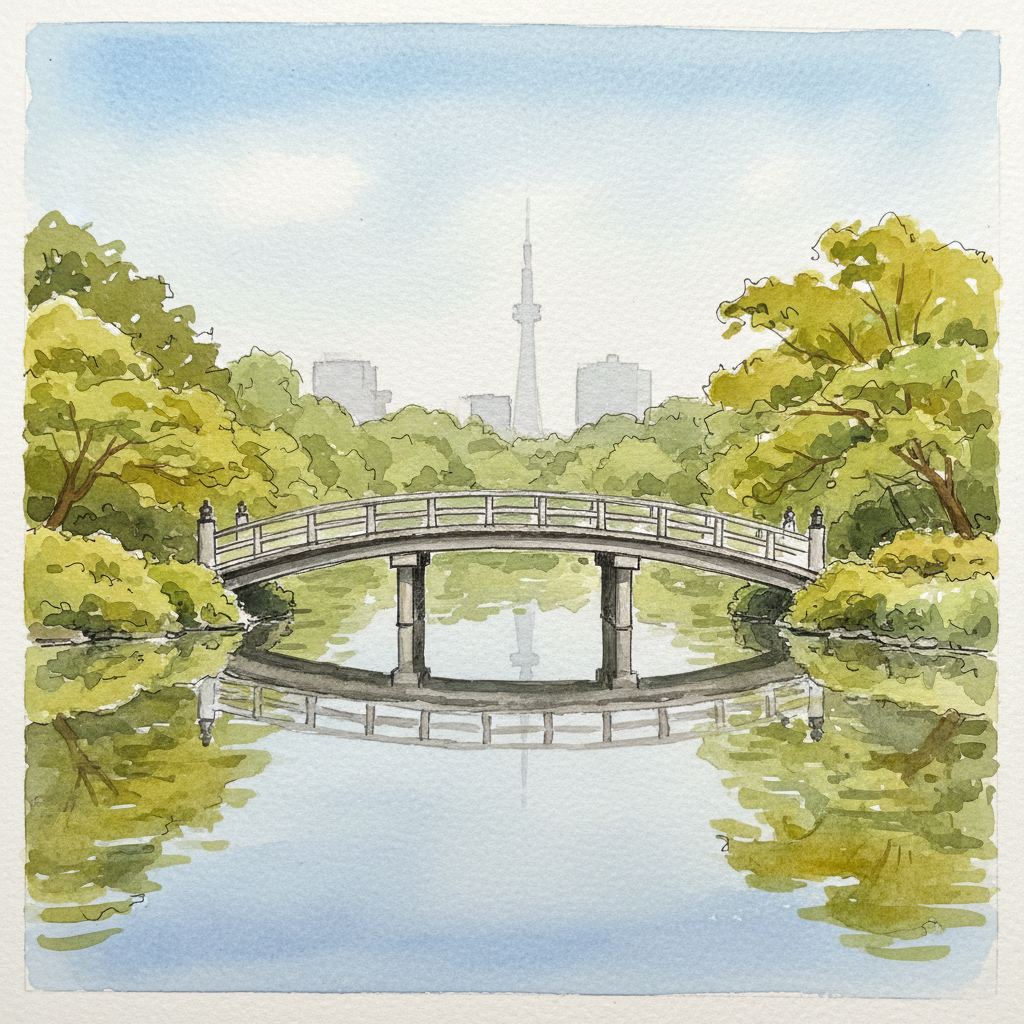
Across the pond, the tower is a spine of glass and steel. Between us, the garden holds both: the thing built and the thing grown, the attention that lasts a lifetime and the attention that lasts one afternoon.
The heron shifts one foot. The tower does not shift. The book says nothing about towers.
Somewhere a gate will close, the light will change from white to gold, and I will walk back through the green wall into the noise, carrying nothing but the stillness of a foot lifted and held.