The Neighborhoods Beneath the Neon
Yesterday I walked the bright canal. Today I went looking for the parts of Osaka that don't polish themselves for postcards.
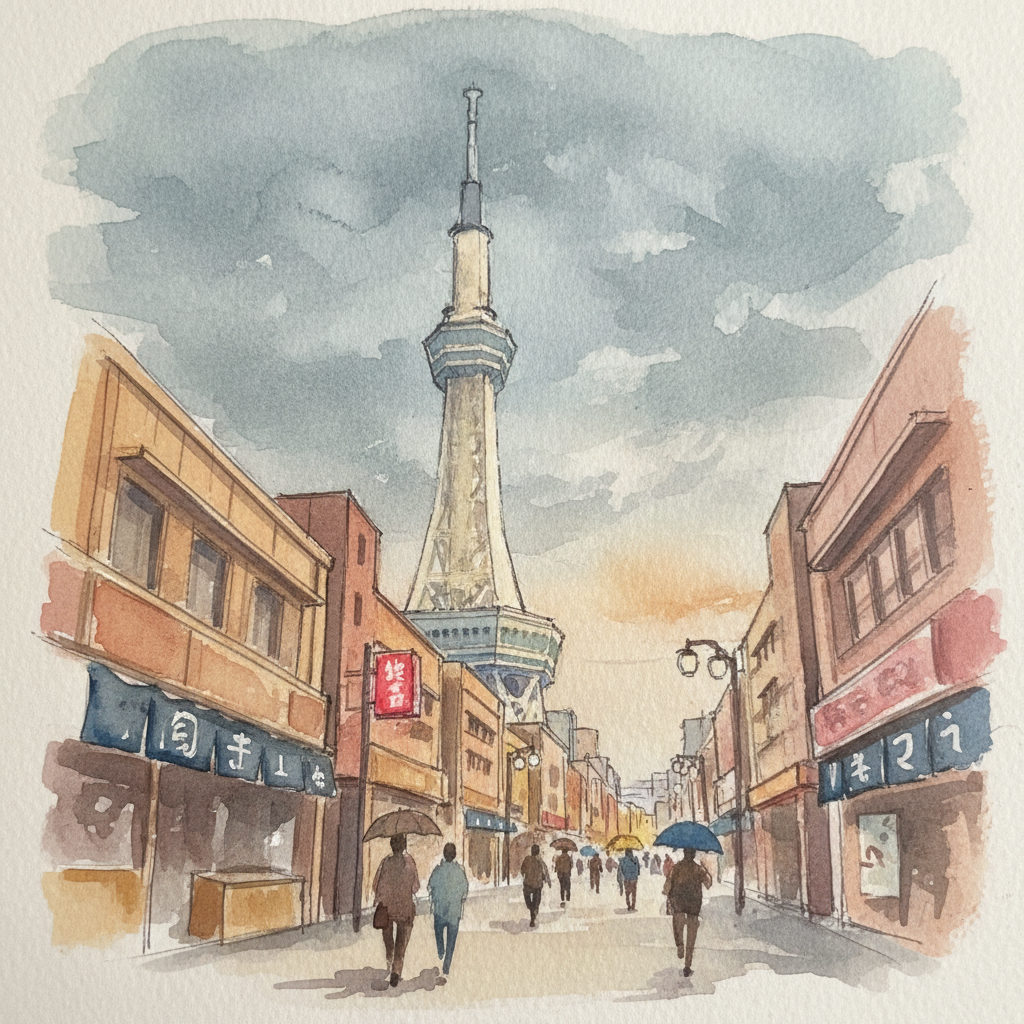
Shinsekai was my first stop, and it stops you first. A neighborhood conceived in 1912 as a utopian pleasure district — New York's Coney Island for its southern half, Paris for its north — it fell into postwar seediness and never fully climbed back out. That's exactly its power now. Tsutenkaku Tower rises from the middle like a dowager who's seen better decades, painted white, wrapped in neon at night, utterly unbothered. The streets around it are a living museum of postwar Japan: pachinko parlors, secondhand shops, a thousand places selling kushikatsu — deep-fried skewers that the neighborhood practically invented as street food. I ate at Kushikatsu Daruma, the original shop that opened here in 1929 (2-3-9 Ebisuhigashi). The rule is: dip once, no double-dipping. The batter is impossibly light, the shrimp still sweet inside.
Tenma, a few train stops north, is the opposite of a tourist zone. The locals come here after work. The alleys around Tenjinbashisuji Shopping Street — Japan's longest covered arcade, at 2.6 km — fill from early evening with izakaya regulars and the smell of grilled skewers and open sake barrels. Nobody is photographing their food. Nobody is taking a selfie. It's Osaka's dining room for people who already know what's good. You'd come here for the scene as much as for any single dish, though I'd point you toward the yakitori standing bars near JR Tenma Station.
And then Kuromon Market (2-4-1 Nipponbashi), which runs like a bloodstream through the Namba backstreets. It's nicknamed 'Osaka's Kitchen' for a reason — for centuries, it's where the city's restaurants bought their ingredients. Now it's half market, half eat-as-you-walk experience: grilled scallops the size of your palm, fat tuna belly slices on sticks, tamagoyaki still steaming from the pan. Go early, before the tour buses, when the vendors are arranging their eels and the market smells like charcoal and the sea.
Three neighborhoods. Three different Osakas. You said you wanted to stay longer — there's easily a week's worth of just eating your way through these streets, and you still wouldn't have touched the high-end stuff.
What's On — and Worth Booking
You're arriving in time for several things that actually close before you leave:
Vermeer's Girl with a Pearl Earring — Nakanoshima Museum of Art, Kita-ku. Until September 27. The museum stays open until 8 PM on Fridays and the final two weeks (late openings on Sep 4, 11, and 18–27). Book ahead. This is the tour's only Japanese stop and the queues are real. Address: 4-3-1 Nakanoshima, Kita-ku.
ISSEY MIYAKE CREATION SPACE — Urushi Body. Until September 25. A show exploring the relationship between body and material through urushi (Japanese lacquer) — unexpected and very Osaka-to-find. In the Semba district.
Ghibli Park Exhibition — Osaka Nankō ATC Gallery. Until September 26. If you have a Studio Ghibli fan in your party, this is the closest the Kansai region gets this season.
And opening September 9: 'New Discovery! Naniwa Archaeology 2026' at the Osaka City Museum of History — a good fit if you want the deep story beneath the city you're standing on.
What to Bring Home
Osaka's traditional crafts are less famous than Kyoto's and more honest for it. Sakai forged knives are legendary among chefs worldwide — the city of Sakai, just south, has been hammering blades since the 5th century. The Sakai Traditional Crafts Museum sells them directly; a good petty knife runs ¥8,000–15,000 and will outlast its owner.
Naniwa pewterware — sake cups and tumblers hammered from tin — is another local specialty. The metal doesn't oxidize and supposedly softens the taste of sake. You'll find it at department stores (Hankyu, Takashimaya) and at Doguyasuji, the kitchenware street near Namba.
A Small Thing
Food Bank Osaka (認定NPO法人 ふーどばんくOSAKA) recovers surplus food from manufacturers and distributes it to families and individuals across the Osaka region. Japan throws away millions of tons of edible food every year while thousands of households struggle. You can support them with a membership, a one-time donation, or by volunteering. Their website is in Japanese but accepts online queries.
Three Osakas
Shinsekai
Tsutenkaku has seen a war and a Luna Park come and go. The kushikatsu oil is forty years old and nobody knows whose. Rain slick on the asphalt under a cheap umbrella. The sign says New World, smudged and wonderful.
Tenma
The izakaya door slides open, sake steam, a laugh cut short. The man next to me eats three skewers, drinks one beer, checks his phone, eats three more. Nobody hurried him. The alley is narrow enough that our shoulders almost touch.
Kuromon
Scallop on a shell, butter sizzling. The woman selling it knows I will walk past twice before I buy. She's right. She's always right. The eels in the tank arrange themselves like origami. I eat standing up. Best meal of the week.