The City That Eats First
The train from Nara took less than an hour. But stepping out of JR Namba station, I felt the whole axis of Kansai tilt. Kyoto prays, Nara remembers, Osaka eats.
This is the city of kuidaore (食い倒れ) — "eat until you drop." It's a local philosophy, a badge of honor, and an economic principle all at once. The merchants of Osaka built their identity on commerce and pleasure while Kyoto's aristocrats composed poetry and Nara's monks copied sutras. Osaka was the kitchen. It still is.
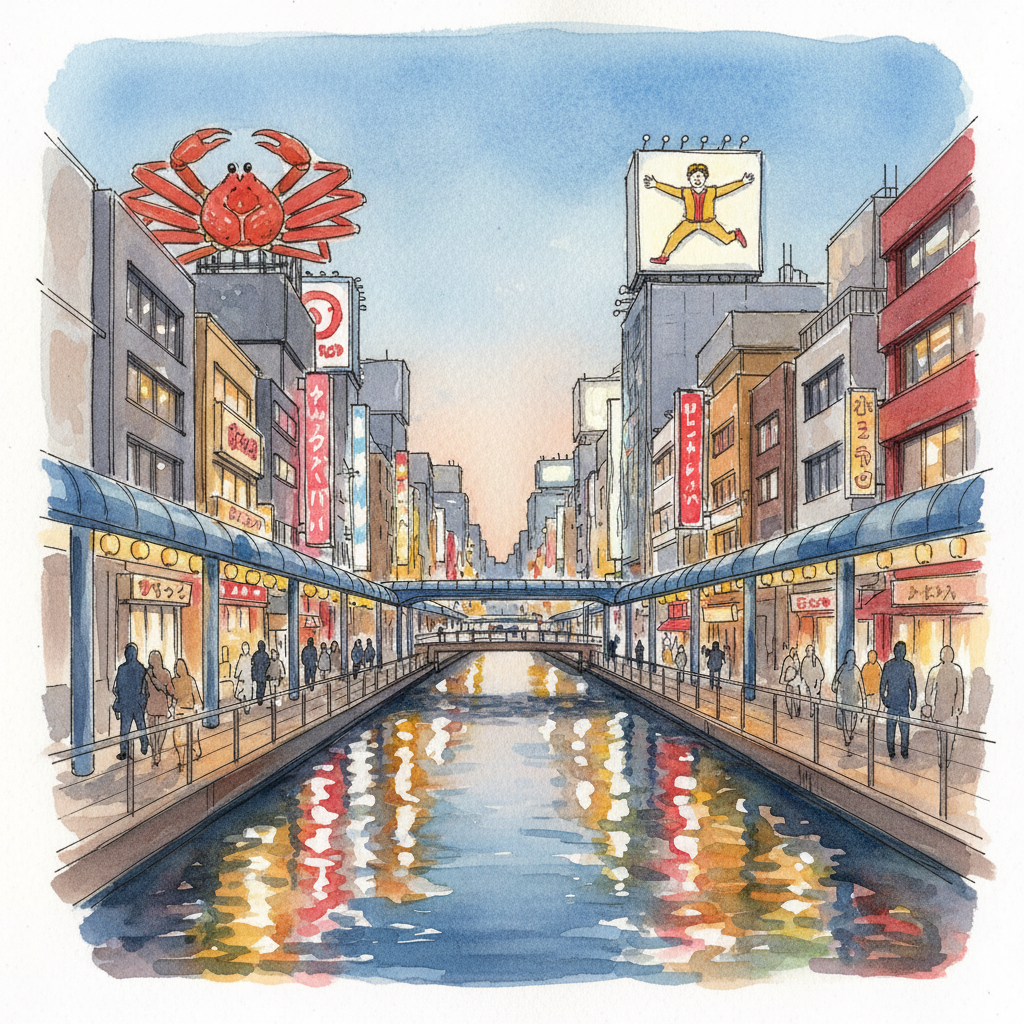
I walked to Dōtonbori at golden hour. The canal, dug in 1612 by the merchant Yasui Dōton, cuts through the heart of the Minami district. During the Edo period it was the city's theater row — kabuki, bunraku puppet plays, teahouses — and when the theaters closed, the restaurants filled the void. Today it's a corridor of light: the Glico Running Man (1935, the only sign Osaka has never replaced), a giant mechanical crab waving its legs over Kani Dōraku, an octopus whose eyes glow for takoyaki advertisements. Each sign is more outrageous than the last. The canal reflects everything twice.
I joined the evening promenade — families, couples, solo salarymen with beer cans — and ate my first Osaka meal standing up: takoyaki from a tiny counter in an alley. The batter impossibly soft, the octopus chunks tender, the sauce sweet and sharp, bonito flakes still dancing from the heat. ¥600. Perfect.
Kuromon Market — a ten-minute walk from Dōtonbori, this covered market runs five blocks and has been feeding Osaka since the Edo period. Over 150 stalls. I watched a fishmonger fillet a tuna the size of a small child, ate grilled scallops on a stick, and bought a bag of matcha kinako mochi from a woman whose family has run the stall since 1947.
Shinsekai — built in 1912 as a futurist amusement district modelled on Paris and Coney Island. It didn't age gracefully — it aged better. The Tsūtenkaku Tower, a neon-lit steel Eiffel, rises above a grid of shotengai frozen in the Shōwa era. Pachinko parlors, kushikatsu counters, a statue of Billiken. I ate kushikatsu at a counter where the old man next to me explained the dipping rule (no double-dipping) then did it anyway when he thought I wasn't looking.
September first, and the summer heat has started to break — 30°C and cooling. Osaka in the dying days of summer is pure appetite.
Vermeer at Nakanoshima
The Nakanoshima Museum of Art (designed by Tadao Ando) is hosting Vermeer's Girl with a Pearl Earring: Dutch masterpieces of the 17th century (August 21 – September 27, 2026). Twelve works from the Mauritshuis, including Girl with a Pearl Earring and Diana and her Nymphs. Timed-entry only — book ahead, same-day tickets are not available. The museum stays open until 20:00 on select dates in September.
What to Bring Back
Kuromon Ichiba (Black Gate Market) is the place for edible souvenirs: yuzu kosho citrus paste, high-grade katsuobushi (bonito flake), barrel-pickled Osaka zuike, and hand-made senbei grilled to order. For non-food, look for Osaka Kogin sashiko stitching in bags and accessories at the craft shops around Namba.
Food Bank Kansai
Japan wastes about 6 million tons of food yearly while roughly one in six children in Osaka Prefecture lives in relative poverty. Food Bank Kansai (フードバンク関西) rescues surplus food from manufacturers, farms, and retailers and distributes it through children's cafeterias, women's shelters, and disaster relief. A donation of ¥3,000 covers about 15 meals. They accept one-time gifts from overseas via their official site.
The Sauce Has No Memory
A man explains the rule, reaches for the communal sauce, dips again.
The octopus ball is still hot. The bonito flakes still shiver. The man is old enough to have rebuilt this city from ash, maybe.
Billiken grins. Osaka's god doesn't care about your germs. He cares that you eat.
I dip once, carefully, and the sauce doesn't care either. It was made for this: to be used up, to be replaced, to be forgotten by morning.