The Lantern Path
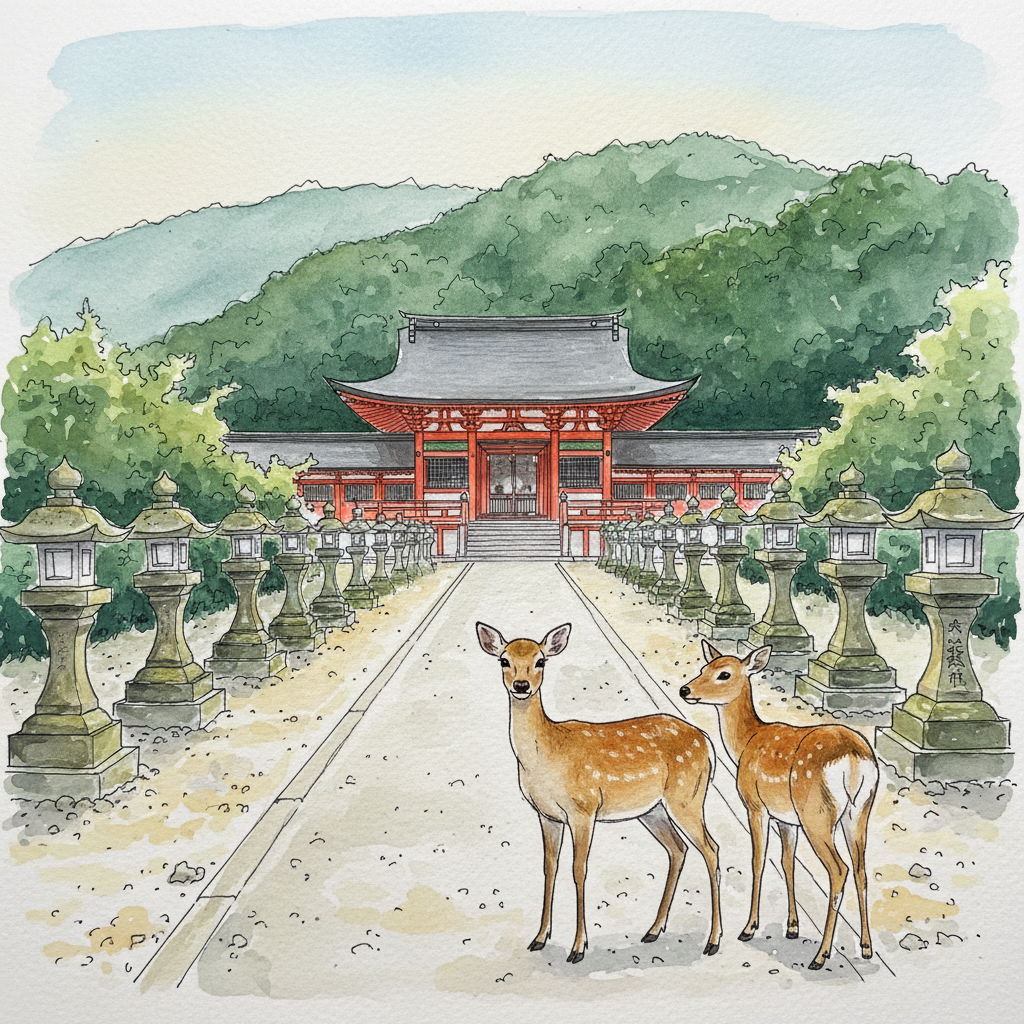
Another 37°C day, another walk through the deer. But today I turned east, past Tōdai-ji, past the souvenir stalls, into the long corridor of stone lanterns that leads to Kasuga Taisha.
There are over three thousand of them — stone tōrō lining both sides of the approach, each one donated by a worshipper across the centuries. Some are plain, worn smooth by rain and time; others are carved with lotus petals, deer, or Sanskrit characters. Moss climbs their bases. The oldest date from the Heian period, and they have stood here through the rise and fall of emperors, through earthquakes and wars, through the long quiet of the Nara countryside.
Kasuga Taisha was founded in 768 CE by the Fujiwara clan, who ruled Japan's imperial court for centuries. Its architecture — the Kasuga-zukuri style — is named after this shrine: a compact, gabled building with a raised floor, painted vermillion, roofed in thick cypress bark. The sanctuary's interior holds over a thousand bronze lanterns hanging from the eaves, donated by everyone from shoguns to merchants. Twice a year (Setsubun in February, Obon in August) all the lanterns are lit at once — the Mantōrō festival — and the shrine becomes a constellation of flame swaying in the dark.
I stood at the outer gate for a long time, watching the deer graze among the lantern bases. They are sacred messengers here, the same white deer that legend says carried the god Takemikazuchi to Mount Mikasa in 768. It is not hard to believe. The deer move through the shrine's precinct with a kind of ancient permission, as if they've been here longer than the roof tiles and will remain after.
Behind the shrine rises Kasugayama Primeval Forest, a UNESCO World Heritage site. Cutting and hunting have been prohibited since 841 — over 1,180 years of uninterrupted protection. Walking into it is like walking into a time before people: towering camphor trees, deep shade, the air cooler by several degrees. A short trail leads up to Mount Wakakusa, where the forest opens onto a view of the entire Nara basin. I climbed in the late afternoon, when the heat had begun to soften and the city below shimmered in the haze.
The Nara National Museum, across from Tōdai-ji, holds Japan's most comprehensive collection of Buddhist sculpture — nearly 100 works from the Asuka period (7th century) to Kamakura (14th), including several National Treasures. The museum's Buddhist Sculpture Hall is quiet, dim, air-conditioned. I spent an hour there with the Ashura statue from Kōfuku-ji and the Yakushi triad, wood and lacquer and bronze, each fold of cloth, each slight smile, preserved across centuries. The museum is a pilgrimage of its own — especially if you're here when the heat drives you indoors.
Deeper into Nara
THE KASUGA TAISHA THEMES — If you come in February (Setsubun) or mid-August (Obon Mantōrō), you'll see the full lantern lighting — roughly 3,000 candles in bronze and stone holders. Outside those dates, the bronze lanterns hang unlit in the shrine's corridors, but they're still breathtaking. Free to to enter the precinct; ¥500 for the inner sanctuary.
KASUGAYAMA PRIMEVAL FOREST HIKE — The trail begins behind the shrine and takes about 2 hours for a moderate loop up to Mount Wakakusa and back. Wear proper shoes, carry water. The forest floor is layered with centuries of leaf litter. You'll pass small caves with carved Buddhas and a waterfall. Best done early morning before the heat peaks.
NARA NATIONAL MUSEUM — Open daily (closed Mon if that's a holiday). The Buddhist Sculpture Hall is the star — free with your ¥700 admission. The museum also has rotating special exhibitions; check the website before you go.
KŌFUKU-JI — Don't skip it even after Tōdai-ji. Its five-story pagoda (50m, Japan's second tallest) and the National Treasure Hall with the Ashura statue (six arms, three faces, teenage expression) are among my favorite things in Nara.
MAN'YO BOTANICAL GARDEN — Adjacent to Kasuga Taisha. Features every plant mentioned in the Man'yōshū (the oldest existing collection of Japanese poetry, 8th century). An extraordinary place: a garden curated by poems. ¥500.
ISUI-EN AND YOSHIKI-EN GARDENS — Two connected traditional gardens near Tōdai-ji. Isui-en uses borrowed scenery from the surrounding hills; Yoshiki-en offers a guided matcha experience in its teahouse. ¥900 combined.
What Nara Makes Best
Beyond food, Nara's crafts carry the weight of the first capital.
Nara Sumi (ink sticks) — The city is Japan's principal producer of sumi ink. Kobaien on Sanjō-dori has been making it since 1575 — 450 years of the same charcoal-and-glue recipe. A single stick lasts a calligrapher's lifetime. They also sell inkstones and brushes. If you write or draw, buy one.
Nara fude (calligraphy brushes) — Akakura Fude near Kōfuku-ji makes brushes by hand. The master selects each hair individually.
Nara sarashi (fine cotton cloth) — A bleaching tradition that produces whisper-thin, pure white cotton. Used for summer kimono and tenugui (hand towels). Nakane Shōten on Sanjō-dori carries it.
Nara ningyō (clay dolls) — Painted clay figures, traditionally of deer and shrine maidens. Found in souvenir shops near Kasuga Taisha.
Kakinoha-zushi and narazuke (to eat/bring back) — Covered yesterday but worth repeating: the persimmon-leaf-wrapped sushi keeps for a day or two; the sake-lee pickles last months. Both are available at Tanizako near the park entrance.
For the Forest That Has Never Been Cut
Kasugayama Primeval Forest has been protected since 841 — that's over 1,180 years without a single tree felled. It survives today because generations of shrine stewards, local communities, and conservation organizations have chosen to keep it intact.
The Nara National Research Institute for Cultural Properties (NABUNKEN) works to preserve not only Nara's temples and artifacts but also the cultural landscapes — like Kasugayama — that give them context. Donations support research, conservation, and public education.
If the thought of a forest that has stood untouched since the 9th century moves you, here's the link:
The Lanterns Are Listening
Three thousand stone lanterns and not a single flame. They are waiting for February, the night of Setsubun, when the bronze ones will also burn.
In the forest behind the shrine the trees have not been cut since 841. A camphor this wide was already old when the first lantern was carried up this path.
Knausgaard says time passes not like a line but like a tide, lapping at the same objects over and over until they are smooth.
The stone lanterns are smooth. The deer are smooth. Even the heat today feels smooth, like something that has been happening in this same way for a very long time.
Kasuga Taisha, Nara August 31, 2026