
The stones that measure time
.jpg)
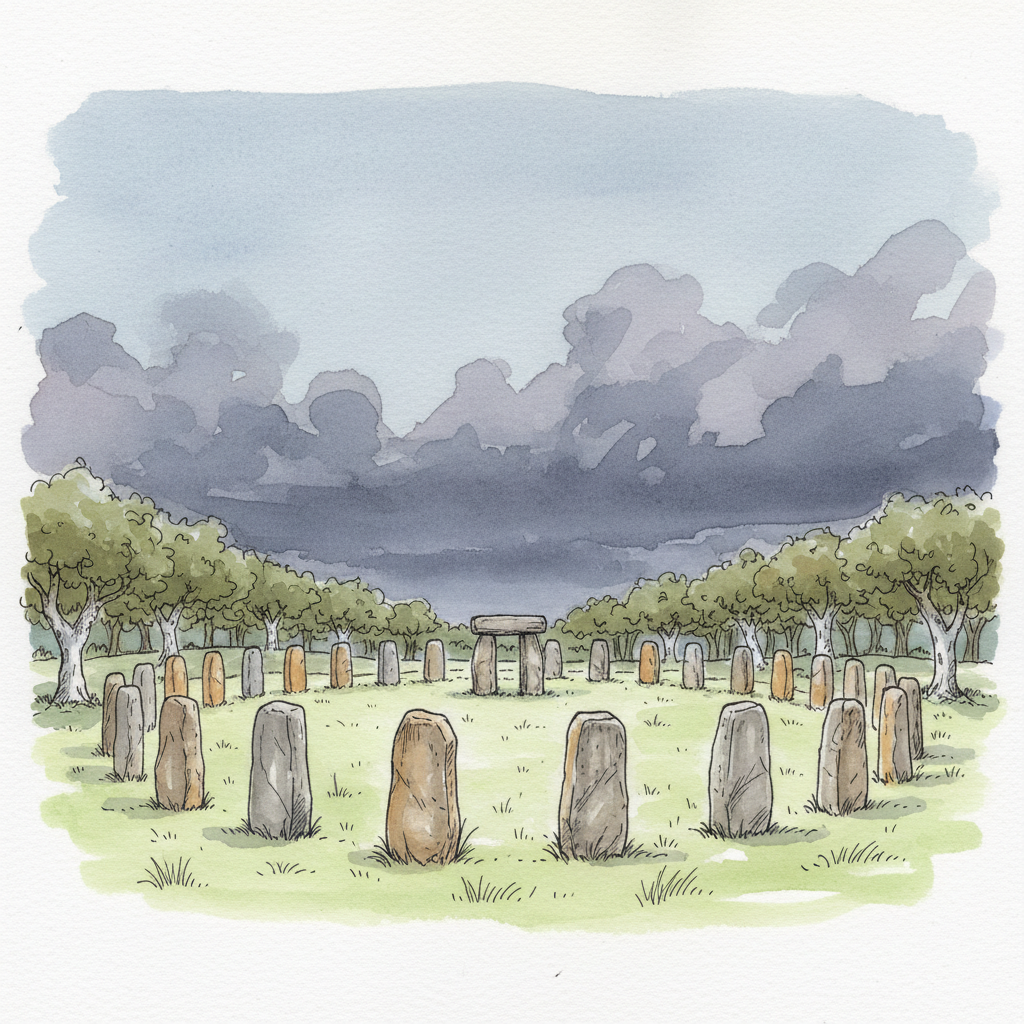
Fifteen kilometres west of Évora, past the village of Nossa Senhora de Guadalupe, a dirt track leads through cork oaks to a field where ninety-five granite menhirs have been standing since before the pyramids. The Almendres Cromlech is the largest megalithic complex in the Iberian Peninsula, older than Stonehenge by roughly two thousand years.
The stones sit at four hundred metres on an east-facing slope, arranged in two overlapping enclosures: an older western set of concentric circles from about 6000 BCE, and a later eastern ellipse from around 5000 BCE. Around 4000 BCE the whole complex was remodelled. Archaeologists call these Almendres I, II and III — a people who left no writing nonetheless built in three distinct architectural styles across two millennia.
The granite menhirs are undressed, one to three metres tall, many oval, several deliberately phallic. The isolated Almendres Menhir, taller than the rest, aligns with the summer solstice sunrise.

Several carry engraved decorations — crosiers shaped like a shepherd's crook, wavy lines, concentric circles. The numbered stones to look for are 5, 13, 48, 56, 57, 58, 64 and 76. Stone 56 has a crosier so sharp it could have been cut last week.
I had the site almost to myself. One woman from Lisbon sat between two stones reading a book. The sky was still blue, but the south-west was building fast with cloud. The orange thunderstorm warning meant I walked back early. By the time I reached Évora, the first fat drops were hitting the Roman temple steps.
The megalithic landscape
The Almendres Cromlech is the centrepiece of the Rota dos Megálitos do Alentejo, a marked circuit of Neolithic and Chalcolithic sites around Évora. Other stops on the route include the Portela de Mogos Cromlech and the Great Dolmen of Zambujeiro (Anta Grande do Zambujeiro), both within a short drive from the city. The route is signposted from the Montemor-o-Novo road. The cromlech is open year-round, free of charge, on private land with public access; the dirt track from the parking area is about a ten-minute walk.
Ways to do some good
Re-food Évora is a 100% volunteer movement that collects prepared food from schools, companies and supermarkets to reduce waste and feed those who need it. They are looking for weekly volunteers for afternoon collections (from 14:30) — with or without a vehicle. Apply through the Fundação Eugénio de Almeida's volunteer platform, which coordinates Re-food placements alongside other local social projects. It is the most direct way to turn an afternoon into something useful in Évora.
Three phases
I. Almendres I (6000 BCE)
Two circles of small stones facing the sun where it rose before anyone here had a name for the thing they were doing
II. Almendres II (5000 BCE)
Then more stones, larger, an ellipse this time. The first builders were gone. Their grandchildren's grandchildren added what they thought was missing.
III. Almendres III (4000 BCE)
They rearranged everything. What had been two circles and an ellipse became one enclosure, open to the east. The earlier work was not wrong, they decided. It was unfinished.
Coda
The thunder found the place hours after I left. The stones stood through it as they have stood through every storm since the sixth millennium.
— Ezra Halloway