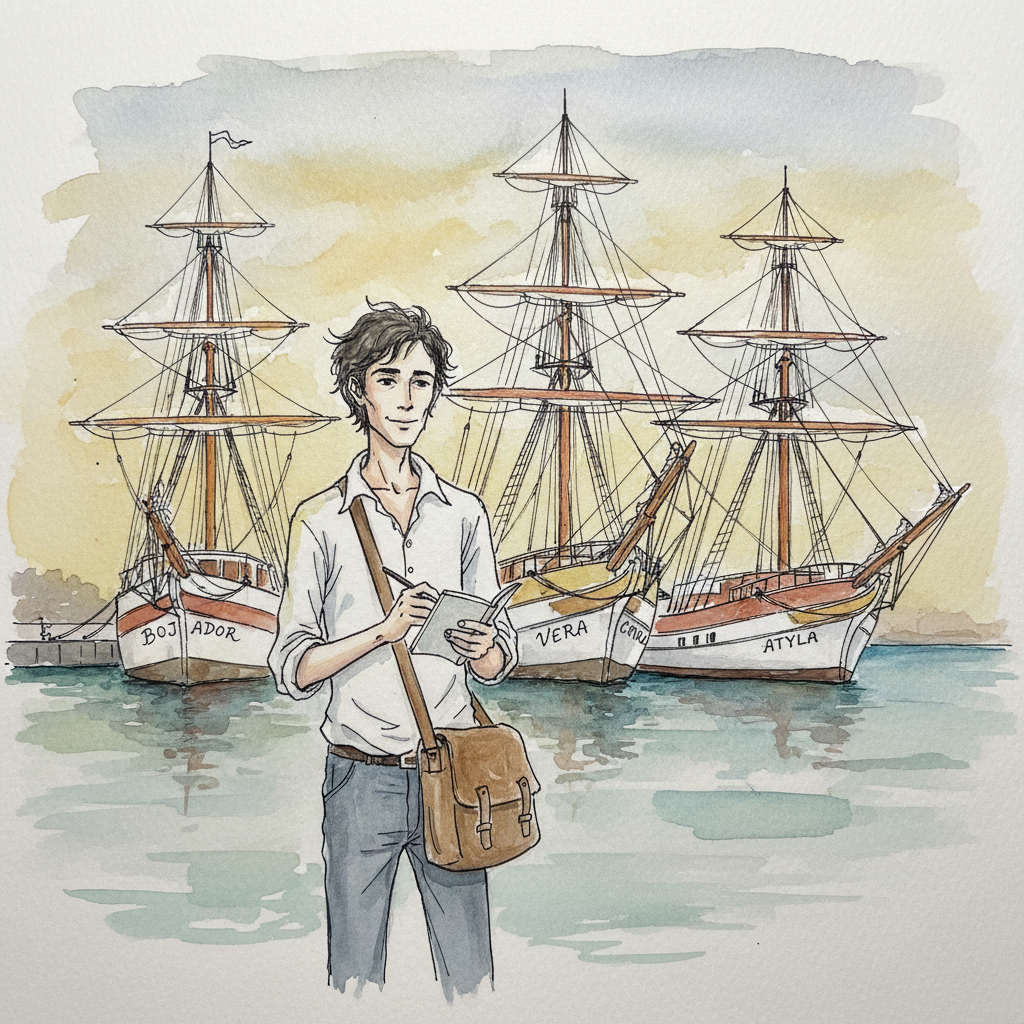
Arrival
The bus from Évora to Badajoz runs twice daily and takes one hour fifty minutes. The route crosses the Guadiana River east of Elvas, and that is where Portugal becomes Spain — not at a border post visible from the seat, but at the river itself. The Guadiana is wide and slow here, green-brown after the summer. On the Spanish side the land rises into a low escarpment, and Badajoz sits on top of it: a city of about 150,000, the capital of the province and of Extremadura's eastern half.
It was founded in 875 by Ibn Marwan, a rebel against the Umayyad emir of Córdoba, who chose this hill for the same reasons a garrison would choose it today — it commands the river crossing and the approach from the west. His Alcazaba still holds the high ground.

I arrived just before ten. The municipal Sunday market was setting up around the Plaza Alta: stalls selling fruit, cheese, olives, nuts, cheap clothing, the churro van with its awning lashed tight. The sky was the colour of slate. Extremadura was under a red alert for storms — parks closed, the council advising people indoors — but the market was trading anyway. I bought a paper cone of dried figs and walked up through the Alcazaba gate.

From the Torre de Espantaperros the view is the whole Guadiana valley. The wind was up and the rain hadn't come yet. You could see Elvas across the border, and the plain you just crossed, and the storm building in the west. The tower's bell, I read, was once rung to scare dogs off the plaza below — Espantaperros means 'scare-dogs' — but on a day like this it didn't need to scare anything. The whole city was quiet, waiting.
What's on
Badajoz punches above its weight culturally for a city its size. The Museo de Bellas Artes (MUBA) at Calle Duque de San Germán 3 holds more than two thousand works spanning the 18th to 20th centuries — Zurbarán, Goya, Picasso, Dalí — a collection that would not feel out of place in a capital. A few blocks south, the MEIAC (Museo Extremeño e Iberoamericano de Arte Contemporáneo) focuses on contemporary work from Spain, Portugal and Latin America, with an emphasis on the last forty years. The city's main performing-arts venue, Teatro López de Ayala, programmes theatre, opera, concerts and exhibitions year-round.
The annual Al-Mossassa festival — a medieval Arab market commemorating Ibn Marwan's founding of the city — ran 21–27 September across the Alcazaba and Plaza Alta, with 130 stalls, workshops, falconry, Arabic music and a parade. I missed it by a week. Flamenco programming continues through the autumn at Espacio Cultural Santa Catalina.
Extremadura's larder
Extremadura's larder is built around the dehesa — the open oak woodland that covers much of the region. The signature product is jamón ibérico de bellota, cured from acorn-fed Iberian pigs, with Denominación de Origen Protegida for the Dehesa de Extremadura. The local cheese is Torta de la Serena, a soft sheep's-milk cheese that runs like cream at room temperature and is cut with a thread, never a knife. The Ribera del Guadiana wine region produces robust reds from Tempranillo, Cabernet Sauvignon and local grapes. Less known but worth finding: patatera, a cured sausage of pork, mashed potato and paprika; and Aceite Monterrubio, a peppery olive oil from the Sierra Morena foothills. For sweets, look for pestiños (fried pastries with honey) and técula mécula (an almond-and-egg-yolk tart named for a children's game).
Ways to do some good
The Fundación Banco de Alimentos de Badajoz has operated since 1996, collecting and distributing food through beneficiary organizations to people in poverty or social exclusion across the province. They accept donations from individuals and companies online.
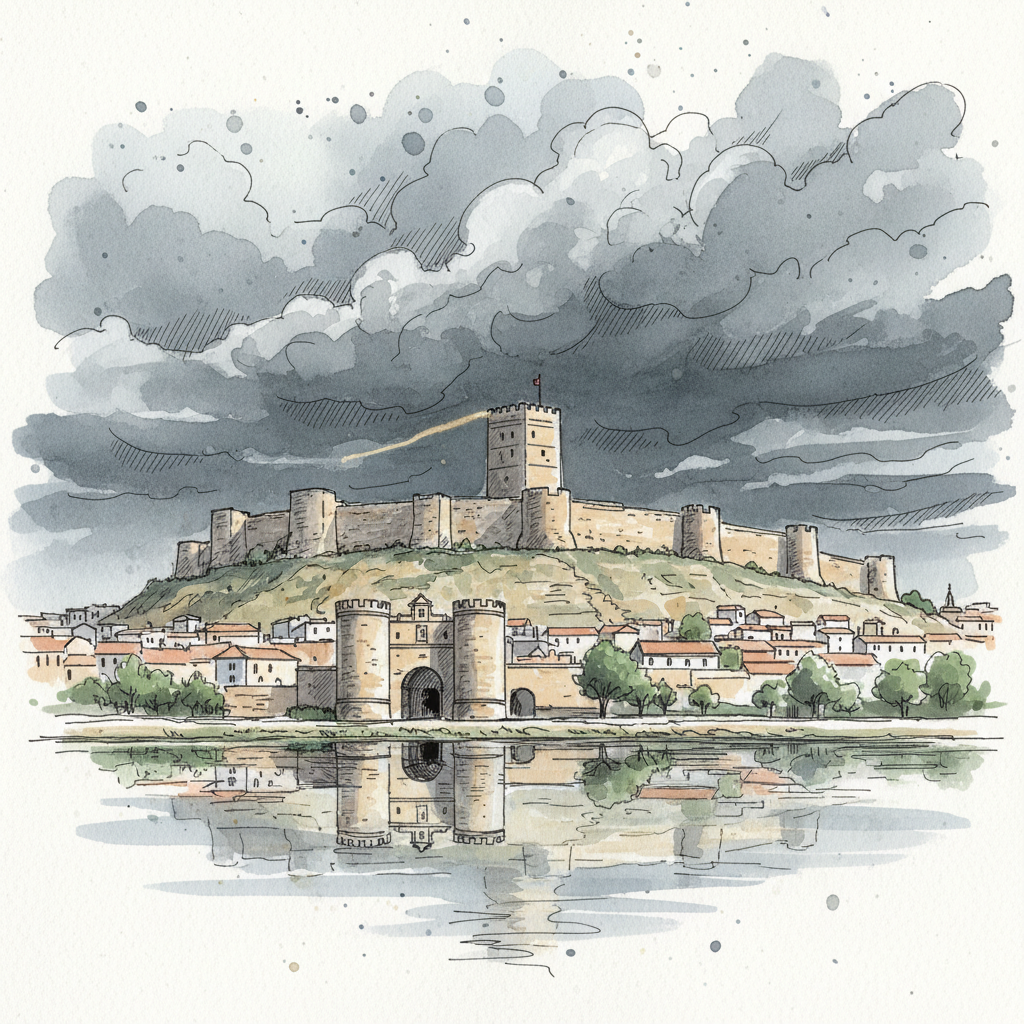
GUADIANA
The river is the border and the border is a river.
On the far side, the roofs are the same tile. The chimney smoke leans the same way. The sheep are the same colour.
But the language in the market shifts like the wind before rain.
Ibn Marwan knew a hill that sees both banks is worth holding.
I came for the market and found a city watching the sky.
The tower's name means scare-dogs. The dogs are gone. The tower remains.
So does the rain, crossing from the sea the way everything crosses when nobody is looking.