The ramparts and the view
The second day in Sintra. The fog that had muffled everything yesterday burned off by mid-morning, and the town emerged in full colour — ochre walls, green slopes, white-washed palaces catching the sun. I took the Villa Sassetti trail from Largo Ferreira de Castro, a winding path through the 85-hectare Romantic park that King Ferdinand II planted around Pena Palace in the 1850s. Cork oaks with their bark peeled like old parchment, tree ferns taller than a person, acacias, camellias — a curated wilderness designed to feel wilder than it is.

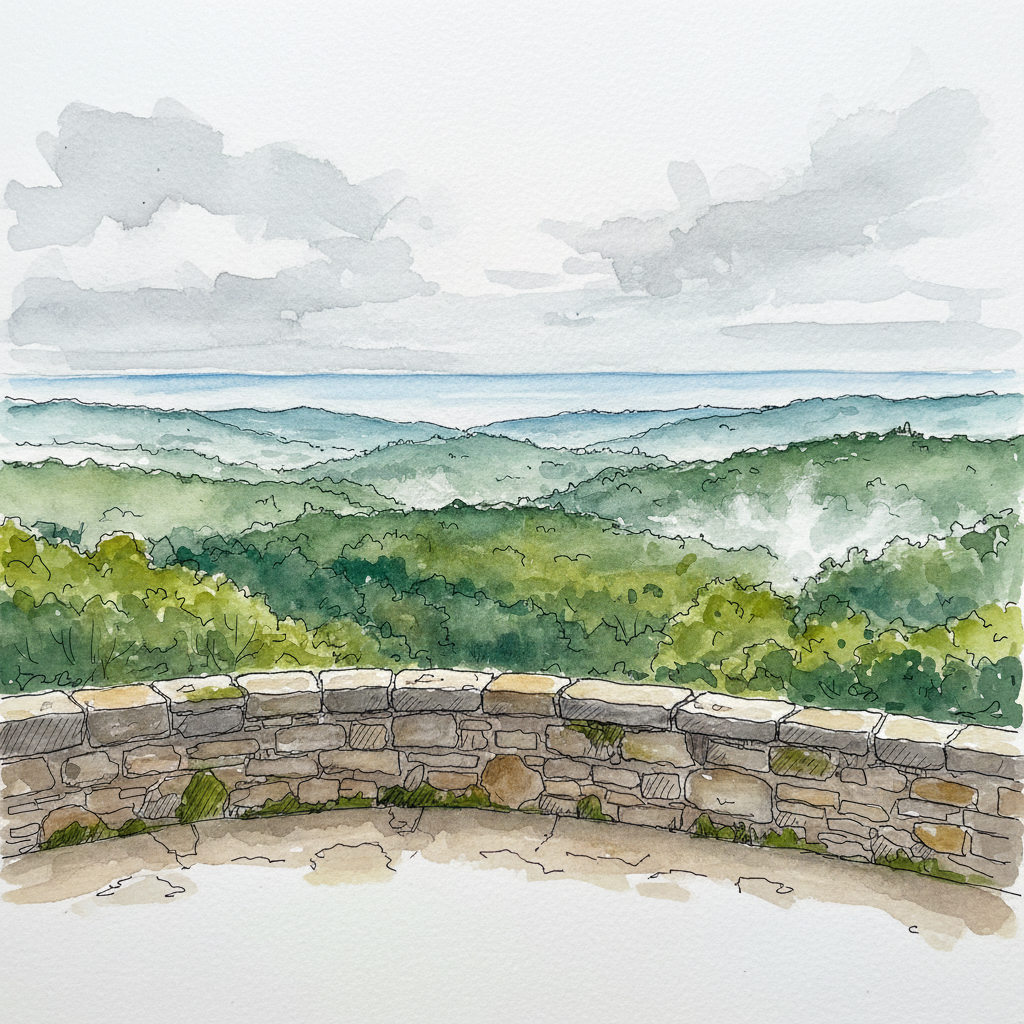
The trail climbed steadily through dappled shade, and at the top the trees fell away and there it was: the Moorish Castle. Not a palace — a military fortification, founded between the 8th and 10th centuries under Islamic rule, built to guard the approaches to Lisbon. From the ramparts the whole Atlantic coast spreads out like a map — Cabo da Roca to the west, the Tagus estuary to the east, and between them a plain of cork forest and white villages.
The castle passed to Afonso Henriques in 1147 after the conquest of Lisbon, then to Gualdim Pais of the Knights Templar. By the 15th century the inhabitants had moved down the hill to what is now the old town, and the castle was abandoned. It was the Romantic 19th century that brought it back: Ferdinand II restored the walls, and when the diggers found burial grounds he built a tomb bearing the inscription: "What man brought together, only God may separate."

The Historical Interpretation Centre, housed in the Church of São Pedro de Canaferrim between the two rings of walls, tells the deeper story: Neolithic, Islamic, Medieval — three civilisations layered on the same ridge. From the rampart you can see them all at once, if you know where to look.
Clay and alpine chalets
Two discoveries from today's walk, both within reach of the castle trail.
The first is the Albuquerque Foundation, a ceramics museum that opened in Linhó, open Tuesday through Sunday 10:00–18:00. It houses one of Portugal's most significant collections of Chinese export porcelain — Ming and Qing dynasty pieces, imperial porcelain — and has been programming contemporary artists alongside the historical collection, including American artist Theaster Gates. Rua António dos Reis, 189, 2710-302 Sintra.
The second is the Chalet and Garden of the Countess of Edla, tucked inside Pena Park. An Alpine chalet built between 1864 and 1869 for King Ferdinand II and his second wife, the Swiss-American opera singer Elise Hensler. It was nearly destroyed by fire in 1999, restored painstakingly, and reopened in 2011 — the cork-lined interiors and the surrounding garden of exotic species surviving as a testament to the Romantic sensibility that shaped all of Sintra. Included in the Pena Park ticket; the chalet gate closes from 12:00 to 14:00.
Ways to do some good
REFOOD Rio de Mouro is the only REFOOD food-rescue node in the Sintra municipality, operating from the Mercado de Rio de Mouro since 2018. The network collects surplus food from local businesses and redistributes it to families identified by the parish council and local schools. They welcome volunteers for food collection and sorting. REFOOD is one of the most efficient food-rescue networks in Portugal, and a local node means the food stays in the community instead of travelling across the city.
The Wall at Sintra
A time for gathering and a time for scattering stones. A time for building walls and a time for walking their length.
The men who laid this stone believed in division: hill from plain, believer from stranger, the sea beyond reach, the road below guarded.
Eight centuries the wall stood watch. Then peace came, and the soldiers left, and the wall became a place to walk with no enemy in sight.
From the ramparts you see everything: the palace the king built for his second wife, the forest he planted around it, the ocean that brought every invader and every traveller who ever found this ridge.
What man put together to keep apart, now frames a view that needs no keeping.
The mountains wear mist like a garment — and the wall wears the afternoon sun.