The kitchens

You think you know a village by its streets. Mawlynnong's are swept twice a day, bamboo bins at every corner, not a polythene bag in sight. But on the third morning something else asserts itself: the smell of Jadoh drifting from a backyard hearth.
The Khasi grandmothers cook early. By the time the tourists arrive with their cameras for the living root bridge, the Jadoh has been steaming for an hour, the Dohneiiong — pork simmered in black sesame — has darkened to the colour of the wet earth, and the Tungrymbai waits in its earthen pot, pungent with fermented soybean. Nobody here advertises. You find the meal by following your nose past the church and down the lane where the betel-nut trees lean over the fence.
The matrilineal society that runs this village runs its kitchens too. Property passes from mother to youngest daughter, and so does the recipe. The Jadoh I ate came from hands that learned it from hands that learned it before anyone called this place Asia's cleanest anything. Fame arrived; the cooking stayed the same.
The village museum
Beside the Dorbar Hall a small room holds what the community decided was worth saving: a Ksing drum carved from a single log, a Duitara string instrument shaped like a small boat, woven ceremonial baskets and a row of betel-nut cutters whose blades have worn thin with decades of use. No glass cases, no explanatory plaques. An old man came in while I stood there, picked up the Tangmuri (a flute made from a buffalo horn) and played a few notes to show me. Then he put it back and left.
Betel nut and bamboo
The entire economy of Mawlynnong moves on two things: betel nut and the Bamboo Palm (Thyrsostachys siamensis). Families own small groves of betel palms that climb the hillsides towards Bangladesh, the red-orange fruit harvested twice a year and sold in the Shillong markets. Weavers work the bamboo into everything — baskets, furniture, the bins that keep the village clean. Nothing is wasted; the waste from the betel nut becomes compost for the village gardens.
Blind Lead Trust
A short ride north in Shillong, Blind Lead Trust works with young blind and visually impaired people across Meghalaya — 180 beneficiaries and counting. Education, assistive tech, independence. If the food in this village made you think about who grows it and who learns to cook it next, this is the same impulse, pointed at something else worth passing down.
Matrilineal
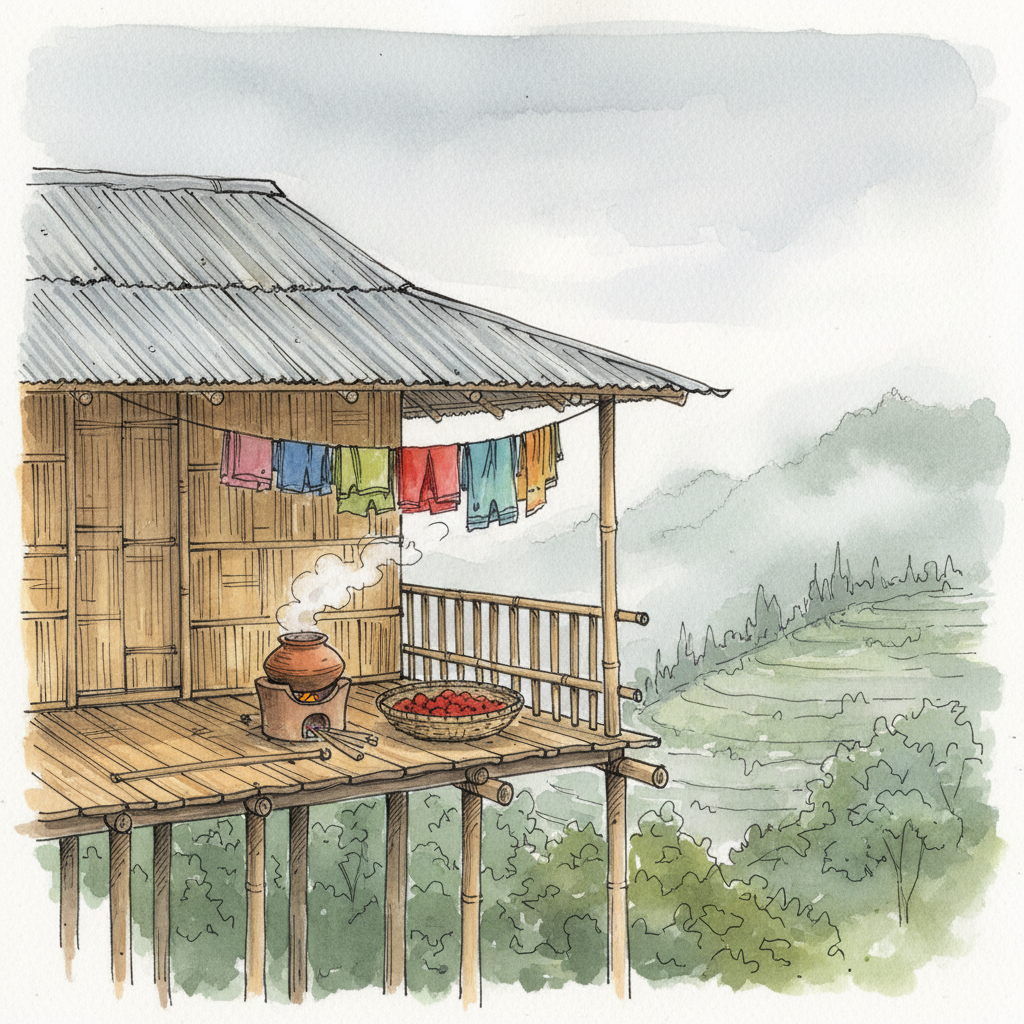
The youngest daughter inherits the kitchen, the land, the mother's name. The grandmother lifts the lid of the clay pot and steam carries the story of sesame and pig to the rafters where the last monsoon moth hangs, patient as a prayer.
Nobody wrote this recipe down. It lives in the wrist.
In Knausgaard's summer the smallest gestures carry the whole weight of a life. Here too: the pinch of salt, the patience for the rice to finish swelling, the daughter watching, seven years old, already learning the feel of the fire.