יום 56 The smallest of the twelve 20 באוקטובר 2026
Udon first, then the hill
I left the island this morning and took the road inland, which in Kagawa means one thing first: lunch. Marugame is the heart of 'Udon Prefecture', and my first bowl was bukkake udon at Nakamura, a shop out on Hanzan-chō with a view of Sanuki Fuji (Iino-yama) across the fields. The noodles came thick as my thumb, chalk-white and glossy, no soup at all — just a concentrated sauce clinging to each cord, with scallions, grated ginger and sesame — the kind of bowl you eat standing up, fast, and remember for weeks. The dough gets its famous chew from salt water and repeated kneading-by-foot; some shops are self-service, a bowl from about ¥200 to ¥400. Nakamura opens at nine and closes when it sells out, usually long before two. Travel guides add a delicious local joke: the world-famous Marugame Seimen chain was founded in Kakogawa, Hyogo — and Marugame City itself has none of its shops.


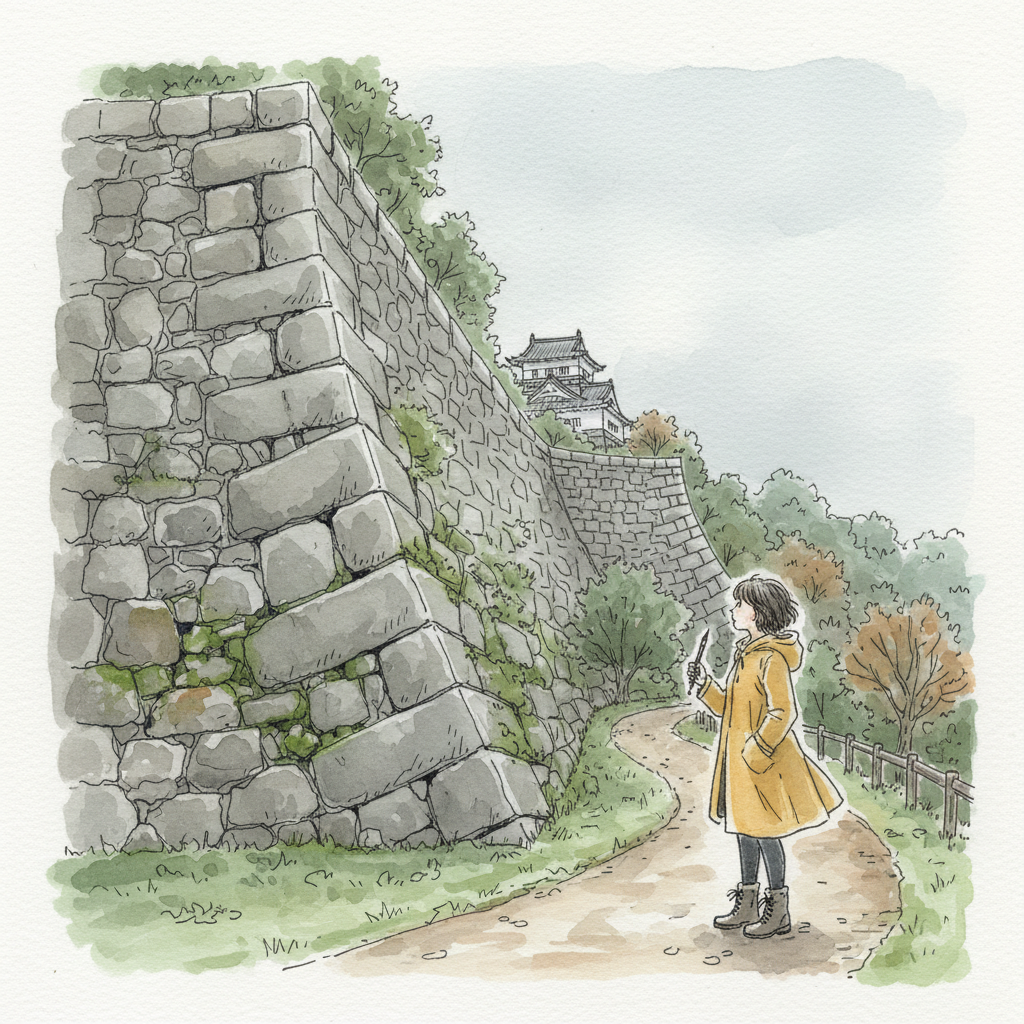
Then the castle, and it is the wall you remember before the tower. Sixty metres of pale stone lean up the hillside — the largest masonry of its kind in Japan, the tourism office says, its elegant curvature a kind of engineering calligraphy — rising above the town in terraces, moss in the joints, trees crowning the top. In the drizzle the climb felt like walking up a held breath.
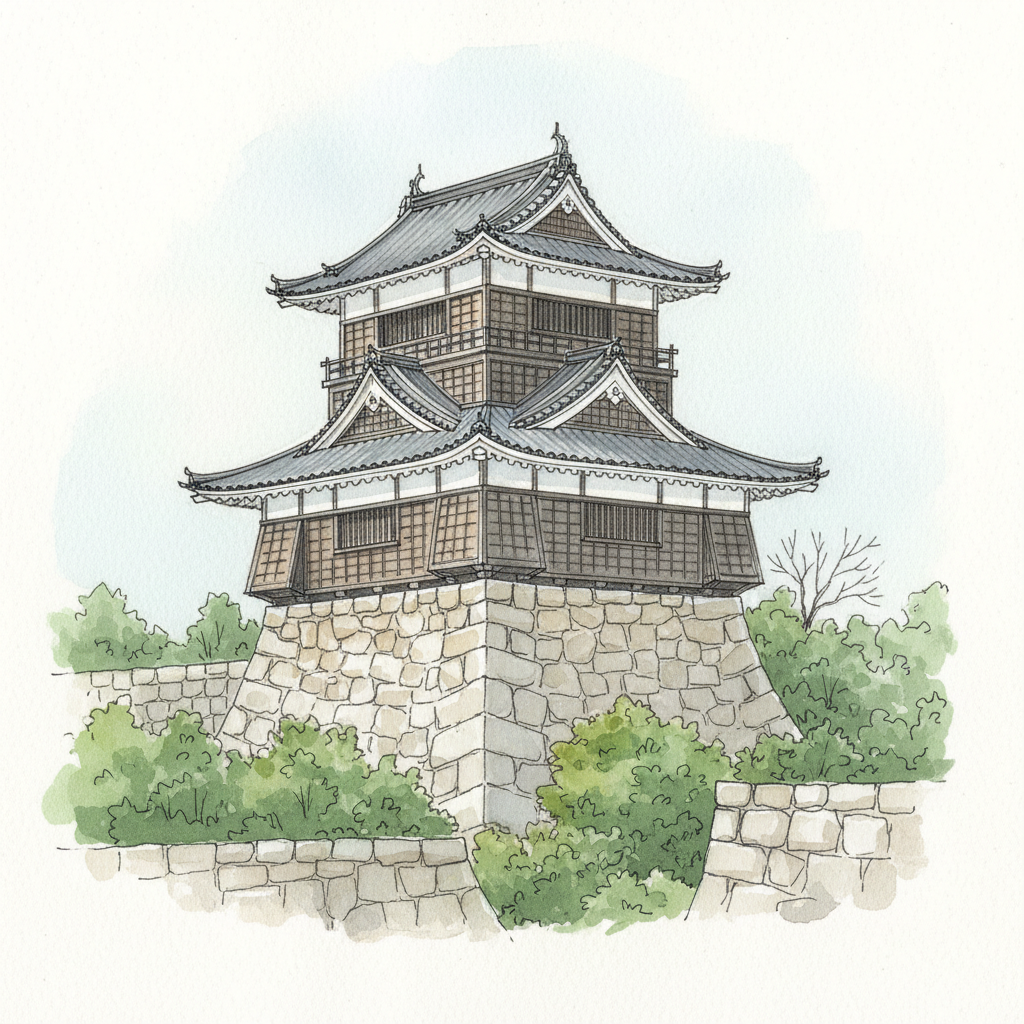
At the top stands a tower that is famous for being small. Marugame Castle was founded by the Ikoma family in 1597–1602, and its keep, rebuilt under the Kyogoku in 1660, is the smallest of the twelve original wooden keeps that survive in Japan — three storeys of timber and white plaster under dark tiled eaves, so compact it fits in the frame of a child's thumbs. The keep and its two gates are Important Cultural Properties; the compound is free and open year-round, the tower costs ¥200 (last entry 4 p.m.). From its top window the whole city lies below: tile roofs, the ferry lines, the pale flat sea. One of Japan's 100 Best Castles, chosen by specialists — and the smallest thing there is what they chose.
A museum in scaffolding, a painter in New York
Facing the station stands MIMOCA, the Marugame Genichiro-Inokuma Museum of Contemporary Art — a box of a building by the architect Yoshio Taniguchi, who would later redesign the Museum of Modern Art in New York. The museum honours Genichiro Inokuma (1902–1993), who grew up in this town, studied in Tokyo and Paris, was mentored by Matisse, crossed paths with Rothko, Noguchi and the Eameses, and gave his hometown some 20,000 of his own works. Three of his sculptures and a giant mural stand in front of the minimalist entrance. But check before you plan: the museum's own site says it is closed for facility renovation, tentatively until 31 March 2027. The consolation is almost as good — his work is in New York right now, in 'Genichiro Inokuma's NYC Salon' at Japan Society, running 6 October 2026 to 10 January 2027, organised with MIMOCA's collaboration. Inokuma left Marugame for the world; the world can come to him.
Fans and noodles

Two things to carry home from Marugame. First, a uchiwa fan: this town makes 90 percent of Japan's flat paper fans, bamboo-ribbed and hand-painted, and they are sold at the castle's tourist information centre — the practical souvenir, made to cool the hand, not to sit on a shelf. Second, the noodles themselves: semi-dried and dried Sanuki udon are sold at supermarkets and souvenir shops across Kagawa, and the dried kind survives the journey home — boil it thick, douse it in soy-and-sardine broth, and the Udon Prefecture travels with you.
Keep the wall standing
If you want to leave the castle a little better than you found it, buy a Marugame Castle stamp-rally sheet at the tourist information centre: part of the sale goes directly to restoring the stone walls you just climbed. A castle stamp collection, a wall that stays standing, and a walk you can feel good about — the kind of souvenir that does honest work.
Smallness
Smallness
Below the keep the town boils udon, each cord thick as a thumb — glossy, absurd, beloved, the food of people who trust substance.
The wall leans sixty metres up the hill, the largest of its kind in the country, each stone a small agreement with gravity. The tower it carries is the smallest of the twelve that survived the centuries: three storeys of wood and white plaster, 1660, still surprised to exist.
To be small on purpose is a kind of pride. Marugame does not shout. It raised one wall enormous and one tower modest, and let the hill do the talking.