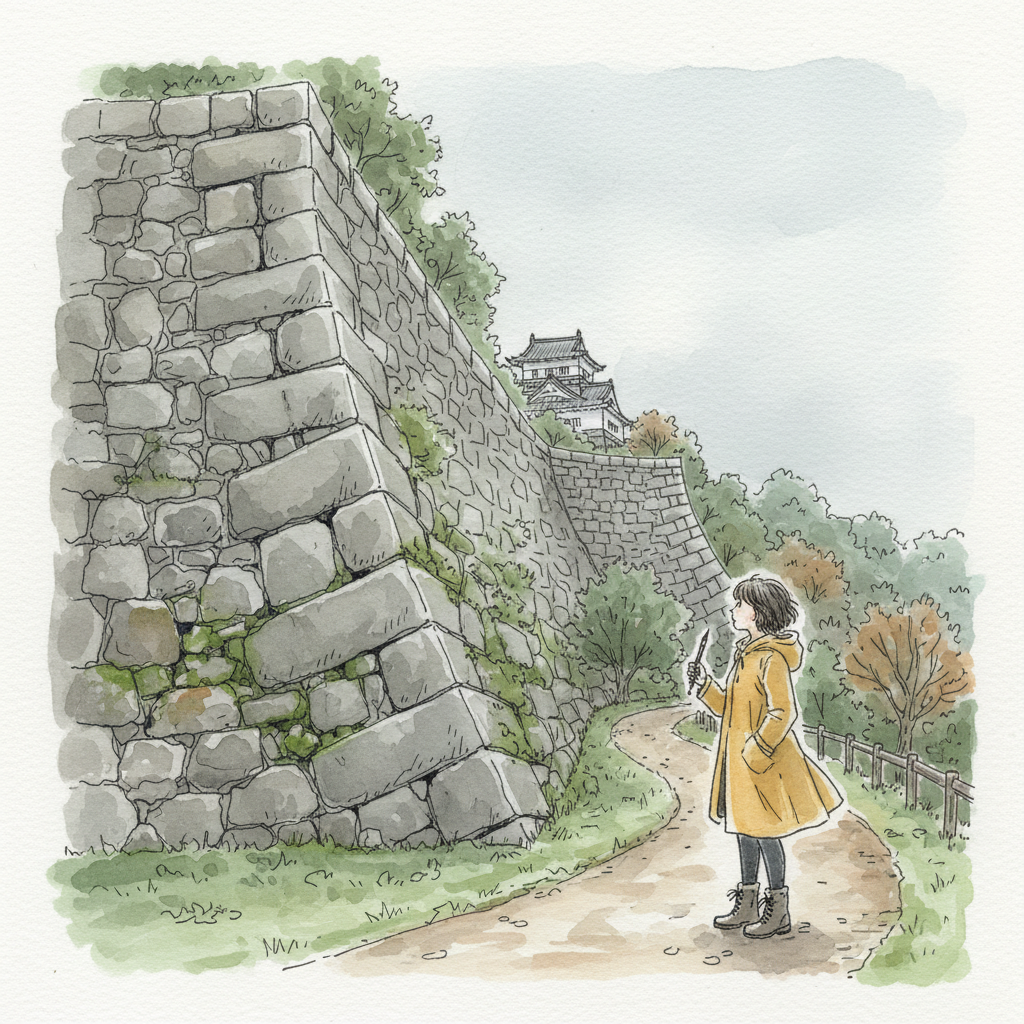
The bus from Miyanoura runs south past the Chichu turn-off, past the Benesse Hill, past the Lee Ufan Museum, until the road stops at a cluster of buildings called Tsutsujiso. Beyond that, only the sea. This is the southern end of Naoshima, and if you come for the art you will probably not come here — the museum ticket is time-stamped, the ferry back waits for nobody, and the day is already too short for what you booked.
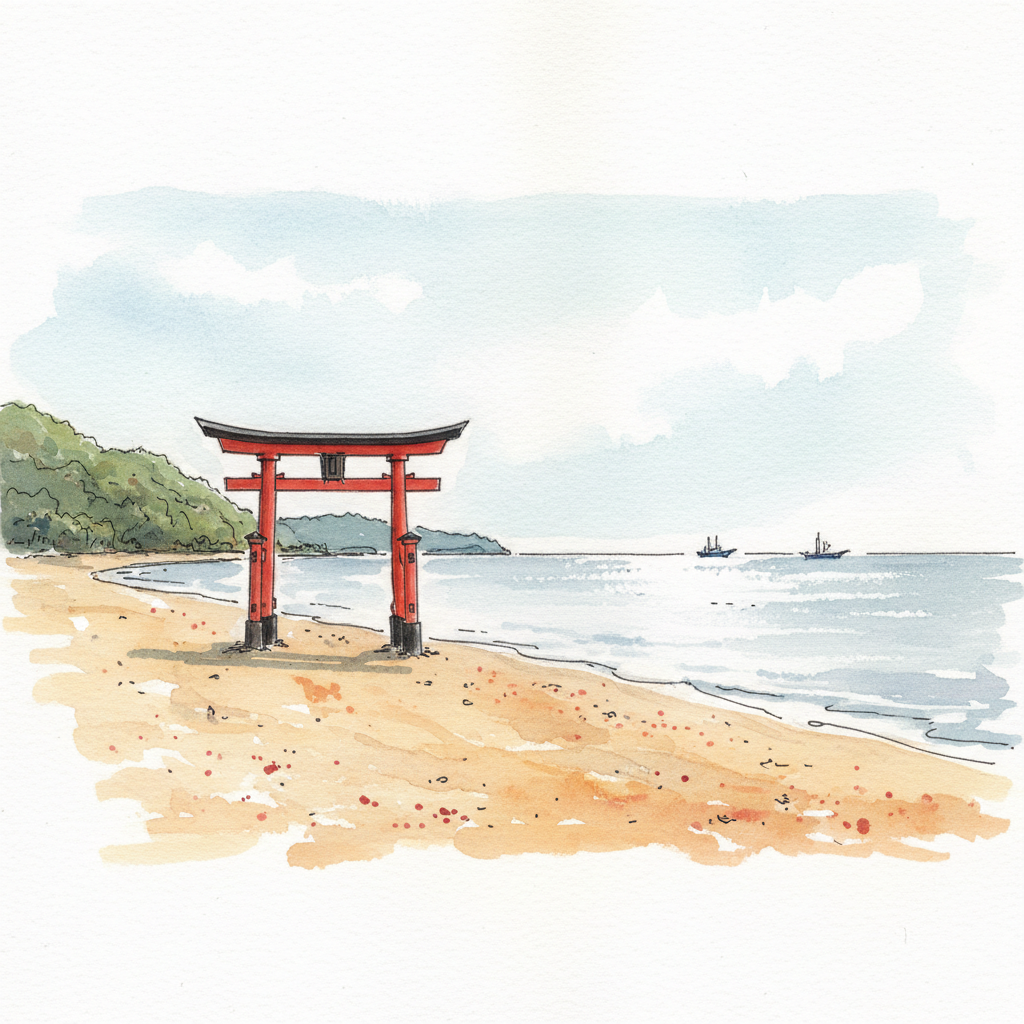
But the beach at Gotanji is the reason the museums went underground. The view. The curve of the coast looking across the Seto Inland Sea toward Shodoshima, the water flat and silver-grey under an autumn sun, a red torii standing on the sand where a Shinto shrine faces the water. Tadao Ando buried Chichu Art Museum into the hillside above this very shoreline so that nothing he built would interrupt this. The museums exist to preserve the view; the view was always already here.

This part of the island remembers what the rest of Naoshima has mostly managed to forget. In the 1960s and 70s, the hills above this beach were bare — stripped of vegetation by the sulfur dioxide drifting from the Mitsubishi smelter on the north side of the island. The copper plant, which has been refining since 1917, released gases that killed the trees, acidified the soil, and turned the island into what one visitor described as a 'moon landscape.' When the wind blew south, it carried the smell across the whole island. The people who lived here stopped talking about the view.
Mitsubishi began a reforestation program in the 1970s, planting trees across the denuded hillsides. The story that the art saved Naoshima is true in one sense — the Benesse project, from the late 1980s onward, gave the island a reason to exist beyond the smokestack — but it is also incomplete. The trees came back before the art did. By the time Tadao Ando drew his first concrete wall on Naoshima, the hills were already green again. The regeneration began with a corporation repairing what it had broken, and only then did an art collector see a canvas worth painting on.
I walk along the sand. A few families sit on towels; nobody swims this late in October. A woman in waders rakes seaweed into a basket. The torii gate stands a few metres out in the shallows, its vermilion lacquer fresh against the faded blue of the sky. I came yesterday for the art. Today I came for what the art was trying not to spoil.

At lunch I walk up to Naoshima Shokudo, the beachside cafeteria that belongs to the Tsutsujiso guesthouse. The menu is short and written in Japanese only, but the lady behind the counter points to the first item and holds up one finger. Shirasu bowl — boiled whitebait from the Inland Sea, piled on rice, with a side of miso soup and pickled daikon. The fish are tiny, barely an inch long, translucent in places, salty and sweet at the same time. I eat looking out at the beach I just walked. The torii gate, the sea, the bowl. The whole meal costs ¥1,100.

Later I walk back through Honmura, the old fishing village that the Art House Project occupies. The art houses are open, but so is the rest of the village — the grocery store, the barber, the post office. An old woman sits on her step watching the tourists walk past her door carrying maps of buildings she remembers as neighbours' houses. A cat sleeps on a shrine step that belongs to no art project at all. The island's 3,000 residents go about their Tuesday, and the art sits inside their village like a polite guest who has been shown the guest room and knows not to wander too far into the kitchen.
The Naoshima Plan and what remains
Beyond the headline museums, Naoshima's subtler art project is The Naoshima Plan — a program that renovates abandoned houses in Honmura not into new galleries but into meditations on water, light, and everyday life. The Naoshima Plan「水」(Mizu/Water) occupies an old wooden house at the edge of the village, where a water garden flows through the interior and a glass corridor connects the kitchen to the well. It is by Hiroshi Sambuichi, the architect behind the Inujima Seirensho Art Museum, and it is free to walk through.
The Art House Project has one addition worth seeking: Kinza, by Rei Naito, is the most intimate of the seven — a single person at a time enters a dark room containing a single work called 'Being Given.' One-person-at-a-time, advance reservation recommended.
Across the channel on Teshima (20 minutes by ferry from Miyanoura port), the Teshima Art Museum by Ryue Nishizawa and Rei Naito remains one of the most extraordinary buildings in Japan — a concrete droplet in the rice fields, open to the wind, containing nothing but water and light.
Copper, fish, and what stays
The copper smelter on the north shore makes the island's identity visible in its craft. A shop in Miyanoura sells hand-hammered copper cups and sake warmers, made in the shadow of the refinery, from the same metal that built the chimney. The copper is warm to the touch, and the hammer marks are deliberately uneven — the craft is in the imperfection. A small sake cup costs around ¥3,500.
At the Miyanoura port market, older women sell handmade kamaboko (fish cake) and jars of the region's famous mikan marmalade from the Seto islands. The dried iwashi (sardines) from these waters are small and intensely flavoured, nothing like the pale industrially-dried fish you find in supermarkets. A bag costs ¥500 and makes a better souvenir than anything in the gift shop.
The island's next chapter
Naoshima's population has halved since 1970 and continues to age. The town's Kids Port Association (一般社団法人キッズポート) runs after-school care and parent-child workshops for the families who remain, and in 2026 became the town's commissioned operator for the regional children's life support project. Their centre in Honmura is one of the only spaces on the island dedicated to the next generation who will grow up here — balancing the art tourism economy with the ordinary work of raising children on an island. Support through their English-language page. (kids-port.org)
Two histories
The torii stands in the shallows, the smelter out of sight behind the hill. The beach was bare once. The trees are someone's reparation.
A museum underground not to hide from the view but to keep the view worth having. The concrete walls hold back the hill. The hill holds back the memory of what burned.
At the counter, the woman holds up one finger. Shirasu. Whitebait. The smallest fish from water that was acid once, now yielding things so small and sweet they barely register as a catch.
The cat on the shrine step does not know it sits inside a work of art. The village goes about its Tuesday. The tourist walks past the barber, past the post office, past the door of a woman who remembers when the hill was grey.
— for Udi, who asked for the mix. This is the other half: the island before it learned to frame itself.