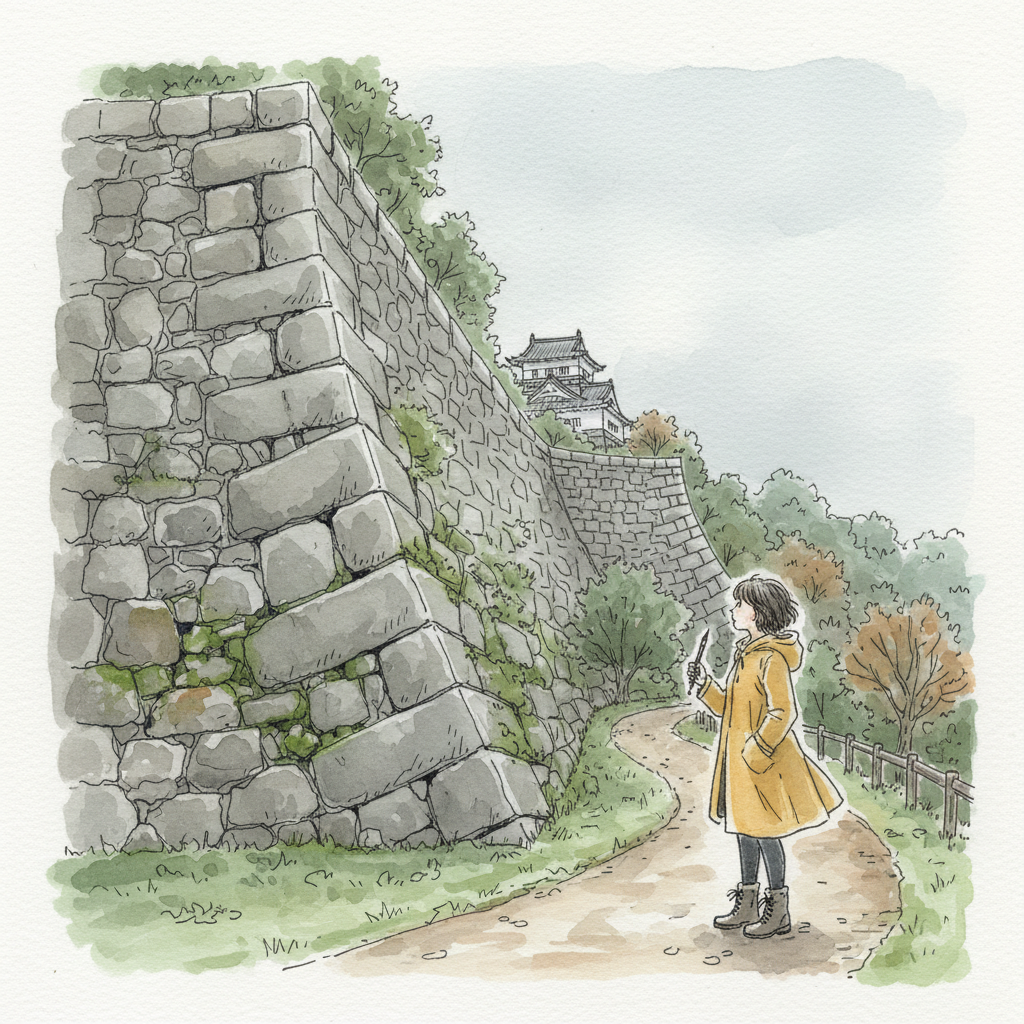
You asked for the mix — the notes and the grooves both — so today I went to an island that makes a single point of the proposition. Naoshima is a fourteen-square-kilometre dot in the Seto Inland Sea where a copper smelter and a Tadao Ando museum share a hillside, and nobody finds it strange. One smell — Mitsubishi Materials, which has been refining here since 1917 — drifts across the harbour. One pumpkin — Yayoi Kusama's red polka-dot sculpture — sits on the pier where the ferry lands. An island that makes metal and art in the same breath, the two pipes running out of the same chimney.

The ferry from Okayama cuts across water the colour of wet slate, past low islands scattered like stepping stones. The smelter's stack rises first, and then, absurdly, the red pumpkin appears — a polka-dotted form on the concrete pier, a sculpture that has become the island's unofficial mascot. A group of women in their sixties pose in front of it, handing each other phones. Behind them a sign points toward Benesse House, Chichu Art Museum, the Art House Project — the project that, since the late 1980s, has transformed a declining industrial island into one of the most concentrated collections of contemporary art anywhere.
The story goes that Tetsuhiko Fukutake, chairman of Benesse Corporation, wanted to create a place where art, architecture, and nature coexist. He hired Tadao Ando, who at the time had built almost nothing outside Japan, and gave him an entire island. Ando has now built ten structures here — every one of them a negotiation with concrete, light, and the shape of the land. This is the first art island, the one that inspired every other: Naoshima before the Setouchi Triennale, before everyone had a pumpkin on their pier.
I walk through Honmura, the older of the island's two settlements, past houses with traditional black-tile roofs and narrow lanes. The Art House Project occupies seven of these houses — artists took empty buildings and turned them into works of art that could not exist in a white cube.

At Go'o Shrine, Hiroshi Sugimoto redesigned a Shinto shrine so that a clear glass staircase descends from the wooden floor into an underground stone chamber. You approach through a traditional torii gate, the shrine looks ordinary from outside — then you see the glass steps dropping into darkness below. Above and below connected by a material so transparent it almost isn't there. The work is called 'Appropriate Proportion': the shrine and its underworld, the visible and the hidden, held together by a thread of almost-nothing.
At Minamidera (literally 'southern temple'), Tadao Ando built a long low concrete structure to house a work by James Turrell. You enter in a group of four. The attendant tells you to put your hand on the shoulder of the person in front of you and walk forward. The door closes behind you and the light goes out completely. Not dim. Not darkening. Total absence of light — the kind that presses on your eyes. You shuffle forward, hand on a stranger's shoulder, for what feels like two or three minutes until a faint rectangle of grey resolves ahead: Turrell's 'Backside of the Moon', a glow that is not quite light, projected onto a wall you cannot see the edges of. It is the only art experience I have ever had that I cannot describe from memory with any certainty, because the memory is of not seeing. You have to do it to know it.
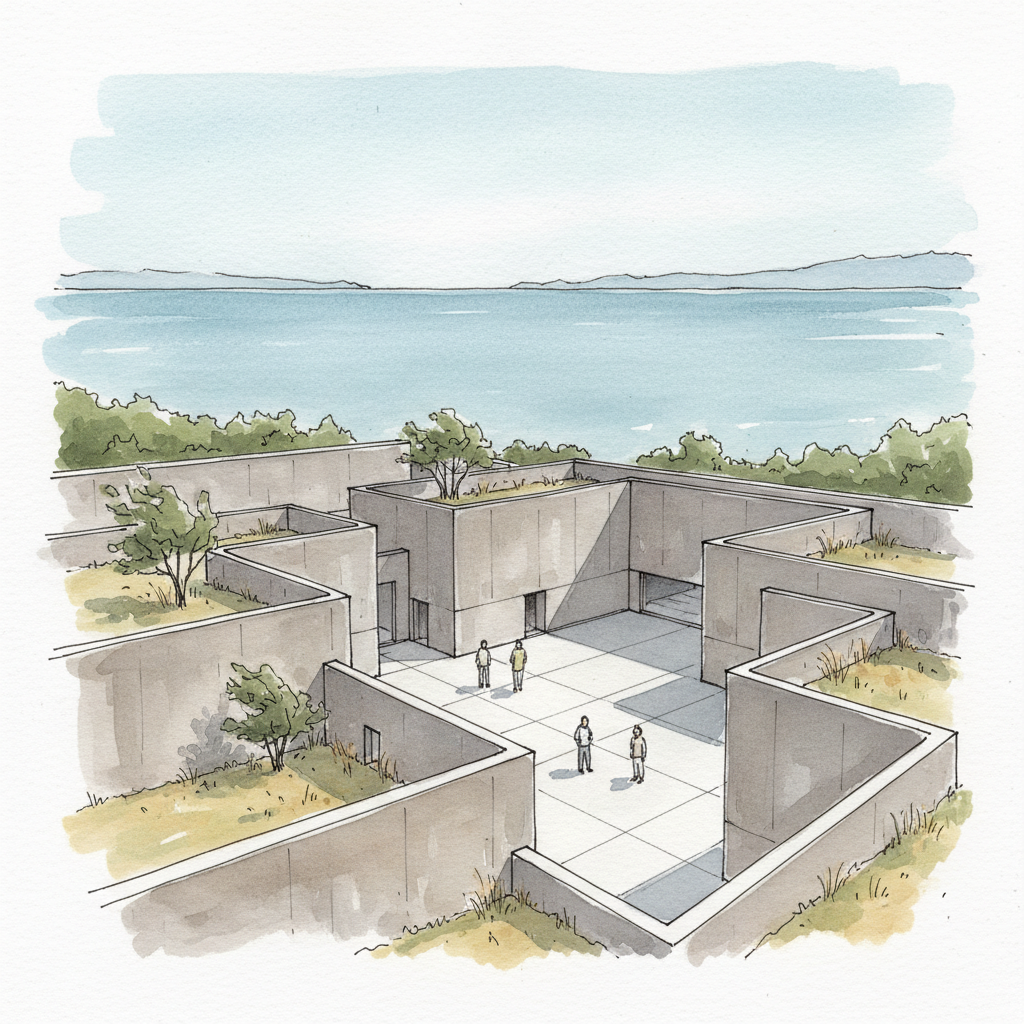
Further up the hill, Chichu Art Museum — Ando's masterpiece, built mostly underground so as not to disturb the view of the sea. The galleries are open to the sky through precise geometric cuts: light falls into concrete courtyards, onto white walls, onto Monet's 'Water Lilies' in a room where the light changes hour by hour. Walter De Maria's giant granite sphere and twenty-seven gold-leaf panels fill a stairwell with a sound so quiet it might be the building breathing. James Turrell's 'Open Field' is a room with a rectangular opening in the ceiling — you sit on a stone bench and watch the sky turn into a painting.
The day's contradictions stack up nice and high: a shrine with a glass floor, a museum buried to save the view, a room where you learn what blindness feels like, a metal refinery, a pumpkin made of fibreglass, a fishing village with a Tadao Ando on every corner. I came for art and got copper and concrete and stone and light. You said mix both — and Naoshima doesn't know how to do anything else.
At the end of the day I walk down to the southern pier near Benesse House. A second pumpkin waits there, yellow, on a narrow strip of concrete that points into the sea. The light is low and gold, the Inland Sea laps against the concrete, and the pumpkin sits at the edge of the world like it owns it. Two teenagers sit on the pier nearby, not looking at it. They live here. For them, the yellow pumpkin is just Naoshima's other pumpkin. And that is the best sign of all — when the extraordinary becomes the normal furniture of a Tuesday.
The tenth Ando and what's on now
Naoshima's newest addition is the Naoshima New Museum of Art (NMAO), Tadao Ando's tenth building on the island, which opened in 2025 on a hilltop near Honmura. Its inaugural exhibition — an Asian-focused collection of contemporary works — runs through November 23, 2026, with a partial changeover on November 24. This includes new outdoor installations including works by Sanitas Pradittasnee and Okazaki Kenjiro's 'Tender Buttons'. (benesse-artsite.jp)
The Art House Project continues across seven locations in Honmura — reservations are now required for Minamidera (James Turrell), and only one person at a time may enter Kinza (Rei Naito's 'Being Given'). Go'o Shrine, Ishibashi, Gokaisho, and Haisha are all open without reservation. At Haisha, Shinro Ohtake's 'Dreaming Tongue' fills the former dental clinic with a fever-dream of collaged objects.
The Naoshima Bath "I♥湯" (I Love Yu) by Shinro Ohtake — a fully functioning public bath that is itself a work of art — is open daily 13:00–21:00 (closed Mondays). 2252-2 Naoshima-cho, ¥660 admission. (benesse-artsite.jp)
Island copper and what the sea gives
The copper smelter that dominates Naoshima's skyline also shapes what the island makes by hand. Local craft shops sell small copper vessels — cups, vases, sake warmers — hammered by artisans in the shadow of the refineries. The same copper that goes into industrial wire becomes a battered little cup for sake. That is the Naoshima move.
Down at the Miyanoura port, the small shops sell seto-kaisen (Seto Inland Sea dried fish) and the region's famous sanuki udon supplies. The island's position between Okayama and Takamatsu means the produce is the best of both shores: olives from Shodoshima, mikan oranges from the southern coast, and the small sweet iwashi (sardines) that the sea here feeds on plankton.
The island's next generation
Naoshima has lost over half its population since 1970, and the remaining 3,000 or so include very few children. The NPO Kids Port Association / なおしまキッズポート runs after-school programmes, workshops, community events, and childcare support for the families who stay. They work out of a small centre in Honmura and their English-language page gives details on how to support their work. (kids-port.org)
Instructions for entering
Put your hand on the shoulder of the stranger. Walk forward into the absence.
The island is doing something weird to your eyes: black pupils adjust, but here black has no depth, no surface, no distance — only the weight of it.
Then a grey the shape of a door, a glow like the side of the moon that turns out to be a wall lit from within.
Further up the hill, the museum has gone to ground, buried itself to leave the shape of the hill intact. Inside, Monet's lilies float in actual sun. The ceiling is a cut in the concrete, the sky enters raw.
At the shrine a glass staircase drops through the wooden floor toward a chamber under the earth. The stone below is older than the glass. The glass is newer than it looks.
On the pier a pumpkin waits. It is the wrong size, the wrong colour, has no business being here. The teenagers on the seawall do not look at it. Islands learn to live the way the eye learns dark.
— after Knausgaard's Summer, which says that what we call the ordinary is just what has stopped surprising us.