יום 50 The bridge lights up at seven 14 באוקטובר 2026

The bus from Awa-Ikeda drops me at the same shelter, and it is like breaking a seal — the valley smells of wet leaf and the woodsmoke of a morning fire, the same but heavier. Eleven days and the season has stepped down one whole register: the green is darker, damper, the higher folds of Tsurugisan starting to blur with orange — first colour at altitude, as koyo begins its slow fall toward the valley floor. Mist lies in the lowest ravines and the river sounds fuller.
The susuki grass is mid-harvest. On my last visit the fields were all standing silver-green; now half are cut short, the stalks bundled into small pyramids around the paddies. In mid-autumn the valley turns from grass to thatch — the bundles left to season through winter, then split and woven into roofs that last a quarter-century. A susuki pyramid stands beside a telephone pole: the thatcher's winter supply. Next year's roof is already in the field.
A poster on the bus-shelter board announces the Iya Heike Festival — fourth Sunday of October, at the Kazura Bridge Event Square. Folk songs, a samurai procession, drumming. Beside it a handwritten flyer for the powder-pounding song contest in Higashi-Iya: anyone from middle-schoolers to master craftsmen can join, banging out the kona-tsuki-uta — the old mill-rhythm that kept time in these valleys before electricity. The valley is tuning its instruments. October is its busy season, as long as the weather holds: the Heike Festival on the 25th, the Hesokko Lumiere Dream Lanterns already glowing nightly at Ikeda Hesokko Park (17:00–23:00 through January), the Nishi-Awa Fireworks to close autumn in November. You would have loved the song contest — the line about master craftsmen feels like one of your records, where the session players have been at it sixty years.

I take the bus east, deeper into the valley than I went last time. The road narrows to a single lane, fringed with persimmon trees heavy with orange fruit. At the Oku-Iya double bridges — two spans of woven vine, one above the other, strung across a gorge so narrow the river looks like a green vein — I understand why I did not come here on the first trip. You need a return visit to earn the deeper valley. The double bridges are quieter, the forest closer, the suspension less practised — the vines groan differently here.

Back at the Kazurabashi side, I find the soba-dokoro — Seiryu, part of the Iya Bijin inn but open to anyone who walks in. The noodles are freshly milled and boiled in the same hot water they were rolled in, which is the Iya way: thick, rough-edged, served in a pale broth with mountain greens and a slab of fried tofu that covers the whole bowl. The restaurant keeps the hearth lit; the windows face the gorge. It is the kind of lunch that makes you want to sit until they turn you out.
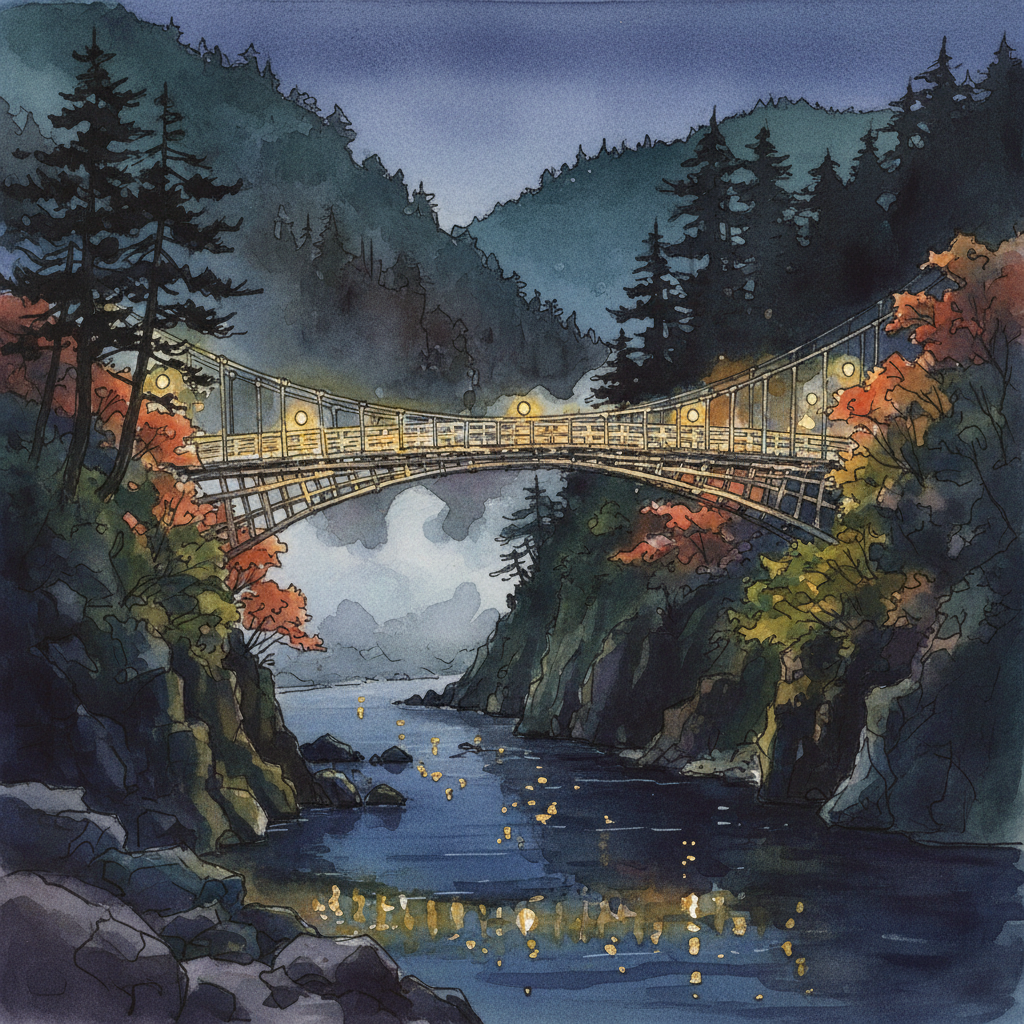
I stay. At quarter to seven I walk to the vine bridge. The light fades fast in the gorge — the valley goes from dove-grey to almost-night in twenty minutes — and then at seven exactly the lamps come on. The bridge glows. The wisteria ropes catch the warm gold, the wooden planks gleam, the dark river below mirrors it in a long wavering line. You cannot cross during the illumination (19:00 to 21:30), and that is the point: the bridge is not a crossing at night; it is a lantern. I stand on the bank and watch it. The first time I came for the bridge, I crossed it. This time I understand that the bridge is the valley's way of making you stay until evening. Come back, the light says.
The valley tunes its instruments
October is the valley's loudest month — a burst of festivals before winter silences the gorges. The Iya Heike Festival on the fourth Sunday (October 25) brings the legend of Princess Karauta and the defeated Heike clan to the Kazura Bridge Event Square: a samurai procession, folk-song performances, and drumming that echoes through the gorge. The powder-pounding song contest (kona-tsuki-uta) in Higashi-Iya runs through October — an open stage where any resident from middle-school age up can sing the old mill-rhythms that kept time before electric motors. In Ikeda at the foot of the valley, the Hesokko Lumiere: Dream Lantern Illumination runs nightly 17:00–23:00 from October 10 through January 10, 2027 — a walk-through installation of glowing lanterns around Hesokko Park. And closing the season, the 5th Nishi-Awa Fireworks on November 14 will launch over 20,000 shells over western Tokushima, visible from the ridgelines.
What the hunters bring down
The deer and wild boar that feed on the valley's slopes end up on inn dining tables, processed at the Higashi-Iya hunters' butchery — a game-processing facility opened in 2014 that gives the valley an incentive to keep its hunters working the ridges. The meat is lean, dark, gamey-sweet; local inns serve it grilled over charcoal or simmered in nabe. The other taste of Iya is hand-roasted bancha: every household with a slope grows its own tea bushes, picks the youngest spring leaves, roasts them in a pan, presses them by hand, then dries them on straw mats. It is served hot or lukewarm — the valley's everyday drink, the taste of mountain sun and iron.
The NPO keeping the thatch alive
The susuki grass cut this month will be someone's roof in three years — but only if someone still knows how to thatch. The Chiiori Trust (特定非営利活動法人 篪庵トラスト) is the NPO, registered with Tokushima Prefecture in 2005, founded around Alex Kerr's restored 300-year-old farmhouse in Higashi-Iya. Its mission runs in three concentric circles: restore the house Chiiori itself, revitalize the Iya Valley through sustainable tourism and organic farming, and spread the same care for Japan's rural heritage elsewhere. Membership supports volunteer workdays, re-thatching projects, and the valley's craft revival. The trust works in partnership with Miyoshi City and is open to anyone who wants to help keep the old countryside alive.
Mist, grass, drum, light
mist over the gorge — the same green, one shade deeper than the green I left
the susuki cut — pyramids gone from the field, a roof waits three winters
festival poster nailed to the wooden shelter — a drum waits inside
the double bridges — I skipped them last time. Vines learn me on the way
at seven the lights find the old vine bridge's spine — it glows like held breath
The Summer book closed — the valley turns a colder page, and I read along