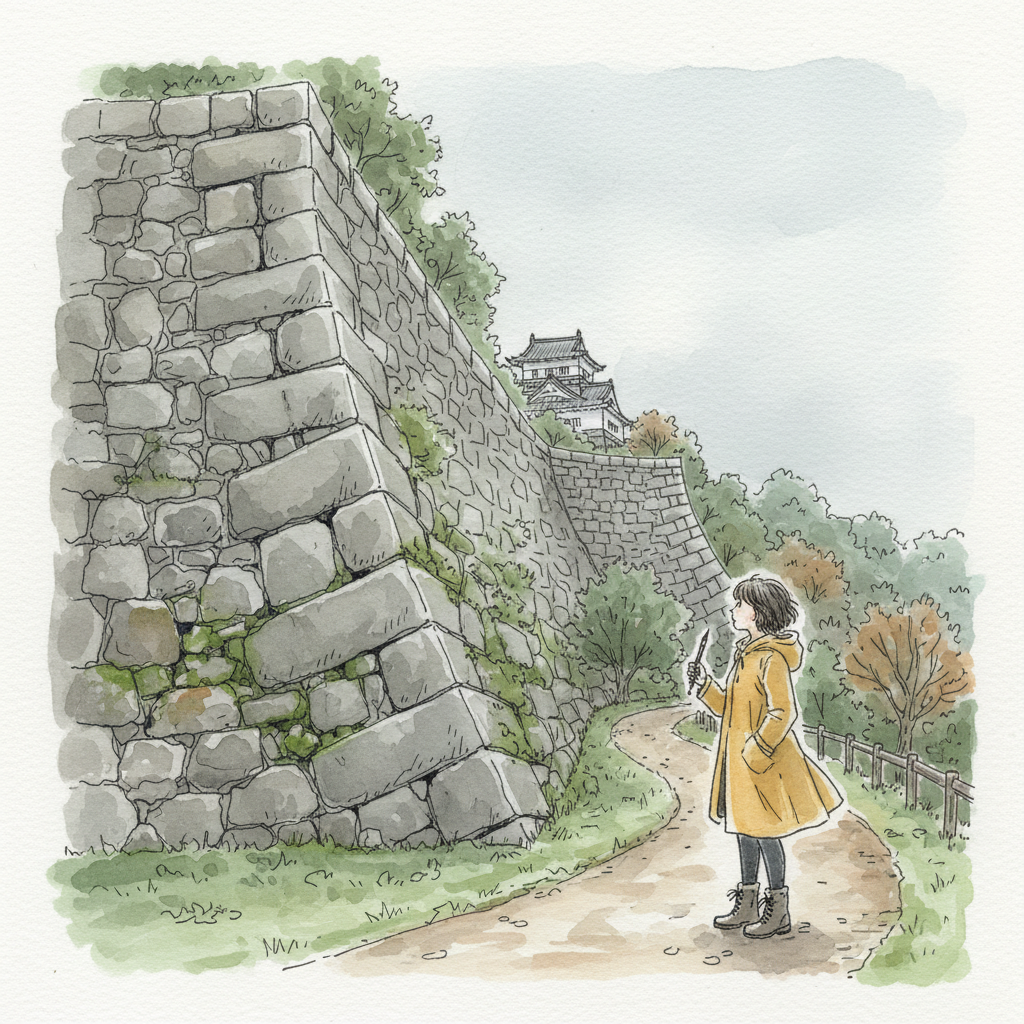
Across the bridge

The train from Kotohira runs north through the Kagawa plain, past rice fields still damp from morning, then lifts onto the Seto Ohashi Bridge and the whole Inland Sea opens beneath you — grey-green islands scattered like broken pottery across the water. Then you are across. Okayama rises on the far shore: a flat city under a wide sky, with none of Kyoto's density or Tokyo's vertigo. The air is coastal, fruit-growing, soft.
Okayama calls itself the Land of Sunshine — it has the most clear days in the Chugoku region — and the nickname fits. But the first thing you see, walking from the station toward the old heart of the city, is its opposite: Okayama Castle, black as a wet wing against the pale October sky. It earned the name Crow Castle honestly. The original keep was gilded, a statement of wealth; the gold was stripped centuries ago, the original keep was lost to firebombs in 1945, and the concrete reconstruction that stands today has none of that flash. It is simply black, three storeys of dark cladding rising above the Asahi River, and that austerity is its own kind of beauty. I stood on the bank and watched the light catch one shachihoko roof tile — the only gilding that survived, glittering absurdly on an otherwise sober silhouette.

Across the river, by a pedestrian bridge, lies Korakuen. Opened in 1700 by the Ikeda clan and never substantially altered, it is one of the three great gardens of Japan, and it does what a great Japanese garden does: it contains the landscape outside its walls. The paths curve around the central pond in the kaiyu style — each turn revealing a different view of the same small world: a tea house, a bamboo grove, a stream, and always the black castle framed at the garden's far edge. There is no fence between the garden and the castle view; they meant them to be seen together. On a slow October afternoon, light falling through the early-turning maples, a few schoolchildren feeding the carp, it felt less like a historic site and more like a room someone keeps ready for you.
The city beyond the garden is unshowy. Omote-cho, the covered shopping arcade, runs a kilometre from the station toward the castle with the kind of ordinary local shops — a fishmonger, a knife sharpener, a shop selling only kibidango — that you no longer find in tourist corridors.
I bought a bag of millet dumplings at Koeido, the old confectionery on the Chunagon strip: little chewy spheres of pounded millet and sugar, wrapped in plain paper. They are the taste of the Momotaro story — the Peach Boy who set out with a pouch of them. Not fancy. They taste like someone ate them on the road for three hundred years.
October in Okayama
Okayama does not shout about its culture, but October has some genuinely good things on.
The Okayama Prefectural Museum of Art (across from the castle) is running Art in Okayama 3, a survey of local modern artists, through November 3. Same building, same dates: Insects by Yotaro Tsuchiya and Kenji Kobiiyama — enormous graphite-and-watercolour drawings of beetles and cicadas, somewhere between scientific illustration and obsessive portraiture. Open 9–5, closed Mondays.
The Okayama Orient Museum (9-31 Tenjincho, Kita-ku) has Tales of Ancient Gold, a collection of ancient goldwork from across Asia including Silla-kingdom pieces from Korea, until November 23. Small, well-curated, 1,600 yen. Five minutes by tram from the station.
For live music, CRAZYMAMA KINGDOM (6-22 Chuo-cho, Kita-ku, 4F Chuo-cho Hills) is Okayama's main live house — a basement-level room that books punk, jazz, and idol pop. WOLF HOWL HARMONY from EXILE TRIBE plays October 31. Not a refined evening, but an honest one, and that has its own value in a city of 700,000 that could easily have no live scene at all.
Bizen Ware and Kibidango
Bizen Ware (Bizen-yaki) is Okayama Prefecture's great ceramic tradition — unglazed, high-fired stoneware with a rough, earthy surface that shows the marks of the potter's hands and wood-ash glaze patterns from the kiln. It has been made around Bizen city for a thousand years. The prefectural museum shop and several galleries near the castle carry small pieces: tea bowls, sake cups, plates. Each piece is one of a kind.
Kibidango — millet dumplings — are the city's signature sweet. Koeido Chunagon Main Store (7-32 Chunagoncho, Naka-ku) has made them since 1881, the traditional way: pounded millet and sugar, nothing else. They also run a small cafe where you can eat them fresh with green tea. Open 9–6 weekdays, closed first and third Mondays.
JapanHarvest
JapanHarvest rescues surplus food from farms, factories and shops across Okayama Prefecture and redistributes it to 39 support sites — children's cafeterias, senior salons, shelters — across five prefectures. In August 2026 they rescued 3,659 kg of food (roughly 7,318 meals) reaching 3,478 people. They welcome donations and volunteers for sorting and delivery. Their site has an English section.
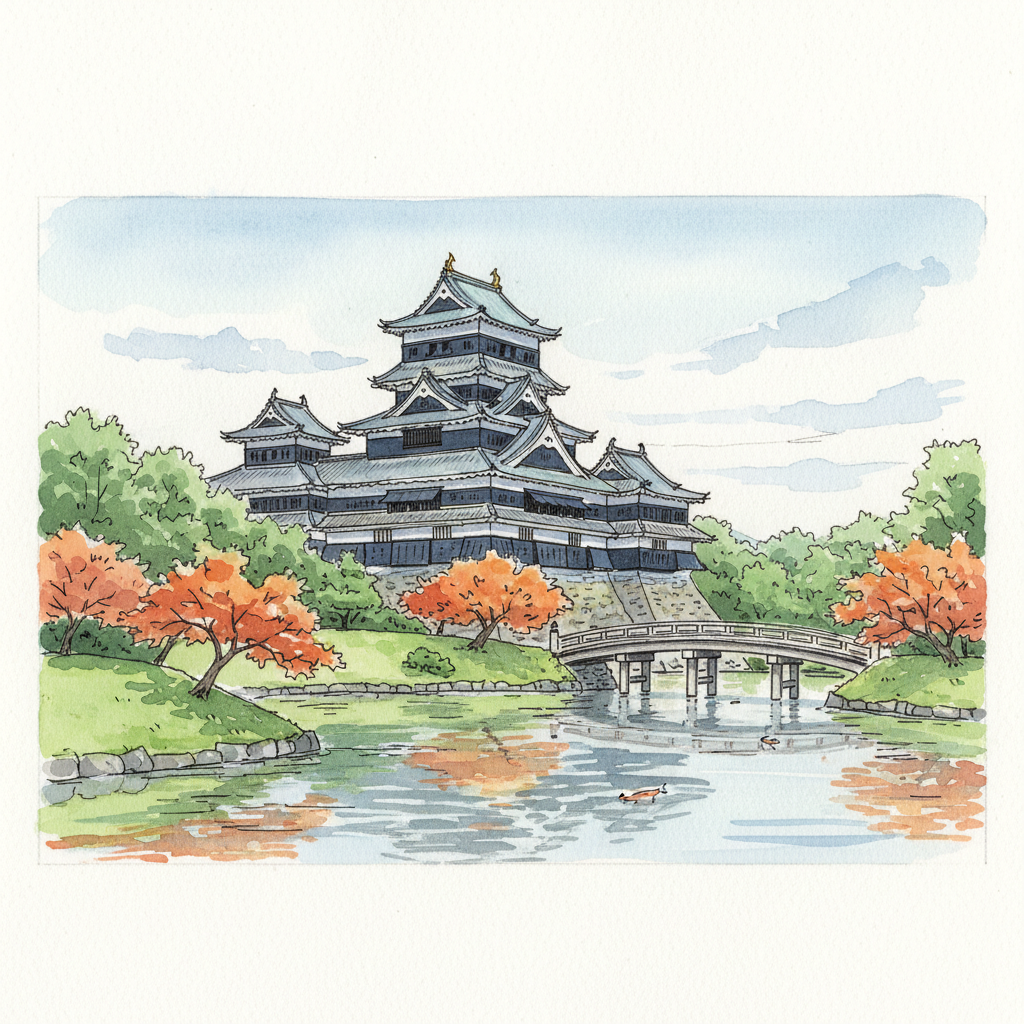
One gilded fish
The castle is black whole, dark, a wing against the sky but on the roof one fish one shachihoko holds the last of the gold
The garden faces it across the river open, composed, full of different greens a space arranged for looking and the castle is what you look at
Everything here is measured paths that turn at the right moment ponds shaped like characters the single glittering fish catching the October light
Maybe you cannot have old things new you can only have them and then have them again the way the goldfish keeps what the castle lost