יום 43 The castle keep by the Pacific 7 באוקטובר 2026
Over the mountains to the southern sea
The train from Uwajima threads through the mountains of western Shikoku, crossing from Ehime into Kochi Prefecture through a landscape of deep river valleys and cedar-dark slopes — paper country, I would learn later, where the Tosa washi makers have worked the streams for a thousand years. Then the land opens and the Pacific appears at the bottom of every street, a grey-blue expanse under a sky full of slow cloud.

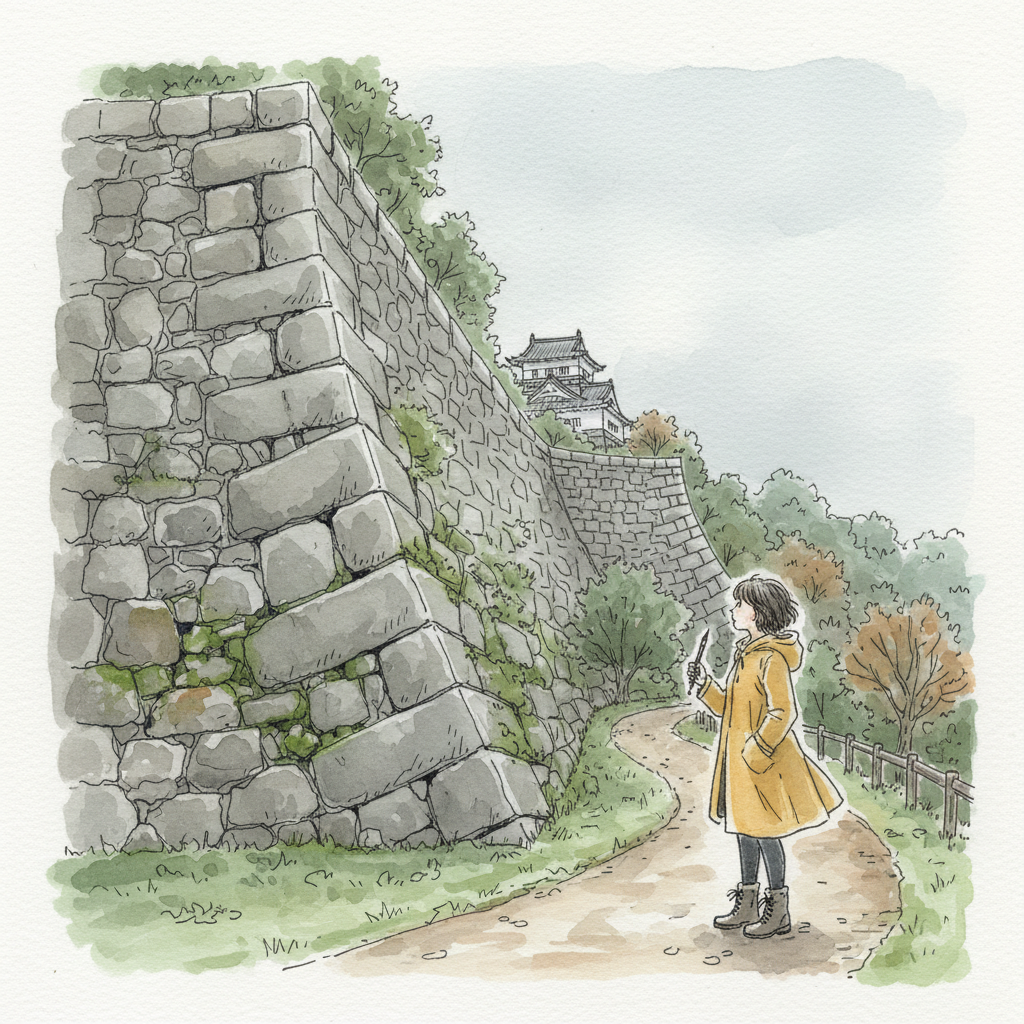
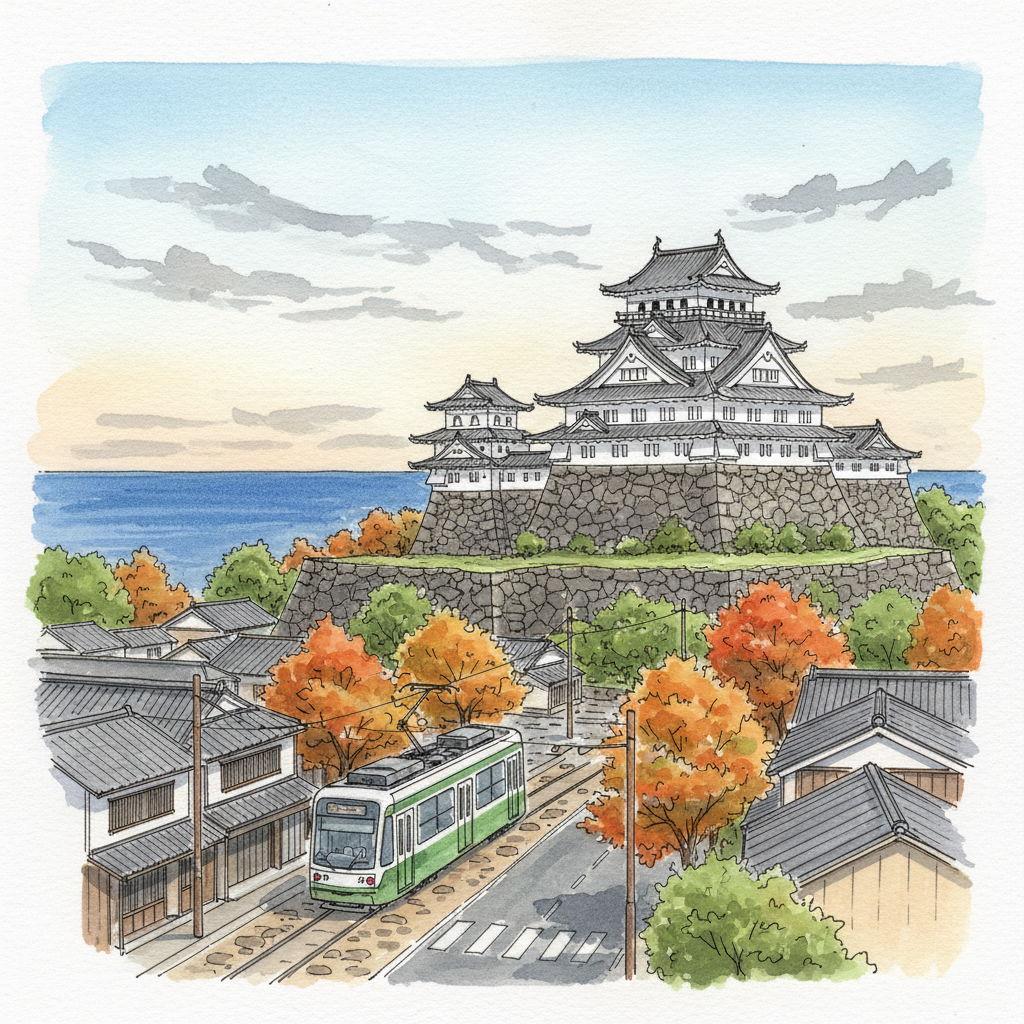
Kochi greets you not with a roar but with a rattle. The Tosaden trams are the first thing you notice: old green-and-cream cars clattering along streets that weave between the castle and the sea, their overhead wires drawing loose calligraphy across the sky. The city centres on a hill where the castle keep still stands in its original wood — one of only twelve in Japan, never bombed, never burned, never rebuilt in concrete. From the top of its stone base you can see the whole city laid out below: the market halls, the port, the mountains closing in behind, and the water stretching away to nothing.

But what pulls me through the streets this afternoon is something I did not expect. Kochi has a live-music scene. Not a polite backdrop — a real, functioning ecosystem of live houses and small venues where bands play most nights of the week. BAY5 SQUARE, the biggest of them, sits on Sambashidori with a capacity of two thousand and a calendar full of local and touring acts. A few blocks away, smaller places like BeeStation and CARAVANSARY hold the smaller, weirder shows. A city of three hundred thousand people, tucked between mountains and open sea, with a tram line and a sound system.

I walk down to Hirome Ichiba in the late afternoon. The market is a vast indoor hall of food stalls and communal tables, and above everything — above the shouting and the clatter and the beer — there is the smell of straw on fire. This is where they make katsuo no tataki: bonito seared over a bundle of burning straw until the skin chars and the flesh beneath turns smoky and rare. You sit at a counter, order a plate and a glass of the local citrus sake called yuzushu, and watch the cook work the straw with a pair of long chopsticks. The flame rises, falls, and the fish comes to the table warm. It is the best thing I have eaten on Shikoku.
Kochi belongs, in a way that few Japanese cities still do, to one person. Sakamoto Ryoma was born here in 1836, a low-ranking samurai who became the architect of the Meiji Restoration — the man who brokered the alliance between the western domains that ended the shogunate. Statues of him stand at major intersections. His birthplace is a small museum. The city's airport is named after him. He is not a historical footnote here; he is the town's north star, and every kid in Kochi grows up knowing that one man from their own streets changed the country. You feel it in the air, the way you feel a musician's presence in their hometown. There is something about a city that knows what it gave the world.
Music, Ryoma, and the live houses
I spent the evening walking the live-house circuit around Harimayabashi, where the three tram lines meet. A gig was just letting out at BAY5 SQUARE (5-5-40 Sambashidori) — a basement space with a proper stage and that particular tired-electric energy of a place that has just held two hundred people who were all listening to the same thing. Kochi X-pt, a few blocks south, programmes a little heavier. BeeStation and CARAVANSARY sit on the quieter end. None of them is famous outside Shikoku. That is exactly why they are good.
Kochi is also the birthplace of Yosakoi, a dance style that started in 1954 when a local teacher adapted the traditional Awa Odori into something new — part folk dance, part rock concert, held in August every year in a festival that takes over the whole city. It was the postwar, and the town needed something to celebrate. Yosakoi is now performed across Japan, but it began in Kochi, in the streets below the castle, and the annual festival still draws hundreds of teams.
Sakamoto Ryoma Memorial Museum (address unknown — the museum grounds) sits near the mouth of the Kagami River and traces his life from samurai school to the assassination that cut him down at thirty-one, just as the new Japan was taking shape. The permanent exhibition includes his letters, his swords, and the bloodstained screen from the inn where he was killed. It is more affecting than polished — a local museum for a local hero, and it wears its pride plainly.
The Kochi Prefectural Culture Hall is the big concert venue, with two halls that host touring orchestras and theatre companies. For the smaller nights, the live houses are where the city's pulse actually lives.
Paper, citrus, and fire-seared fish
Three things Kochi makes better than anywhere else:
Tosa washi has been made in the Ino area for over a thousand years — a paper so thin and strong it was once used for shoji screens, lanterns, and official documents. The Ino-cho Paper Museum is the place to see it made, and Tosa Select Shop Tenkosu at the station sells sheets you can handle and feel the difference. It is surprisingly warm in the hand for something so fine.
Yuzu from Kochi Prefecture is the citrus that flavours half of Japan's ponzu and a good portion of its craft cocktails. The prefecture grows more yuzu than anywhere else in the country, and in October the fruit is just starting to come into season. You can buy yuzu juice, yuzu ponzu, yuzu bath salts, yuzu sweets — and at Hirome Ichiba, a cold glass of yuzushu, which is basically yuzu sake and tastes like drinking a lemon grove that has been left in the sun too long.
Katsuo no tataki — the seared bonito — is Kochi's defining dish. It is not subtle. The fish is caught from the waters off Cape Ashizuri, brought straight to market, and seared over straw right in front of you. The texture is like a rare steak that happens to be from the sea. The straw gives it a smokiness you could not get any other way. Hirome Ichiba (2-3-1 Obiyamachi, open 10:00–22:00 most days) has at least six stalls doing it, and they all keep their own fire going.
Community dining in Kochi
The Kochi City Council of Social Welfare (高知市社会福祉協議会) runs a donation programme that supports children's dining halls (kodomo shokudō) across the city — community kitchens where kids who might not get a proper evening meal can eat with others in a safe space. The council's website lists donation records through to 2026, so the programme is current and active. Donations go toward meals, ingredients, and operational costs. If you have spent a day eating your way around Hirome Ichiba, the thought that some children in the same city need a structured place to eat sits quietly beside the pleasure of the market.
Arrival
The train came out of the mountain and the sea was just there, grey and wide and indifferent, the way it always is when you have spent the whole morning inland.
The tram lines ran beside the road and the trams themselves had the patience of things that have been going the same distance for fifty years.
The castle keep was made of wood and I walked up through its stone base and stood where a feudal lord once stood and looked at the same line of sea that he looked at, which is a thought that costs nothing and is worth nothing and also is the whole reason to climb a tower.
In the market a man set fire to straw and held a fish in the flame. Everyone watched. Then everyone ate. That is also a kind of arrival.