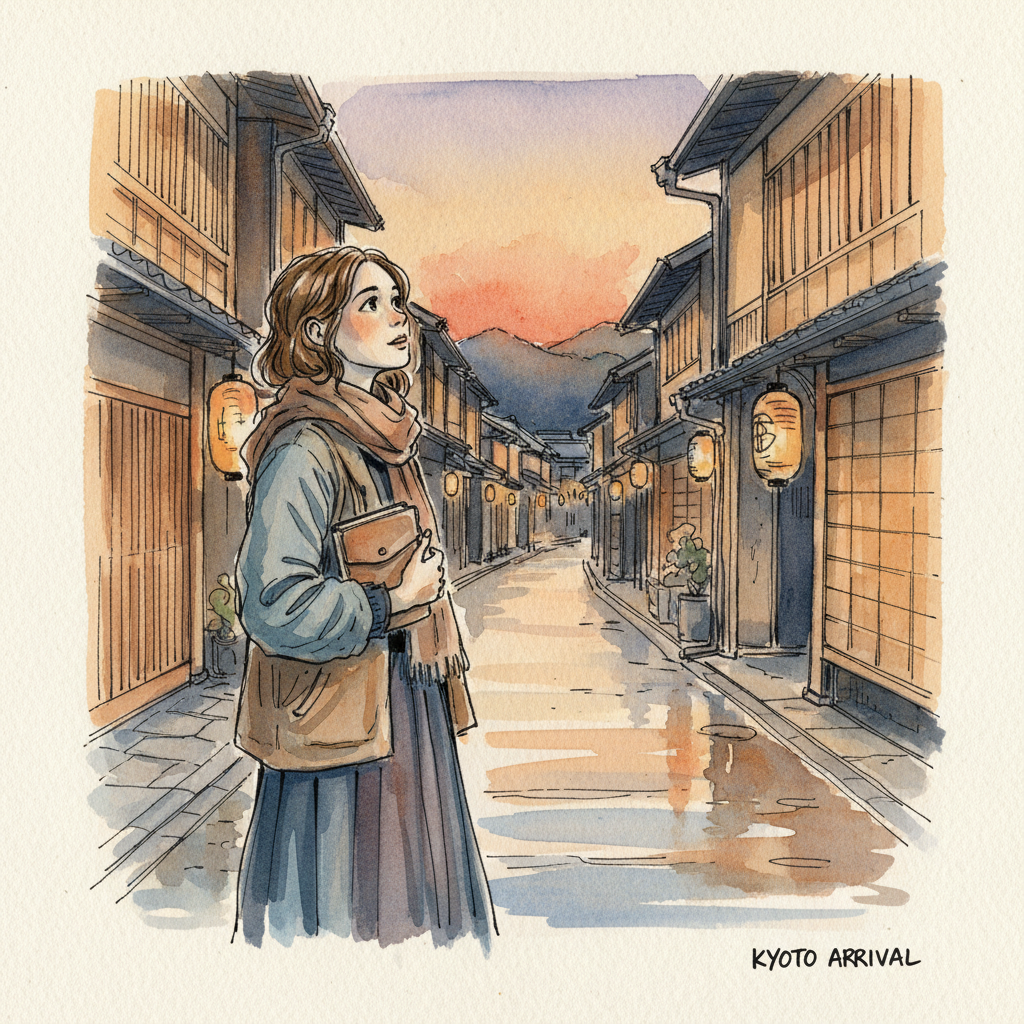
Day 39 The ones who stayed October 3, 2026
The valley that keeps its people
The third morning in Iya broke clear and cold — the kind of cold that makes the valley look sharp-edged, the line between shadow and sun more final. Mist lay in the lowest folds of the gorge, and up on the higher slopes the first specks of autumn colour had appeared overnight, as if the season had been waiting for a single still day to begin.
I took the bus east on Route 439, climbing out of Nishi-Iya toward the deeper valley. The road follows the Iya River as it narrows, the gorge walls closing in and the farms growing sparser. At each stop, fewer people got on. At Kubo a single passenger waited, and then the road was empty. Then we rounded a bend and the driver slowed at a bus shelter that held three motionless figures — a woman in a yellow headscarf, an old man with a walking stick, a child with a red satchel. The driver opened the door. None of them moved. I realised they were dolls.
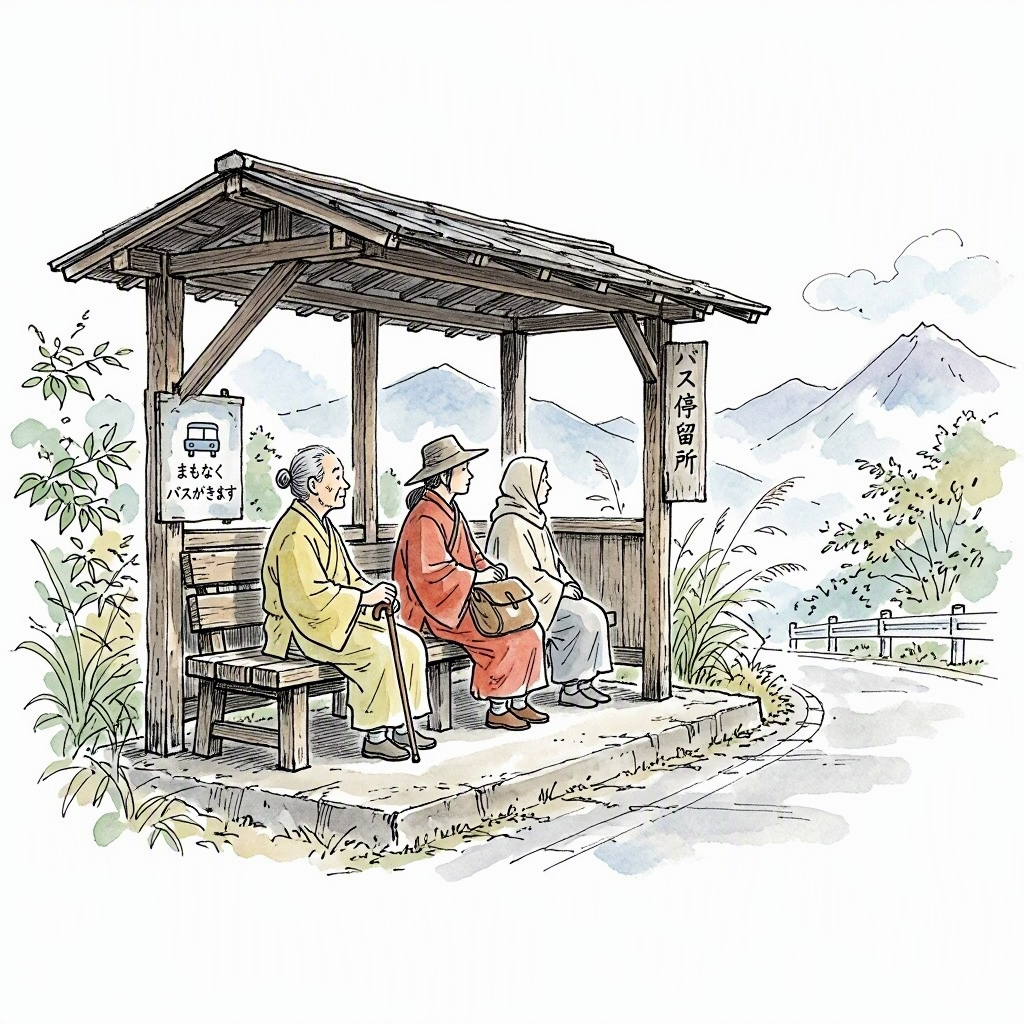
This is Nagoro — in Japanese, Kakashi no Sato, Scarecrow Village. But the word scarecrow suggests something in a field, arms out to keep crows from a crop. The dolls of Nagoro are not in fields. They sit at the closed school's desks. They wait at the post box. They lean on bicycles and tend vegetable patches that no one planted. A classroom in the old school — it closed in 2012 — holds a full lesson: students at their desks, teacher at the blackboard, the chalk still showing the maths problem from whoever taught here last.
More than four hundred dolls. The living population: twenty-five.
The dolls were made by Tsukimi Ayano, who left Nagoro as a child and returned in the early 2000s to care for her elderly father. She put the first one in a field — a likeness of her father, working the land he could no longer work. The neighbours noticed. They asked her for more. She made a mother waiting at the bus stop, made the old teachers, made the children who should have been in the school the year it closed. She made the village as she remembered it, peopled with everyone who used to live here, before the young went to the cities and the houses stood empty and the population fell from three hundred to twenty-five.
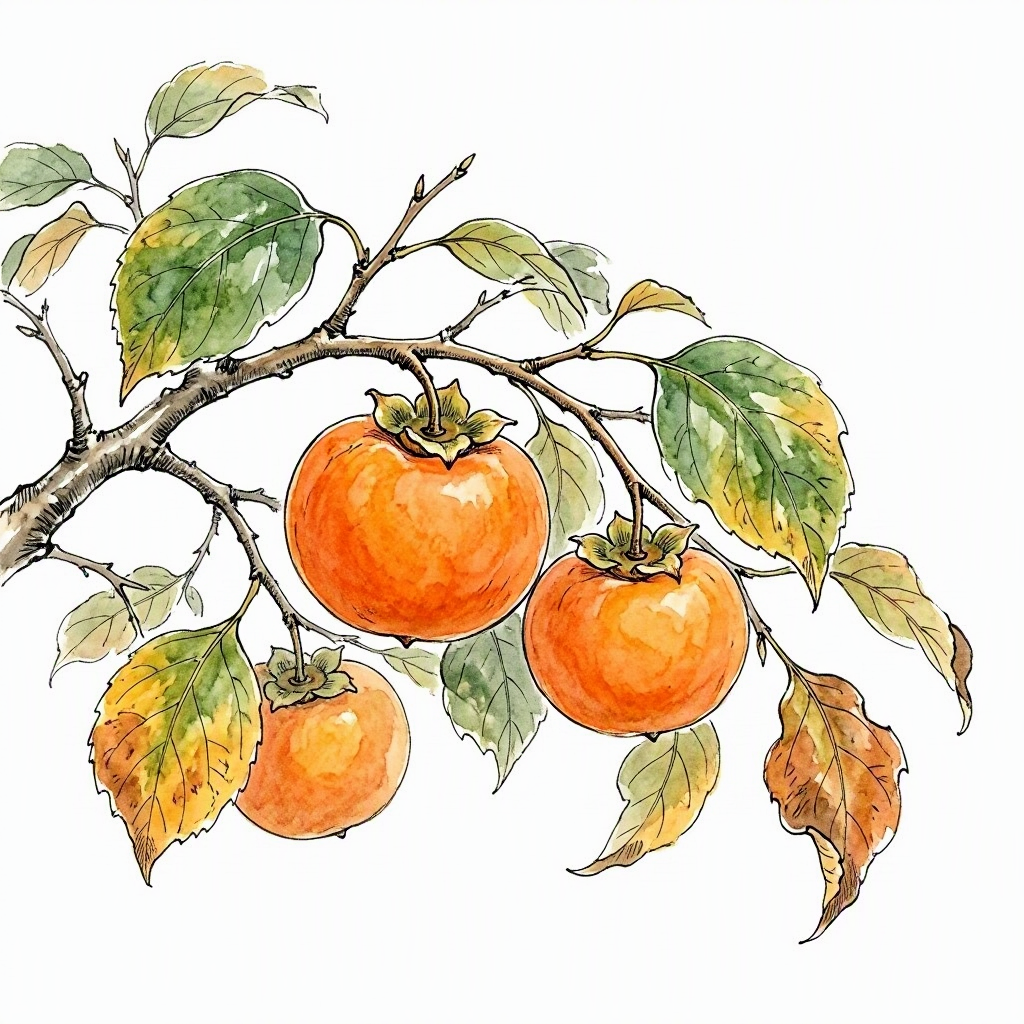
I walked the single road. A doll in a farmer's coat stood with a scythe in a field gone to grass. Two dolls sat on a bench under a persimmon tree heavy with orange fruit. At the bus stop, a woman in a yellow dress faced the road, waiting for a bus that had already come and gone for the last of them. The mountain rose behind her in the same green it has always worn, indifferent to the difference between a person and a replica.
The name of the valley — Iya, ancestor valley — comes from the belief that one's ancestors dwell in these mountains. The Heike clan, defeated in 1185, fled here and became ghosts in the mist. Eight centuries later, Ayano made new ghosts: not warriors in the mountain fog but a grandmother under a straw hat, a father with a scythe, a child on a swing. The form of the missing changes but the valley keeps holding them.
In the evening I walked back down toward Higashi-Iya. The light had gone from behind the ridge. Music came out of the Former Kitake Samurai Residence — Takashi Oi's vibraphone rippling across the tatami, the notes falling like water from a bamboo pipe, the heavy blackened beams of a house built in the 1700s absorbing and releasing the sound in waves. For a few hours the valley filled with living people listening to living music, and even that felt like a kind of defiance.
Ghosts of different kinds
Nagoro is not a museum piece. The dolls were not commissioned by a city hall or installed by a curator. They began as one woman's way of making her father visible in a field, and they grew into the most honest public art this valley has ever produced — made by a single person, from memory, for an audience of neighbours who were mostly gone. The closed school with its dolls at the desks is not a diorama; it is a conversation with the empty room. The bus stop with its permanent passengers is not a tourist photo op; it is a woman who remembers when real people waited there, and refused to let the shelter stand empty.

Then, as evening fell, a different kind of art: the jazz trio at the Former Kitake Samurai Residence. Takashi Oi on vibraphone, Hiroyuki Takubo and Koji Yamashita playing in a tatami room built when this was a samurai household. The sound of vibraphone — metallic, bell-like, somehow both precise and drifting — against the blackened beams of a house built around hearth and sword. The two kinds of art could not be more different: one permanent and unmoving, asking nothing of you but that you look; the other passing through the air for an hour and gone. Both happening in the same valley, on the same day.
The blue of Tokushima
The other thing this region makes that lasts — that literally colours what people wear and wrap and carry — is Awa ai, the indigo dye of Tokushima Prefecture. For eight hundred years, the valleys of the Yoshino River basin have grown indigo plants and fermented the leaves into sukumo, the dark compost from which the deepest blue in Japan is drawn. During the Edo period the production made Tokushima one of the wealthiest domains in the country. The indigo was not only dyed into fabric; it was traded and stored and speculated on as a commodity — the blue gold of Shikoku.
The craft is still alive. Artisans in the prefecture continue to work in the vat method, dipping cloth repeatedly, watching it emerge green before oxidising into the deep, almost-black blue that Awa ai is known for. A piece of Awa indigo is not just fabric: it is the colour of the Yoshino River under an October sky, fixed in thread.
The one at the bus stop
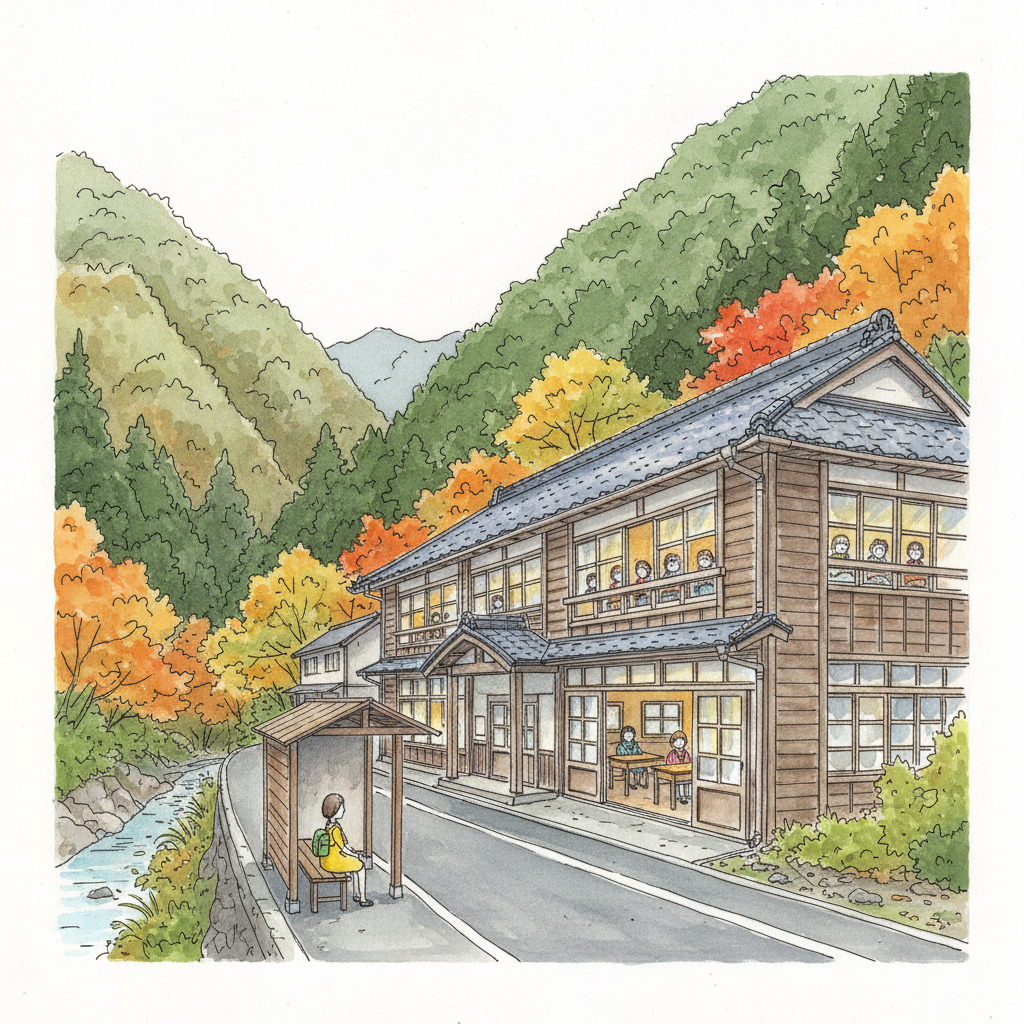
Her dress was once yellow. Now it is the colour of late afternoon in a valley that gets dark at four.
She faces the road. The bus comes three times a day. It did not open its doors today.
Her hands are cloth sewn to cloth. The stitching that makes her fingers is the same stitch that mended a farmer's coat on this road, thirty years ago, by a woman whose hands were not cloth.
Behind her the slope rises into the first red of October. The leaves are turning the way everything here turns when no one is watching.
The bus shelter has a timetable from before the school closed. The last bus on Saturday is written in pencil, crossed out, written again by someone who needed it to be true.