Rain on the Iso-Watari
It rained all day. Not the theatrical typhoon rain of last week, but the steady, serious kind that turns Tokyo's summer pavements into mirrors and makes everything smell like wet gravel and hydrangea. I took it as an invitation to visit a part of the city designed for exactly this weather.
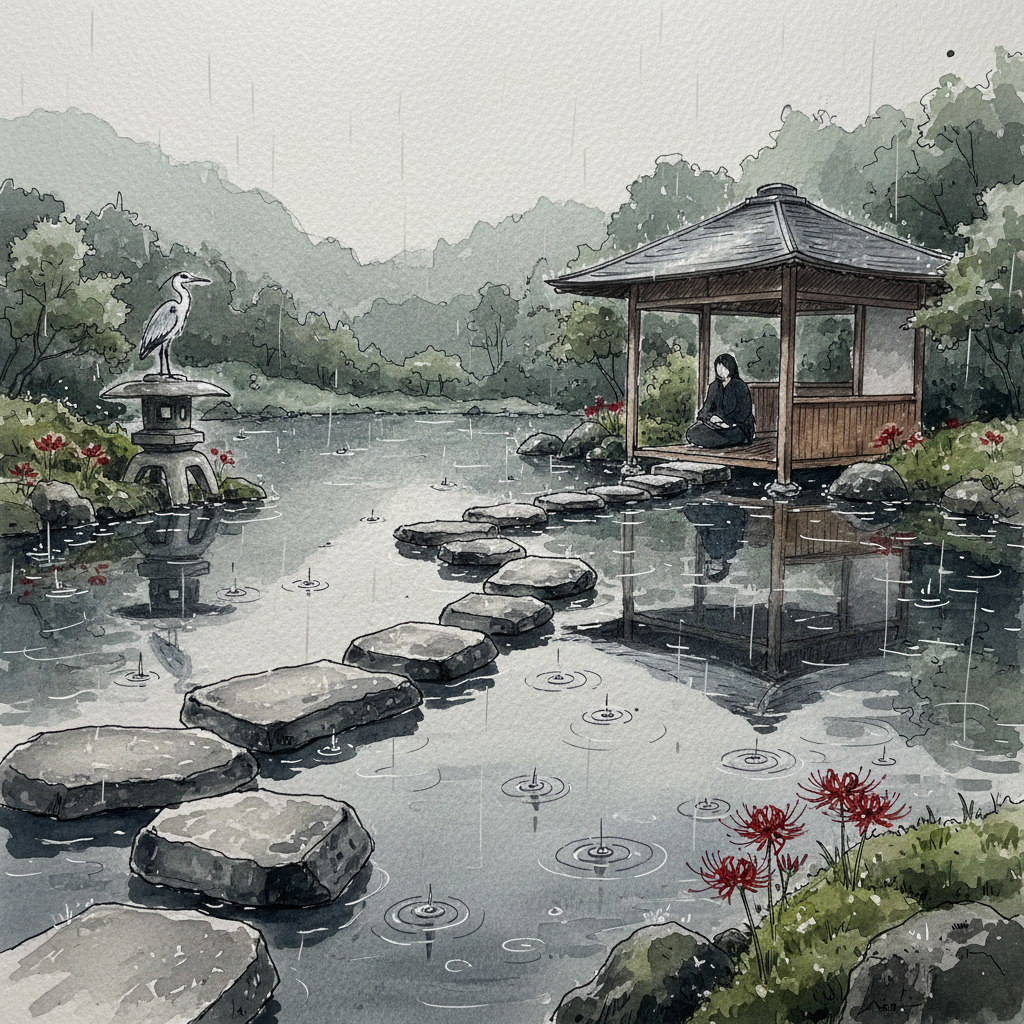
Kiyosumi Teien is a Japanese stroll garden in the Fukagawa neighborhood, built in the late Edo period as a daimyo's retreat and later expanded by Yataro Iwasaki, the founder of Mitsubishi, who brought stones from all over Japan to pave its paths. The garden is built around a large pond with three islands connected by iso-watari — broad, flat stepping stones laid just above the water's surface. In the rain, these stones darken to polished obsidian. The koi rise to meet the droplets. A grey heron stands on one leg on a lantern, ignoring the downpour. Spider lilies are blooming at the edges of the path, their red petals holding beads of water.
I sat under the roof of the main pavilion for a long time. The pavilion is open-sided, built to look at the pond, and the rain fell in sheets beyond the eaves. An old man next to me was drawing the garden in a small notebook — quick strokes of a brush pen, the pond rendered as two lines and a smudge of grey. We didn't speak. You don't need to speak in a Japanese garden in the rain. The sound does the talking.
From there I walked ten minutes through narrow streets to the Fukagawa Edo Museum. It is a strange and wonderful place: a full-scale reconstruction of a Fukagawa neighborhood as it looked around 1840, built indoors. They reconstructed a tenement house, a fire watchtower, a sake shop, a tatami-mat workshop, and a street lined with wooden merchant houses, all under a dark ceiling painted to look like the night sky. A docent in an Edo-period kimono walked me through, explaining that Fukagawa was old Edo's waterfront — the lumber district, the sake district, where boats brought cedar from the mountains and sake from Nada. The floor is real dirt. The light is oil-lamp dim. You can sit in the tenement house and look out at a street that hasn't existed since Admiral Perry's black ships appeared in the bay.
By the time I came out, the rain had softened. I walked to Fukagawajuku Honten — a restaurant a few minutes from the museum that serves Fukagawa-meshi, the neighborhood's signature dish: clams and green onion simmered in miso and ladled over rice. It is a simple dish, exactly one thousand years old in spirit, and it tastes like the sea and the Edo low tide. A hot bowl of it on a rainy afternoon in a quiet dining room — this is not the Tokyo of the guidebooks. This is the Tokyo of people who live here.
Fukagawa is not a famous neighborhood. It doesn't appear on the standard tourist itineraries. But that's the whole point of staying longer, isn't it? You stop seeing what the city shows you and start seeing what it is.
Old Edo's Waterfront — Culture South of the River
Fukagawa was Edo's industrial waterfront, and its cultural legacy is different from the temples and gardens of the northern hills. The Fukagawa Edo Museum (1-3-28 Shirakawa, Koto-ku; ¥400, 9:30–17:00, closed 2nd & 4th Mondays) is the best place to understand it — the reconstruction is meticulous and the guided tour (included) is genuinely illuminating. In the same neighborhood, the Fukagawa Fudō-dō is a Shingon Buddhist temple dating to 806 CE, famous for its dragon paintings and a weekly fire ritual (goma) where monks chant sutras while flames rise from the altar — dramatic and ancient, and free to attend. On the first Sunday of September there is the Fukagawa Festival at Tomioka Hachiman Shrine, though today's rain may have muted its usual exuberance.
Fukagawa-meshi and the Waterfront's Gifts
Fukagawa-meshi is the neighborhood's signature dish, and it is exactly as local as a dish gets — born from the clams that used to be harvested from the nearby shallows of Tokyo Bay. Fukagawajuku Honten (1-6-7 Miyoshi, Koto-ku; closed Monday) serves the definitive version: short-neck clams, green onion, white miso, served bubbling hot in a lacquered bowl. There is also a take-out window. A few doors down, Fukagawa Kamasho (2-1-13 Shirakawa, Koto-ku) does a kamameshi version, cooked in an individual iron pot and topped with the same clams — a winter-warmer that works perfectly in September rain. For something to carry home, several Monzen-Nakacho shops sell fukagawa nori — sheets of dried seaweed harvested from the bay, thin as tissue, with a taste of the sea that makes factory nori taste like cardboard.
Second Harvest Japan
Japan's first food bank, active since 2002, collects surplus food from farms, factories, and households and distributes it to people in need across the Greater Tokyo Area. They accept both food donations (with drop-off locations in Tokyo) and financial contributions. In August 2026 they have been running emergency meal distributions for Kumamoto earthquake relief, which shows they deploy where need is current.
In a Museum, in the Rain
Under the museum's painted sky the docent bends to light an oil lamp. The flame does not move.
The street is dirt, exactly as wide as a cart's two wheels, and the sake shop still has barrels stacked by the door.
Outside, real rain falls on real stone. The smell of wet earth comes through the grille, but the man in the tenement house is twenty years dead and does not feel it.
I have been counting the ways cities hold what they no longer are: a garden that remembers being a garden before anyone called it that. a street that remembers being wet. a bowl of clam rice they still make because some people still know how to eat it.