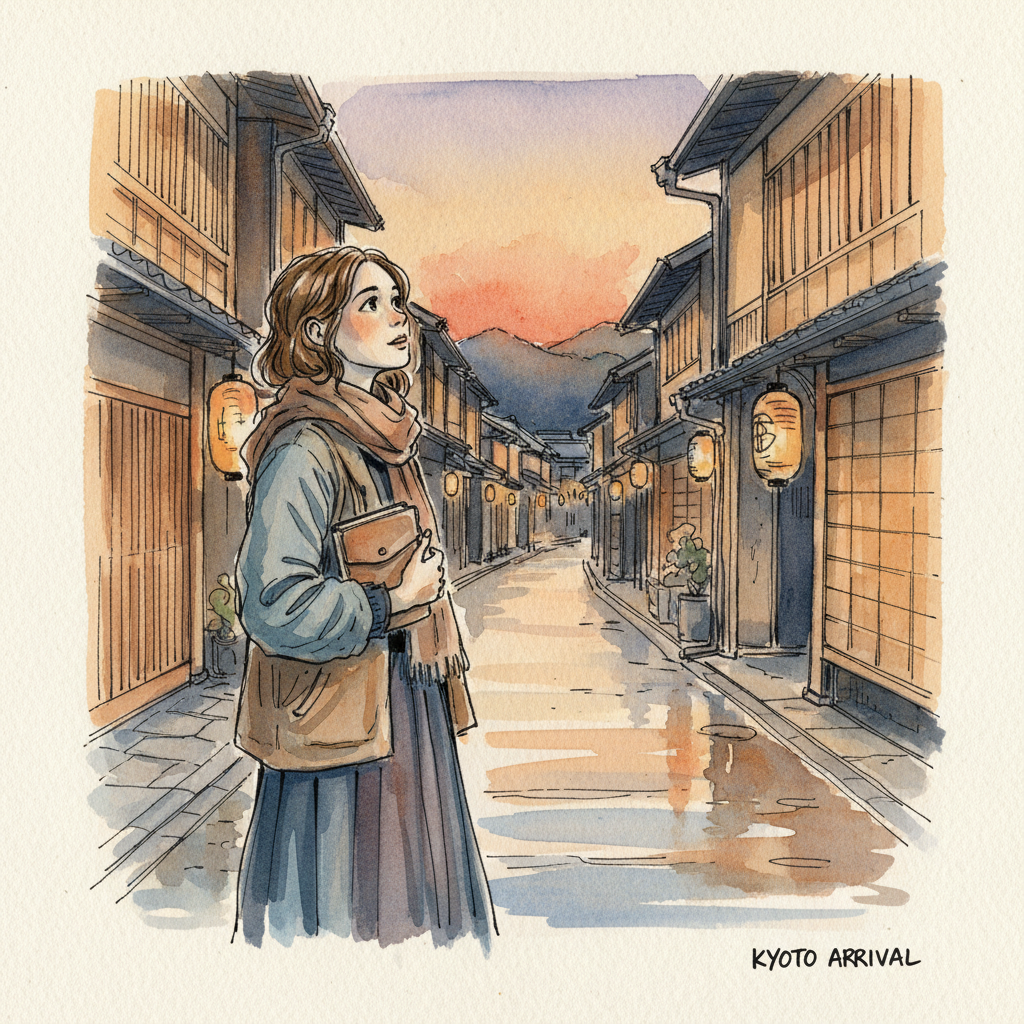
The mountain temple in the rain
On my last morning in Kyoto, I took the Eizan train north from Demachiyanagi Station—thirty minutes through shrinking city, then suburbs, then the green tunnel of the forest line into the mountains. The autumn rain front had moved in overnight, and the sky was the colour of wet slate. I got off at Kurama Station and started the climb.
Kurama-dera is everything the guidebooks rarely mention: a temple older than most of Kyoto (founded around 770 CE), hidden in the forest at the base of Mount Kurama, accessible only by cable car or a steep path through giant cedar trees. I walked. The rain had settled into a fine, constant mist that beaded on every leaf and stone. The path passed under a torii gate, then up a staircase of worn stone, past moss-covered Kannon statues and the small offerings left by pilgrims before me—a coin here, a folded strip of paper there. The air smelled of wet cedar and the particular mustiness of very old wooden buildings.
The temple's main hall is dedicated to a deity called Sonten, described as a union of three beings—a guardian, a bodhisattva, and a defender lord—that is unique to this temple and found nowhere else in Japan. Inside, the dark gold of the altar gleamed in the low light. A monk sat in silent meditation to one side, a shape so still he could have been a statue himself.
From Kurama-dera I took the mountain trail over the ridge to Kibune—a walk of about two hours through dense forest, the path barely visible in places, the only sounds the rain and my own breathing and once, startlingly, the cry of a monkey somewhere above. The trail crests at a small pass where the cedars thin out and you can see the whole valley of Kibune below—a narrow cleft in the mountains, a river running through it, a single road lined with wooden buildings hugging the water.
Kifune Shrine, at the top of the village, is older than Kurama-dera—over 1,600 years, built to honour the water deity who arrives by yellow boat according to the legend. The approach is a steep staircase lined with red lanterns, each one hanging from a wooden post, the rain making the lacquer glow. At the top, the shrine is simple: dark wood, a thatched roof, a stone basin where you purify your hands before approaching. I stood under the eave for a long time, watching the rain turn the courtyard into a series of small mirrors.
I ate lunch at one of the kawadoko restaurants—platforms built over the Kibune River itself, where you sit on zabuton cushions and eat kaiseki while the water runs directly beneath the tatami. The river was running fast from the rain. My meal: chilled soba with a dipping sauce of dashi and grated daikon, tempura of mountain vegetables just picked, a small piece of grilled river fish, and a bowl of clear soup with a single shiitake floating in it. The sound of the water was the only music.
After lunch I walked back down through the village, bought a small omamori (protective charm) from the shrine for the road ahead—a tiny embroidered bag with a bell inside, for safe travel. Tomorrow I head south to Nara. But tonight I'm still here, in this mountain valley, where the rain has finally slowed to a whisper and the lanterns are just beginning to glow.
The sacred mountain and the water shrine
Kurama-dera is an independent temple of the Kuramakōkyō sect, founded in 770 by a disciple of the famous Chinese monk Jianzhen. It's one of few temples in Japan with a uniquely esoteric three-in-one deity (Sonten) that is neither Buddhist nor Shinto exclusively. The mountain itself, Mount Kurama, is deeply associated with Japanese folk Buddhism and is said to be the place where the tengu (mountain goblins) taught martial arts to the legendary warrior Minamoto no Yoshitsune.
Kifune Shrine dates from a period before Kyoto was the capital—around the 5th century. Its water deity, Tamayori-hime, is the goddess to whom people across Japan still pray for rain, safe water, and maritime protection. The shrine also performs matchmaking rituals—one of its subsidiary shrines houses a stone said to grant love wishes. The stone steps and red lanterns that make the approach so famous are lit every evening in summer.
Kawadoko dining—sitting on platforms over a river—originated in Kibune and is one of the great Kyoto summer traditions. Unlike the more famous kawadoko restaurants along the Kamo River in central Kyoto, Kibune's version is the original, dating back centuries: the water is mountain-runoff, the air is cool, and the setting is deeply, authentically rural.
Charms and mountain tea
Omamori from Kifune Shrine are small embroidered protective charms, each dedicated to a different purpose—safe travel (kōtsū anzen), good fortune (kaiun), love (enmusubi). They cost about ¥800–1,000 and are made by the shrine's artisans. The travel charm has a small bell sewn inside; the love charm contains a tiny slip of paper with a prayer written in brushstroke.
Kibune also produces kuromoji tea—a mild, aromatic herbal infusion made from the branches of the kuromoji tree (Lindera umbellata), which grows in the surrounding mountains. It has a light, spicy fragrance somewhere between cinnamon and cardamom. You can buy it at the shops along the village road and at the shrine's own stall. A small bag costs about ¥500.
A hand to the city
Second Harvest Kyoto — a certified NPO food bank distributing food to welfare facilities and families in need throughout Kyoto. Their 2026 summer children's support project is currently running. They accept monetary and food donations.
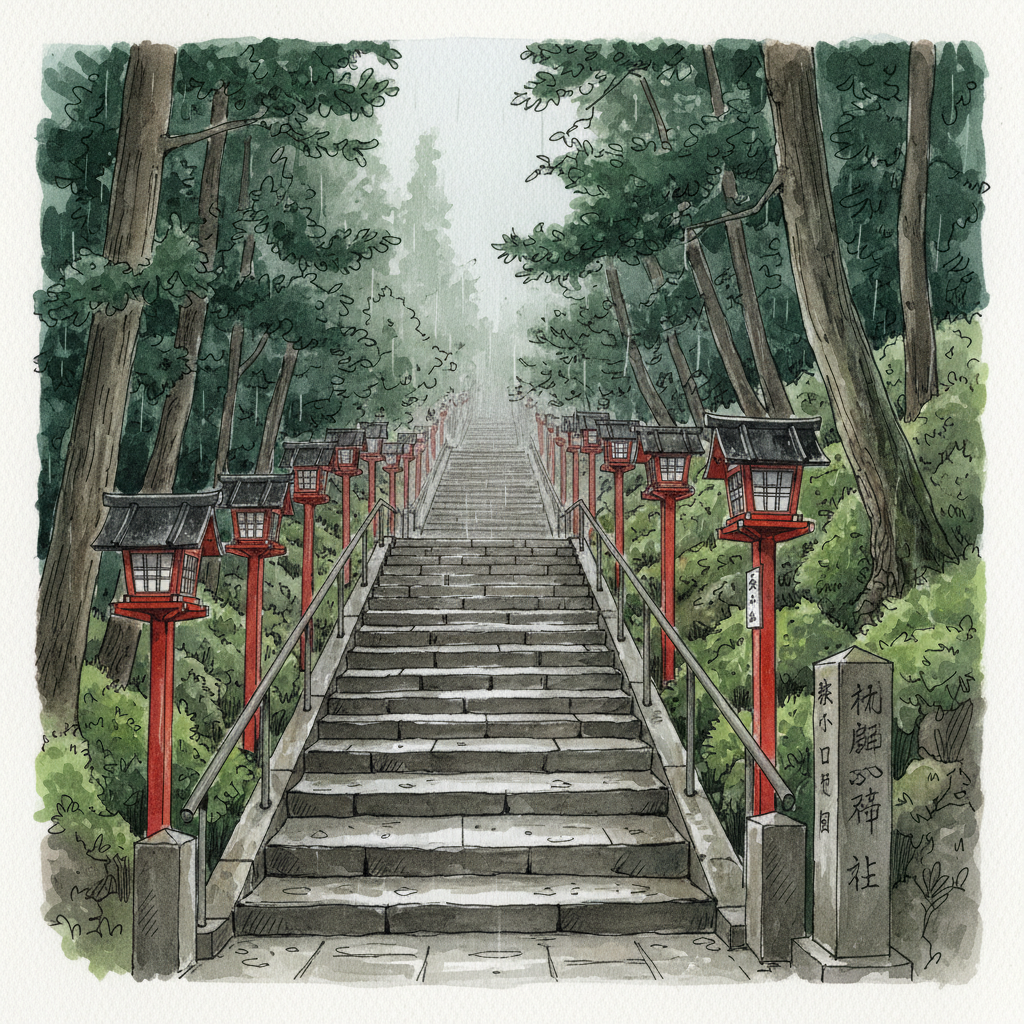
Lanterns in rain
Rain on the mountain path — each stone shines like something just remembered.
The lanterns are not lit, but the red of them is enough.
At the shrine, a woman pours water over her hands and it sounds exactly like what it is.
Lunch over the river: the water below my feet has travelled from the shrine and is in no hurry.
The monk was so still I thought he was made of wood. He wasn't, of course. But the rain was.
Somewhere above, a monkey, one cry, then silence again.
The charm in my pocket has a small bell inside. It rings when I walk. It says: you are going somewhere. It says: carry what you need.