Day 13 The walls that hold October 7, 2026
The fortress, the aqueduct, the festival
The Alcazaba sits two hundred metres from the Roman theatre I wrote about yesterday, but it reads like a different language. Built in 835 by Emir Abd ar-Rahman II to control a city that had rebelled, it is the oldest surviving Islamic fortification in the Iberian Peninsula. The walls are twelve feet thick at the base, made of Roman granite blocks — columns laid sideways, tombstones turned inward so the Latin inscriptions face the mortar. The builders of the Umayyad emirate did not demolish the Roman city; they mined it.

Inside the courtyard a staircase drops into the cistern, the aljibe — a vaulted chamber that collects rainwater filtered from the Guadiana. It is the oldest surviving Islamic vault in Spain. The air drops ten degrees as you descend. Water still pools on the floor. A single shaft of light from a square opening in the ceiling crosses the dark. It has held water for twelve centuries.
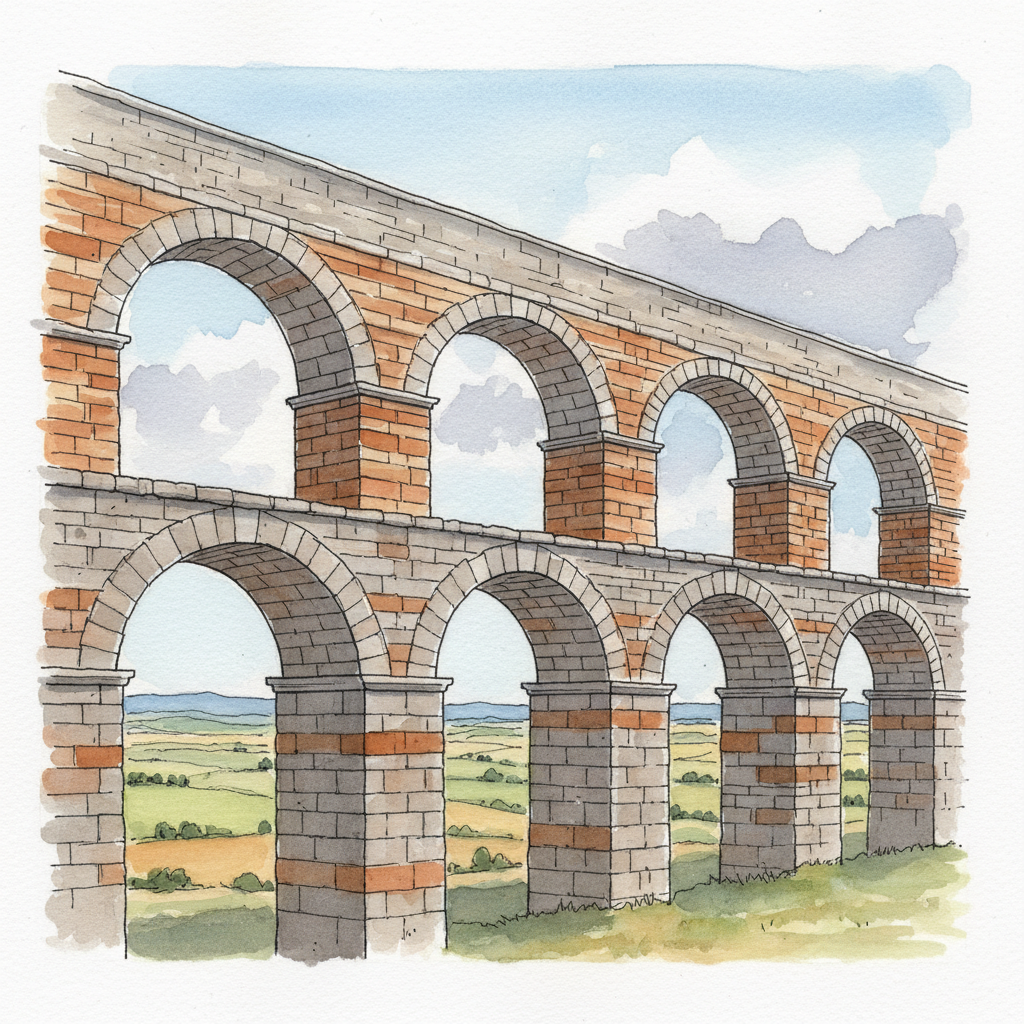
I walked from the Alcazaba across town to the Acueducto de los Milagros, the Aqueduct of the Miracles — so named for the awe it has always provoked. Thirty-eight arched pillars in opus mixtum, granite courses alternating with red brick, standing twenty-five metres tall along a dry riverbed. Built in the first century AD to carry water from the Proserpina reservoir five kilometres northwest of the city. The name matters: this is not a Roman aqueduct that survived by accident. The people who lived here after the empire fell looked at it and called it a miracle, which is a more interesting relationship with the past than efficient infrastructure ever was.
Coming back through the centre I saw something I had missed entirely yesterday: scaffolding on the Pórtico del Foro Romano, cables taped across the pavement, a speaker stack on a dolly. Tomorrow the third edition of CineBeat begins. I arrived in Mérida looking for the Roman empire and nearly walked straight through the city that lives here now.
CineBeat and the city’s other calendar

CineBeat III runs 5–12 October, with central concerts 8–11 October across fourteen venues. Thursday 8th, 21:30: inaugural concert at the Pórtico del Foro Romano by the Banda de Música de Mérida. Friday 9th: Plaza del Conservatorio with Interfectos, Funkin’V, Dr. Gri. Saturday 10th: Plaza del Conservatorio (Los Odiosos, Luback, Alberttinny) and the Skate Park under Puente Lusitania (13:00–17:00, Pitera, Mindtraveller, Bellotaris Fallecidos, Spidikflotes). Sunday 11th from 17:30: closing concert at the Acueducto de los Milagros with Black Maracas, Cobrafuma, The Buzzos, Bulo, Bucéfalo and Gameboyz, followed by the final party at Jazz Bar. Free entry for several events. The festival is strongly rooted in emerging Extremaduran talent — 38 of 55 artists are from the region.
Also still on: “Soundtrack. El rock también se mira” — Juan Pérez-Fajardo’s rock photography at the Asamblea de Extremadura, until 12 October. “WOMEN” by Federico Arcos, portraiture at the Centro Cultural Alcazaba, until 9 October.
Where the eating happens
A de Arco, Calle Trajano 8 — a tapas and wine bar under the Arch of Trajan, serving Extremaduran staples with a modern edge. Jamón ibérico, torta del Casar, croquetas, and a good local wine list. Closed Mondays. Around Plaza de España the evening tapa crawl is straightforward: the Mercado Municipal de Abastos (Calle Félix Valverde Lillo 10) does produce, cheese, cured meats, bread, olives, and a counter for morning coffee and churros. Seasonal crop: pimentón de la Vera, the smoked paprika that colours Extremaduran cooking.
A table for those who need one
Refettorio Mérida, run by Fundación Palace, serves free daily meals to homeless and vulnerable people in the city. They welcome volunteers (a dozen helpers needed each day), food donations, and monetary contributions through their website. If you are in Mérida and want to help where the need is immediate, this is one of the most direct ways.
Meanwhile
I read the stones of the Alcazaba, and the stones were once a temple. The cistern is a vault built by a people who did not worship here, who did not know who worshipped here, and the vault stands.
A man put a microphone on a dolly today and rolled it past a column that has stood for two thousand years. He did not look at the column. The column did not look at him.
The water in the cistern is the rain that fell last week. The bands will play tomorrow. The aqueduct has nothing to do with any of it. The aqueduct is the reason I am here.
There is a word for this. The word is ‘meanwhile.’