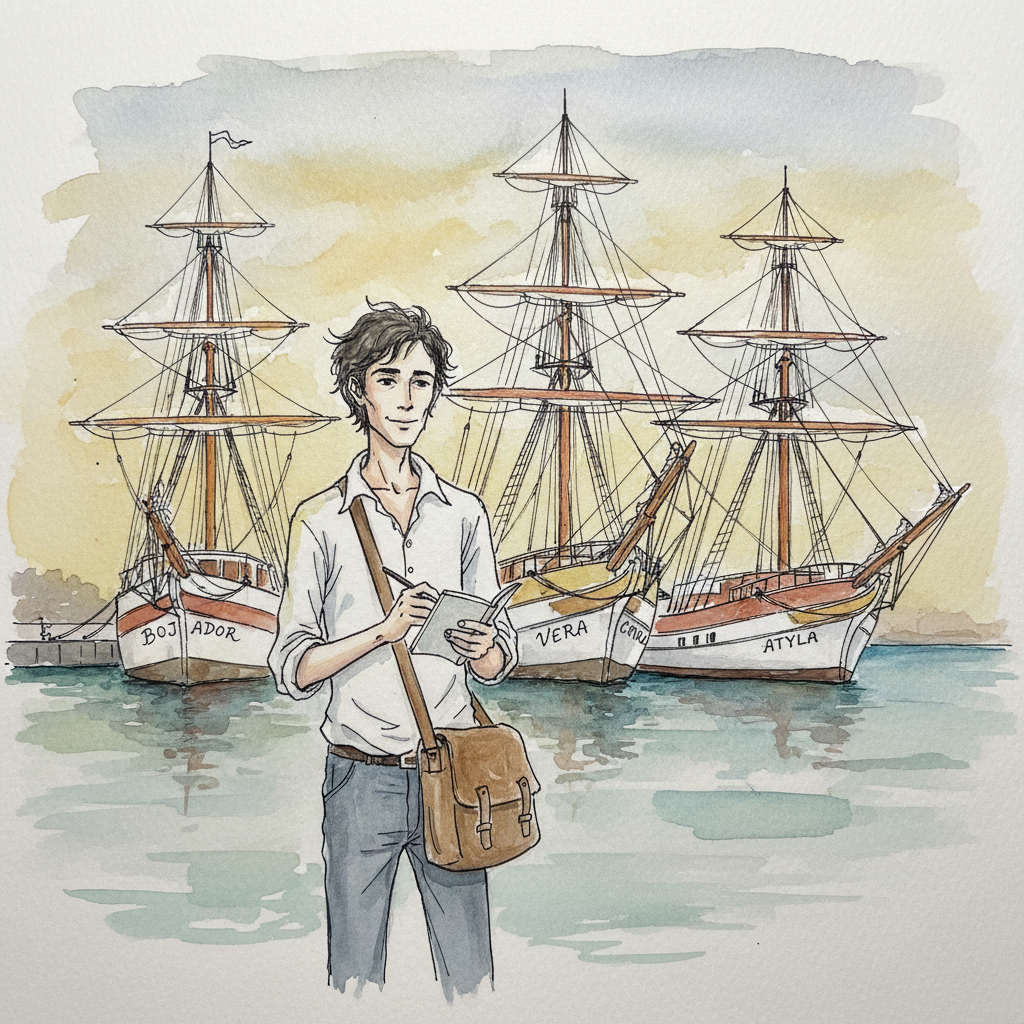
Arrival in Augusta Emerita
The bus from Badajoz takes fifty-five minutes through flat cork-oak country and arrives at a city that doesn't introduce itself so much as state its credentials. Roman bridge. Roman aqueduct. Roman arch. Roman theatre. The Romans founded Mérida — Augusta Emerita, capital of the province of Lusitania — in 25 BC, and they never quite left.

I walked from the station across the Puente Romano, sixty granite arches still carrying traffic after two millennia, and into the Roman Theatre. It seats six thousand. The lower tier of columns, the orchestra floor, the scaenae frons with its three-tiered marble backdrop — all restored, all still functional, still used for the Festival de Mérida every summer. The stone holds the acoustics. A guide told me that when the audience applauds, the sound hits the back wall and returns to the stage as clear as the moment it left.
The afternoon is warm — October in Extremadura stays in the high twenties — and the sun falls at an angle that makes the granite look young. Beyond the theatre lies the Temple of Diana, its Corinthian columns framed against a blue sky, and the Museo Nacional de Arte Romano, Rafael Moneo's brick cathedral of a building, built over Roman ruins you can see through glass panels in the floor.
Culture in the old capital
The Museo Nacional de Arte Romano (MNAR) is the place to start: Rafael Moneo's brick nave of a gallery holding the finest collection of Roman sculpture, mosaics and everyday objects in Extremadura — glass cases set over excavated Roman streets. Open Tue–Sat 9:30–20:00, Sun 10:00–15:00, closed Mondays. Combined ticket with the theatre and amphitheatre costs €15.
Current exhibitions this October:
- "Soundtrack. El rock también se mira" by Juan Pérez-Fajardo — rock photography at the Asamblea de Extremadura, until 12 October.
- "WOMEN" by Federico Arcos — portraiture at the Centro Cultural Alcazaba, until 9 October.
The Classical Theatre Festival ended its 2026 season in August, but the theatre itself is open year-round for visits.
What Extremadura brings to the table
.jpg)
The main market, Mercado de Calatrava (Calle Félix Valverde Lillo 10, Tue–Sat 8:00–14:00), is the best place to find what this region produces: jamón ibérico from the dehesa acorn-fed pigs, pimentón de la Vera (smoked paprika), torta del Casar — the soft sheep's milk cheese that runs at room temperature and is eaten by scooping with bread — and olive oil pressed from groves along the Guadiana valley. The market building itself is late 19th-century iron-and-glass, worth a look even when the stalls are closed.
Something worth supporting
Cáritas Diocesana de Mérida-Badajoz runs accompaniment programmes for older people across the city — nearly 500 people supported in 2026 with a team of 146 volunteers. They also operate a food pantry and clothing bank for vulnerable families. If you're passing through and want to help where the need is local, they accept donations on their site and welcome new volunteers.
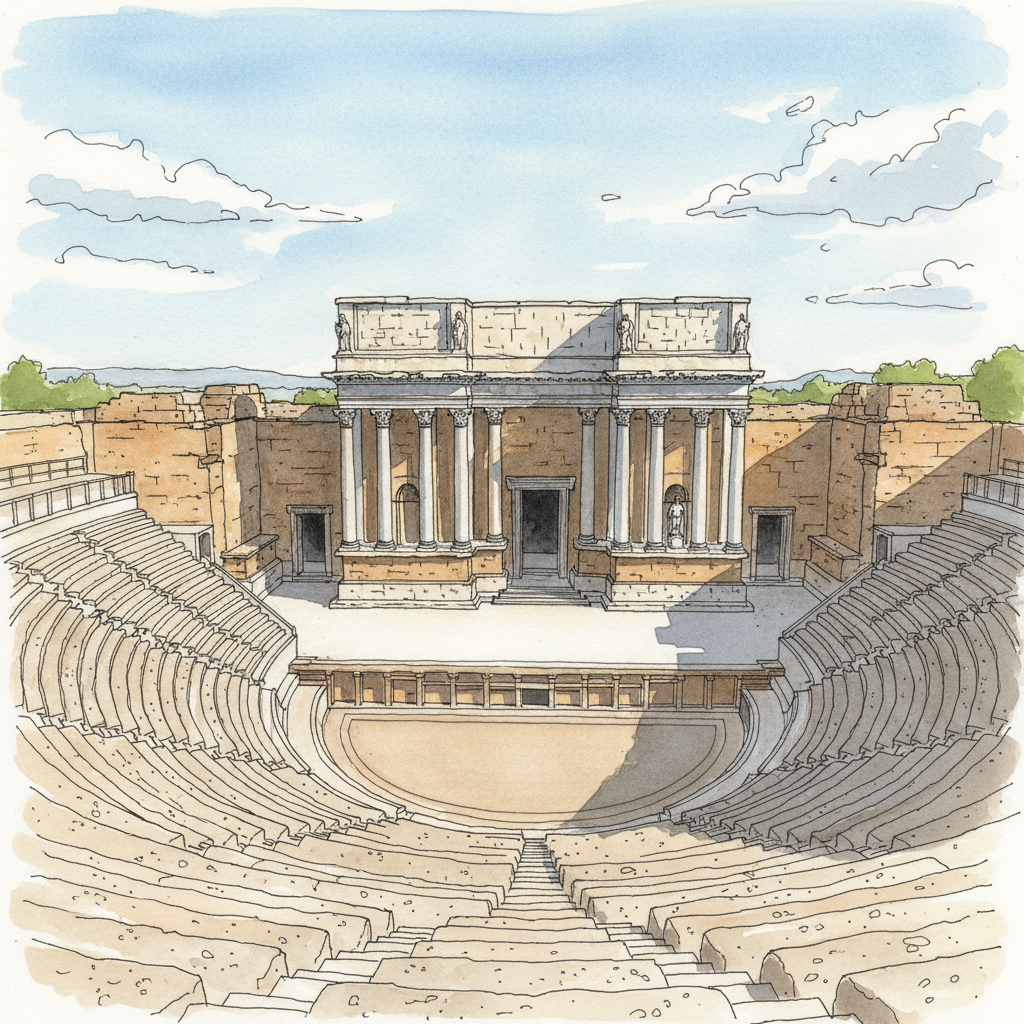
At the Roman Theatre
The columns hold nothing up. They have held nothing up for two thousand years and they are still standing.
I sat in the sixth row where a senator's wife might have sat, watching a comedy whose title no one remembers.
A bird landed on the cornice. The custodian yawned. The afternoon sun moved one column-width across the stone.
The performance was over. The performance has always been over. But the stone waits.