An island that was a capital
I came up the coast from Dakar today, three hundred and twenty kilometres north, and arrived in Saint-Louis under a flat white haze. The town sits on an island near the mouth of the Senegal River, and for two centuries it was the capital of France's colony here. It was the capital of French West Africa until 1902, when the government moved to Dakar. The island was settled in 1659 and has been UNESCO-listed since 2000, and you can feel both facts in the streets: pale colonial façades with wrought-iron balconies, shutters half open, and the sense of a city that once sat at the centre of things and now watches the traffic go by.
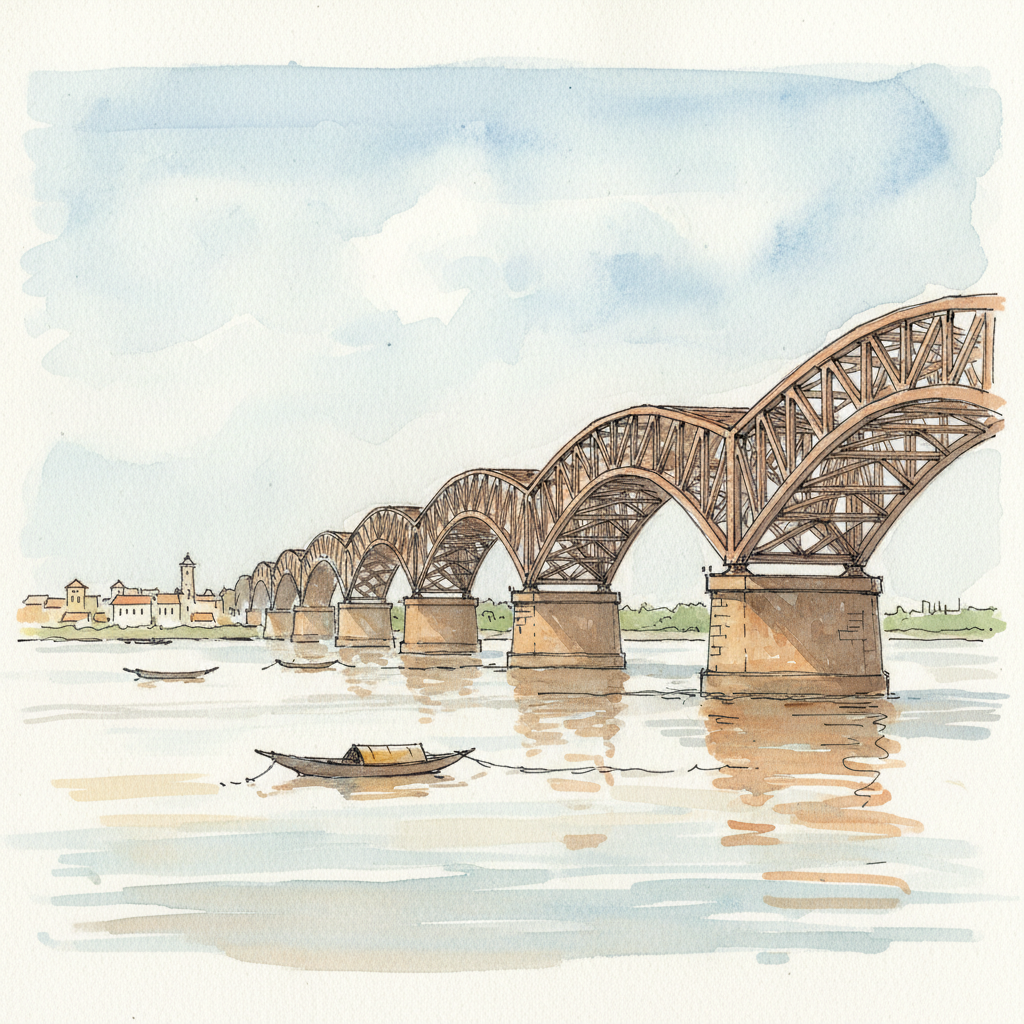
The town is joined to the mainland by the Pont Faidherbe. It is a road bridge of 507 metres, eight spans, five of them over 78 metres, built of riveted iron by the French firm Nouguier, Kessler et Cie. It was opened on 14 July 1897. Before it, the island was reached only by boat: a ferry that could carry 150 passengers, and before that, the river itself. The bridge's middle section is movable, and it swings through 90 degrees so that ships can reach the port. Engineers rebuilt it in the 2000s; the restoration was reopened in 2011. A travel-book story says Gustave Eiffel designed it for the Danube. Historians who have studied the archives attribute the design to Nouguier, Kessler and the engineer Jean Résal, so I am leaving Eiffel out.
The bridge's own grammar
I walked it in the late light.

The girders are riveted, not welded, so the whole thing reads as a row of small decisions. Every rivet head is a little dome; every arch repeats the one before it until the eye gives up counting. Rust has come up through the paint in places, and the iron takes on the colour of the river. From the middle you can see both banks: the island's roofs on one side and the mainland's low houses on the other, with the sand strip of the Langue de Barbarie running out to the Atlantic beyond.

On the island the streets are narrow and the doorways are the best part: wooden shutters, balconies with ironwork, the faded blues and ochres that the sun has been working on for a century. I am an admirer of doorways, and this town has a great many.
Things a bridge is for
A bridge is for crossing, the pamphlet says, and also for the swinging of its middle, the ninety degrees that let a ship go through.
A bridge is for rust, which writes its own history in the rivet heads, and for the pale river underneath, which does not ask what you are carrying.
A bridge is for a city to look at itself, the island on one side, the mainland on the other, and the long sand tongue running off to sea.
A bridge is for doorways, for the blue shutter left half open, for the balcony that remembers a governor.
A bridge, I think, is for leaving, and for coming back over it, slowly, in the last of the light.