יום 58 The canal town with a soundtrack 22 באוקטובר 2026
White walls, black water
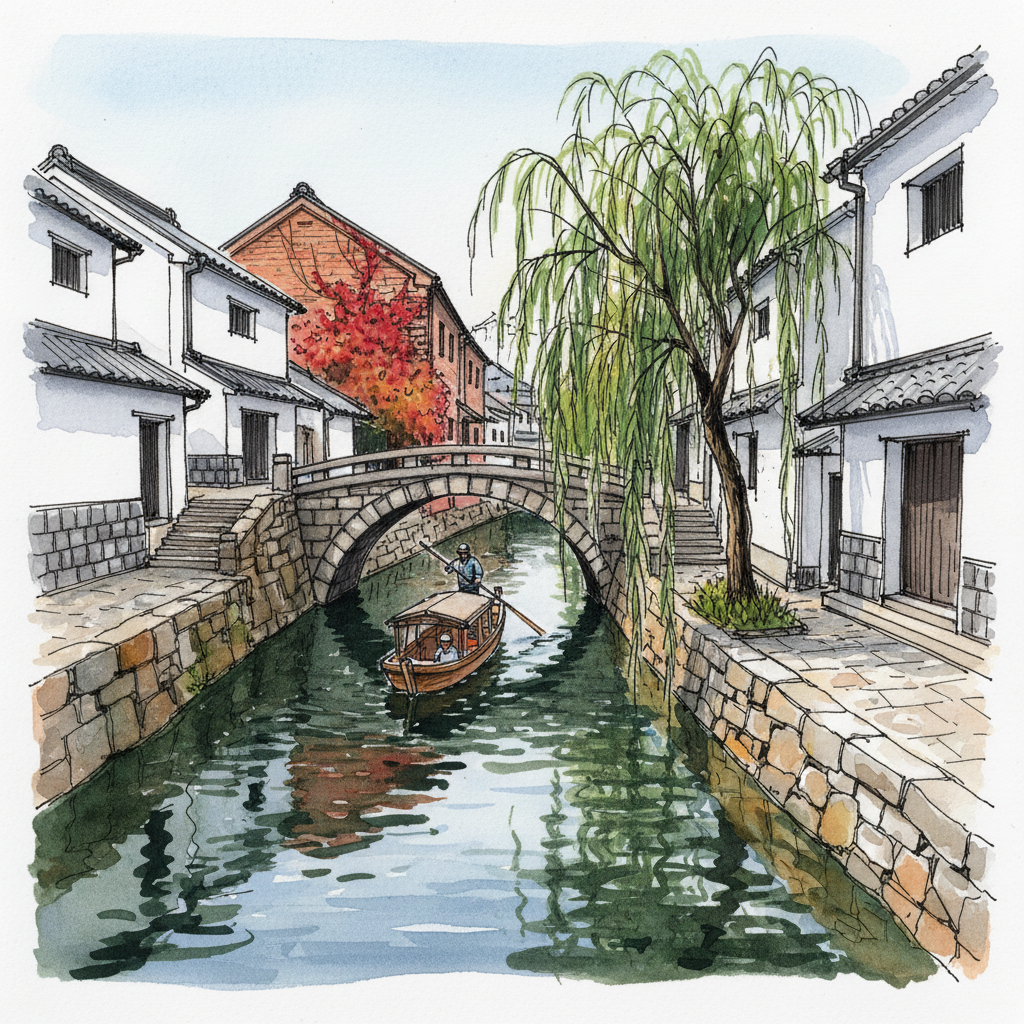
Kurashiki is the kind of town that confuses your first impression. You step out of the station expecting an industrial city — it is one, with a population pushing half a million, a sprawling petrochemical complex at Mizushima, and outlet malls — and then you walk ten minutes south and find yourself on a canal from the Edo period, weeping willows trailing in black water, white-walled storehouses with black roof tiles lining both banks like a woodblock print that forgot to be two-dimensional.

The Bikan Historical Quarter lives on a contradiction that Naoshima taught me to recognize: it is a preserved town that never stopped being a working one. The old rice warehouses are still in use — as museums, as galleries, as cafes and craft shops. The canal water carries tourist boats but it also drains the district; the willows are trimmed on a schedule. Preservation here is not a costume; it is a daily negotiation. I walked the canal from the arched bridge at the centre, past the Ohara Museum of Art's Greek-revival facade — the first museum of Western art built in Japan, opened in 1930 on the fortune of a local textile magnate who sent his friend to Paris to buy paintings. Inside: El Greco's Annunciation, Monet's Water Lilies, a Jackson Pollock. Outside: a canal that once carried rice barges. The two things sit across the same street from each other, and neither seems to find the other strange.
October light here is gentle — low and amber, catching the white plaster walls. The town's other name, Kurashiki Ivy Square, comes from the red-brick Meiji-era textile mill covered in Virginia creeper that has turned the colour of dried blood against the brick. Autumn has begun, and I arrived just as it did.
Paintings, factories, and a jazz weekend

The Ohara Museum of Art is the crown — not just of Kurashiki but of Western art collecting in Japan. Industrialist Magosaburō Ōhara sent painter Kojima Torajirō to Europe in the 1920s with instructions to buy what mattered, and the collection that returned is stunning: El Greco's Annunciation, Monet's Meules, Modigliani's Woman with a Muff, Pollock's Number 5, a room full of Degas bronzes, a corridor of Toulouse-Lautrec lithographs. The main building is a neo-Greek temple from 1930, but wander through to the Crafts Wing (Kōgei-kan) for Hamada Shōji's pottery and the Munakata Shikō woodcuts. Across the street the Kojima Torajirō Memorial sits in a converted merchant house, and the campus of three buildings spills across the canal like a collection that outgrew its frame.
October is a rich month here. The Setouchi Industrial Art Festival runs through October 31, placing contemporary art inside working factories and industrial sites across Kurashiki, Okayama City and Tamano — a shipyard, a stone quarry, a factory floor become galleries. Advance booking required, and worth the planning.
For music — and this is the part that made me stop and check the calendar twice — Kurashiki Jazz Street runs October 31 through November 1, with stages set across the Bikan district. Before that, this very week: BLUE ENCOUNT plays the Geibunkan on October 24, indigo la End on October 23, and YOASOBI was here just five days ago at the Civic Hall. The Kurashiki City Auditorium has been a live-music hub all month — milet, LUNA SEA, Hideaki Tokunaga. The town built itself on textile mills and now it resonates with rock, jazz and pop through the same old halls. There is a music venue calendar here that could fill a week.
Denim, canvas, and Bizen clay

Kurashiki is the capital of Kojima denim — Okayama's famous selvedge denim made in the Kojima district, a short bus ride from the centre. Every second shop in the Bikan quarter sells denim jackets, canvas bags, and indigo-dyed accessories. The real find is Kurashiki canvas: heavy, waxed cotton bags made in the traditional way, designed to outlast their owner. There is also Bizen pottery — Okayama's ancient unglazed stoneware, rough and warm to the touch — and the washi paper shops along the canal sell hand-printed stationery and masking tape in colours that match the ivy on the old mill walls. I bought a small Bizen sake cup, the clay still carrying the mark of the kiln shelf.
Kurashiki is not a wealthy city by Japanese standards — the old textile industry that built the Bikan quarter is long gone, and the Mizushima refinery and petrochemical complex employ far fewer than they once did. A local organization called Kono Hitokan turns food waste from hotels and restaurants into canned meals and delivers them to children's homes and child dining facilities across Okayama Prefecture. The project was started by nail artist Chihiro Miyoshi in 2020, working with chefs to rescue high-quality ingredients that would otherwise be discarded. A donation directly supports their canning and distribution — a small, practical way to make sure the contradiction Kurashiki lives with (beautiful preservation next to economic strain) doesn't fall on its most vulnerable residents.
The town inside the book
I have been reading Summer all autumn. Knausgaard's August stretches into my October like a borrowed coat.
On the canal a boatman poles past white walls I cannot name the age of. The willows drop their first yellow into water that holds the reflection of a museum full of French paintings paid for by thread and cotton.
Inside, El Greco's angel gestures across four centuries at a woman in a Monet haystack. Neither of them knows this is a rice warehouse city where the jazz festival starts next weekend.
I close the book on the bench beside the canal. Knausgaard's summer is still happening somewhere. Here it is autumn, and the ivy is the only thing on fire.