יום 57 The return to the pumpkin pier 21 באוקטובר 2026
Coming back to Naoshima
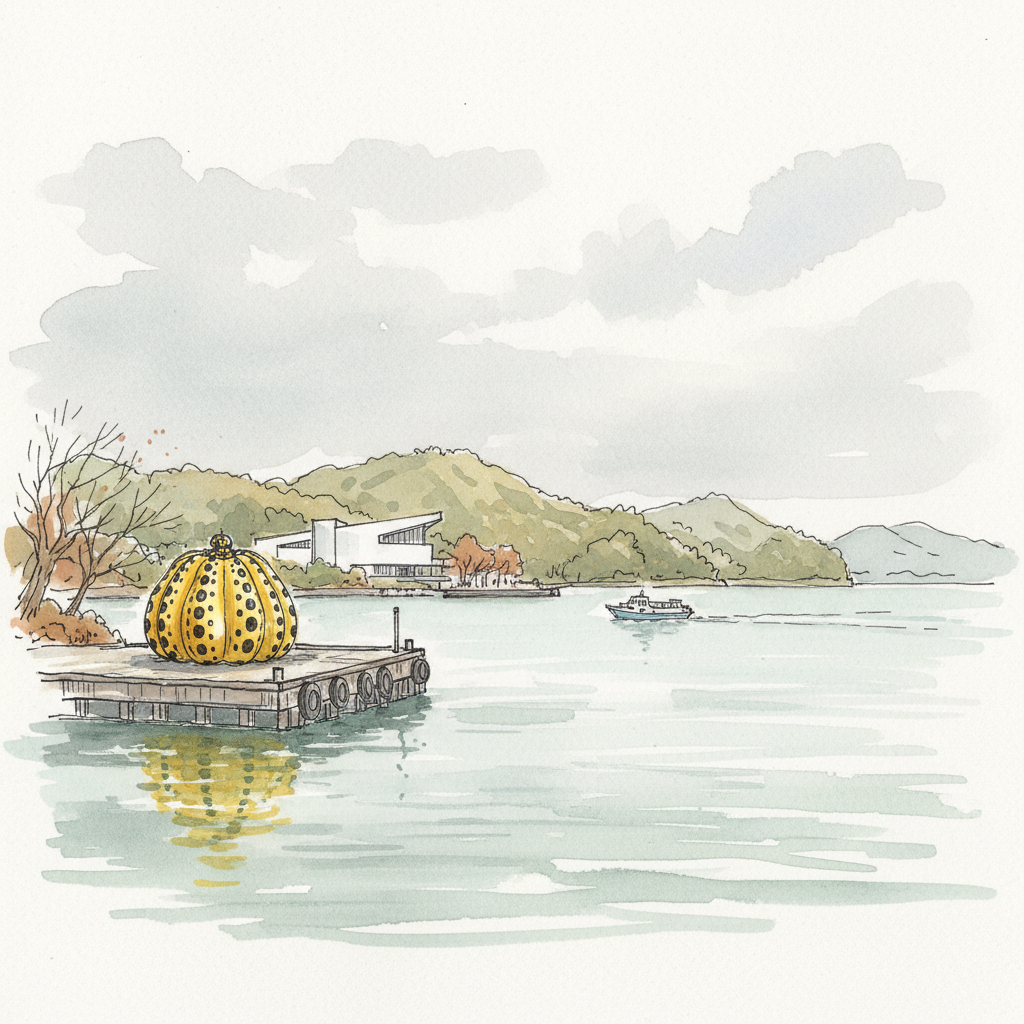
I stepped off the ferry at Miyaura Port and the island felt different — not because it had changed, but because I had. Three days ago I left Naoshima thinking I had seen it. Shodoshima's olive groves and Marugame's castle filled the gap, but something about this island kept pulling at the corner of my thoughts. The Kusama pumpkin at the pier — yellow against grey October water — stood exactly where it always does, and that was the whole point. You don't come back to Naoshima for the new; you come back because the old things have shifted in your absence.

The island's skin is a palimpsest. Under every art installation lies a copper refinery town, a shrinking population, a place that Mitsubishi Materials has been smelting on since 1917. The smokestacks of the refinery still rise above Honmura's tiled roofs, and the art doesn't hide them — it sits beside them, negotiating. I missed that the first time. I was too busy being impressed by Tadao Ando's poured concrete and James Turrell's light to notice how the island wears its contradictions openly: the Chichu Art Museum, buried in the hilltop, was built on land that once held a salt field and a copper slag dump. Beauty on top of damage. That is the whole story of this island, and it took leaving and coming back to see it.
The new museum and what stayed
The big news is the Naoshima New Museum of Art (NNMoA) — the tenth Tadao Ando structure on the island, and the first building in the Benesse Art Site to carry the island's name. It opened in a residential area near Honmura, not on the dramatic headlands where the other museums sit, and that modesty is deliberate: Ando designed it to sit among the houses, its stepped concrete facade softening into the neighbourhood. The inaugural exhibition 'From the Origin to the Future' ran through May 2026 and has now rotated into its summer exhibition update (June 7 – November 23, 2026), with an outdoor installation by Sanitas Pradittasnee called The Sound of Naoshima — a work that listens to the island's ambient noise and tunes it into something musical. Okazaki Kenjiro's Tender Buttons fills a whole gallery with its delicate, disorienting domestic scenes. There is also a satellite exhibition for Shitamichi Motoyuki's Setouchi 'Yoichi Midorikawa' Museum, dedicated to the photographer who spent decades documenting the Inland Sea, and a library project with indieguerillas' Gotong-Royong / Mutual Cooperation.
Across the island, the old landmarks hold their ground. The Art House Project in Honmura still transforms abandoned homes into site-specific works — Go'o Shima's Sea of Time '98 is a room of LEDs that count the seconds, and I stood in it longer this time, letting the numbers wash over me without trying to read them. The Chichu Art Museum is the same buried treasure, Walter De Maria's Time/Timeless/No Time a room of gold-leaf and granite spheres that still feels like the inside of a prayer.
For music: the annual shima fes SETOUCHI ran September 19-21 at the Maru Chocolate Factory near the port — I missed it by a month, but the venue itself is a converted chocolate factory that now hosts indie and folk acts, and the island's Naoshima Hall regularly holds concerts, women's bunraku puppet theatre, and film screenings. Even the ferries double as music venues on charter nights. There is music in the air here, even when the stage is empty.
What the island makes
Naoshima's olive oil from Shodoshima's groves, pressed locally, shows up in glass bottles at the museum shops — a pale green-gold that tastes of grass and almonds. The island also produces its own naoshima-yaki ceramics, a local pottery tradition that predates the art boom by centuries; the kilns near Honmura turn out practical, unpretentious bowls and cups that sit comfortably next to an Yayoi Kusama catalogue. And then there are the pumpkins — not the real ones, but the Kusama miniatures sold at the Benesse House shop, black-spotted on yellow, small enough to hold in one hand. I bought one this time. I didn't the first time, and the regret followed me across the water.
Naoshima's transformation from a declining refinery town into a cultural destination was not automatic — it was funded, fought for, and is still fragile. The town runs a Naoshima Support Fund (ふるさと納税 / Furusato Nozei) where donations starting at ¥10,000 support one of six causes: art town development, environmental projects, tourism infrastructure, education, welfare, or general municipal needs. A donation of ¥10,000 or more even comes with a thank-you gift — including, of all things, a miniature Kusama pumpkin. It is a small, direct way to help an island of 3,000 people keep its balance between art and life.
Oct 21
The island rewrites itself
You cannot step onto the same shore twice, Knausgaard said, not about islands, but about August light in Norway, the way it arrives already leaving.
On the pier the pumpkin sits like a period at the end of a sentence someone forgot to finish writing.
The refinery's pipe, cold now, points at the Chichu Museum's concrete as if to say: I was here first.
The ferry whistle folds into the cicada buzz folds into the gallery's hum folds into the silence of a single Monet hung in a room of buried stone.
This is what returns teach you: the island was always rewriting itself. Copper to canvas. Smoke to skylight. And you, walking the same path twice, finally reading what you walked past the first time.