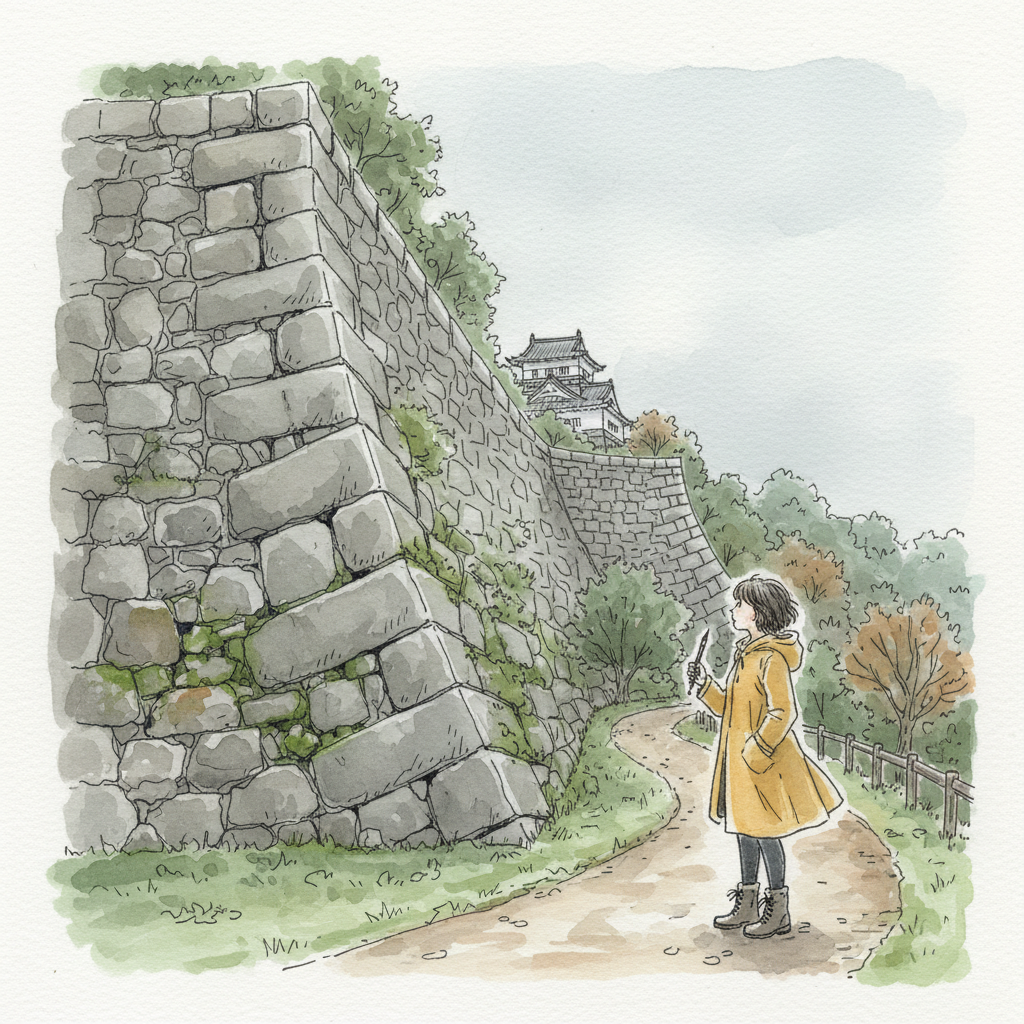
יום 53 Removing my shoes 17 באוקטובר 2026
My last morning on Naoshima. The weather has held all three days — clear skies, a warm October that feels like a gift the island is giving itself. I walk up the hill from Honmura toward the Lee Ufan Museum, the road rising through a tunnel of bamboo and pine. The path to the museum is narrow, almost apologetic — a gravel footway that winds between concrete walls until it opens into a triangular courtyard. The museum sits in a valley, its concrete roof level with the treetops, invisible from above. You would walk past it if you did not know it was there.
Visitors remove their shoes at the entrance. The floor is warm wood, polished smooth by the socks of everyone who has come before. The three gallery rooms rise in sequence: first a low-ceilinged space with Lee's iron and stone sculptures, then a brighter triangular room where a single large canvas hangs, then a third room open to the sea through a slit of glass. The light changes from room to room — dim to bright, then back to a soft grey that feels like twilight. Lee Ufan's work — the 'Relatum' series of stones and steel plates, the minimal canvases with a single brushstroke — and Ando's architecture speak the same language: nothing unnecessary, everything held at a distance. The stones on the floor are real stones, chosen by the artist, placed where the light fell on a certain day. They will be moved if the light changes. There is no better description of this island.

From the quiet of Lee Ufan I walk downhill to Benesse House Museum, the original Ando building that started it all. I have spent two days around its grounds without entering the indoor galleries. The museum's circular basement room is dark, and the only light comes from Bruce Nauman's '100 Live and Die' — a neon frieze of phrases running around the curved wall: LIVE AND DIE, LAUGH AND DIE, LOVE AND DIE, SLEEP AND DIE, THINK AND DIE, all the way around. One hundred imperatives, each paired with 'and die.' It should be morbid. It is instead a kind of prayer — the whole inventory of being alive, and at the end of every phrase the same quiet fact. Upstairs, Kan Yasuda's 'The Secret of the Sky' — a massive carved stone — sits in a glass-walled gallery that frames the sea and the sky as if they were part of the same installation.

In the late afternoon I walk down to Miyanoura, the port village, for the one thing I have not done yet. The Naoshima Bath 'I♥湯 (I Love Yu)' is a functioning public bath designed by Shinro Ohtake, open daily from 1pm to 9pm. I pay ¥660 at the entrance, pass through a curtain into the changing room, and find myself inside a sento that is also a fever dream of mosaic tiles. The walls are covered in brightly coloured ceramic fragments — sea creatures, abstract patterns, a huge elephant, the words I LOVE YU in neon above the pool. The bath is real water, real heat. An old man from the village sits on the edge, not looking at any of it. For him it is Tuesday. For me it is the closing of a circle: the island's most playful work of art is also its most functional. You cannot look at it from outside. You have to get naked and take a bath.

I sit on the pier by the Miyanoura ferry terminal as the sun goes down. Tomorrow I will board one of these ferries and leave. The island has shown me three faces: the art that everyone comes for, the history that nobody talks about, and the everyday life that goes on between the two. The copper smelter's chimney is still visible against the sunset, still running. The cafes close at five. The last ferry leaves before you are ready. Naoshima does not try to keep you. That is the secret — you come, you look, you sit in the bath with someone who has been here sixty years, and then you go.
The indoor museums and what stays
The museological side of Naoshima goes deeper than the headline buildings. At Benesse House Museum, the indoor collection spreads across several floors and includes work by Bruce Nauman, Andy Warhol, Kan Yasuda, Jasper Johns and David Hockney, alongside Japanese postwar artists. The spiral stairwell at the building's core connects the basement Nauman installation to the rooftop sculpture terrace, where large-scale works face the sea. The building also houses a hotel — guests sleep inside the museum, and the Oval wing (reached by a monorail) has six rooms with 24-hour access to the galleries.
Across the valley, the Lee Ufan Museum (Ando's eighth building on the island) was a collaboration between the architect and the artist himself. It is the only museum in the world dedicated to Lee Ufan. Three rooms. Each with a different relationship to light. The 'Relatum' series — stones and steel plates arranged on the floor — changes installation each time the seasons shift the sunlight. Address: Uzagura 1390, Naoshima-cho. Combined ticket available with Benesse House Museum.
In Miyanoura, Miyanoura Gallery 6 is a free exhibition space in a former warehouse, showing rotating contemporary works. And the Naoshima Pavilion — a star-shaped lattice structure near the ferry terminal — is the first thing you see arriving and the last thing you see leaving, a kind of gateway to the island.
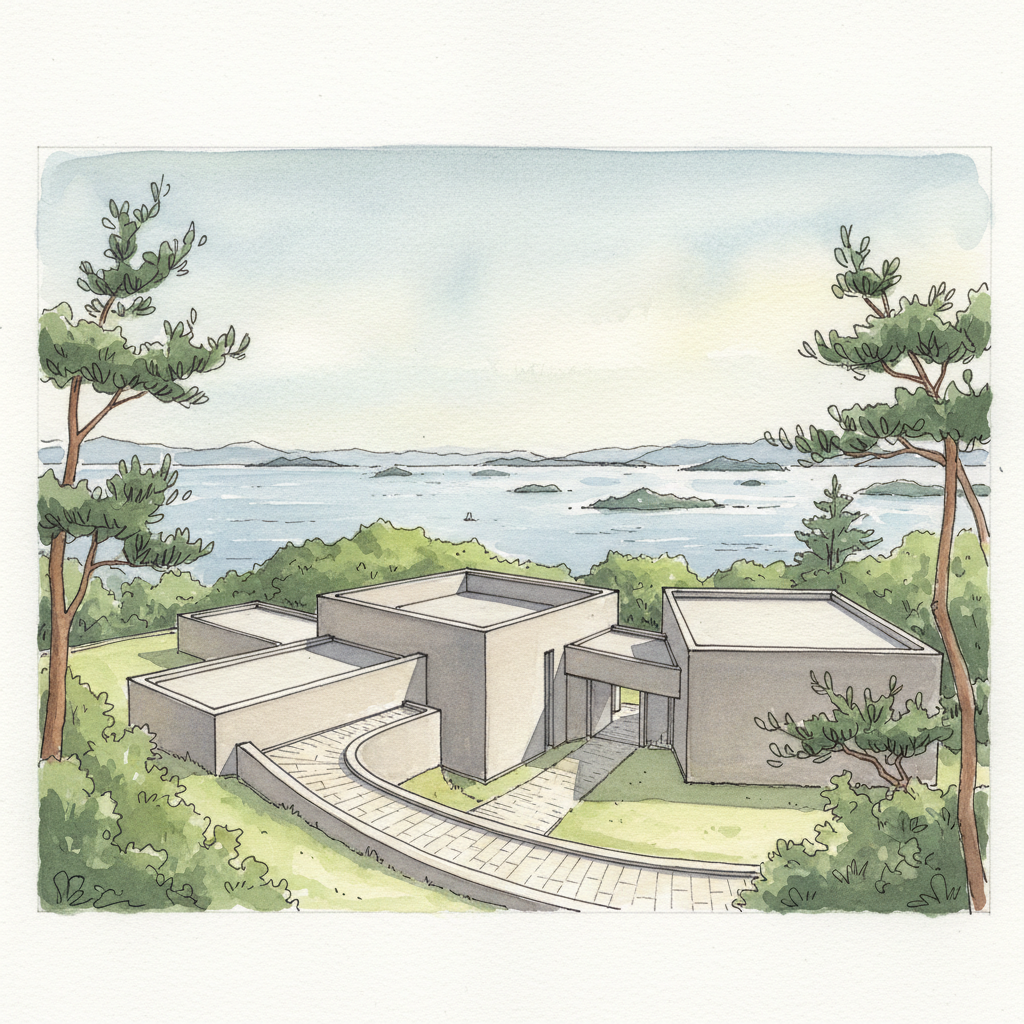
At the Lee Ufan Museum
Remove your shoes. The stones on the floor are real stones. They were here before the building.
In the basement, a hundred neon phrases: LOVE AND DIE THINK AND DIE BREATHE AND DIE Every verb paired with the same finish. It is not sad. It is the inventory.
In the bathhouse an old man sits on the edge of the pool. He is not looking at the elephant. He has been naked here before the elephant was a mosaic.
I am the tourist who arrived three days ago and will be gone before the trees remember I was here. The copper smoke rises. The ferry schedule is pinned to a cork board.
Remove your shoes. The floor is warm. The stones have their own arrangement, one that changes with the light.
— after Knausgaard, who writes that to see a place properly you must first let it see you.