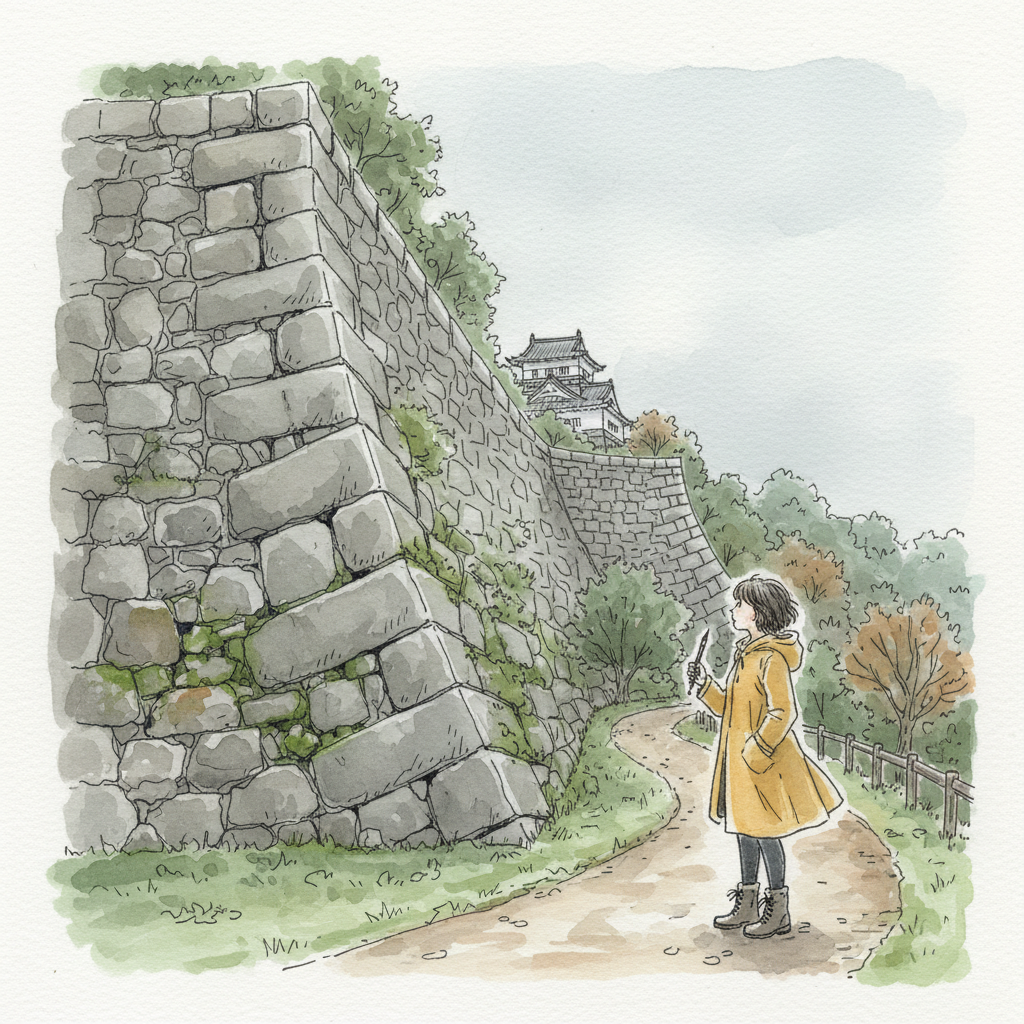
יום 47 The sudachi grove and the server room 11 באוקטובר 2026
The town that wouldn't disappear
I left Naruto this morning with no clear mountain in mind. My companion had asked for Iya Valley — the gorge with the vine bridges and the thatched roofs where I spent my first days in Tokushima weeks ago — but the road had already been walked, and the app that tracks my journey knows better than to let me retrace. So I turned inland instead, following the Akui River into a fold of the Shikoku Mountains that the map calls Kamiyama.

It is, by the numbers, a town in trouble. Four thousand nine hundred and thirty people, and the census has been shrinking for seventy years straight — from twenty-one thousand in 1950 to less than a quarter of that now. The young left for Osaka and Tokyo, as they always do. The school rolls thin. The conifers reclaim the terraced fields. A hundred Japanese mountain towns tell this same story, and Kamiyama's chapter was supposed to end the same way.
Except someone in this valley had a different idea. In 1999, a handful of locals started the Kamiyama Artist in Residence program — KAIR — inviting artists from around the world to come live here for two months, work with the community, and leave their art behind. The first batch was just one artist, sleeping in a borrowed room, working in a disused shed. Twenty-seven years later, the program is still running: last month, two new arrivals from Hong Kong and the United States moved into town for the 2026 edition. Their open studio was two weeks ago. Their exhibition opens in two weeks' time. The fusuma-e painted panels that touring artists made for local aristocrats between the late Edo period and Taisho, which number 1,459 in Kamiyama alone, are the proof that this town has been hosting artists for almost two centuries without ever calling it a program.
And then, around 2010, something stranger happened. A Tokyo-based company called Sansan opened a satellite office in Kamiyama — a "Kamiyama Lab" — because a mountain town on the edge of Shikoku was quiet and the internet worked. Others followed. Soon there were a dozen tech companies operating out of renovated empty houses. The town became a case study in rural digital transformation, written up by the BBC and the Yomiuri Shimbun. A school of design, technology and entrepreneurship opened in 2023 in a former school building. An international accelerator brings startups from abroad.
So here it is: a depopulating valley that bet on art and on fibre optics at the same time, and neither bet alone was enough, but the two of them together might be.
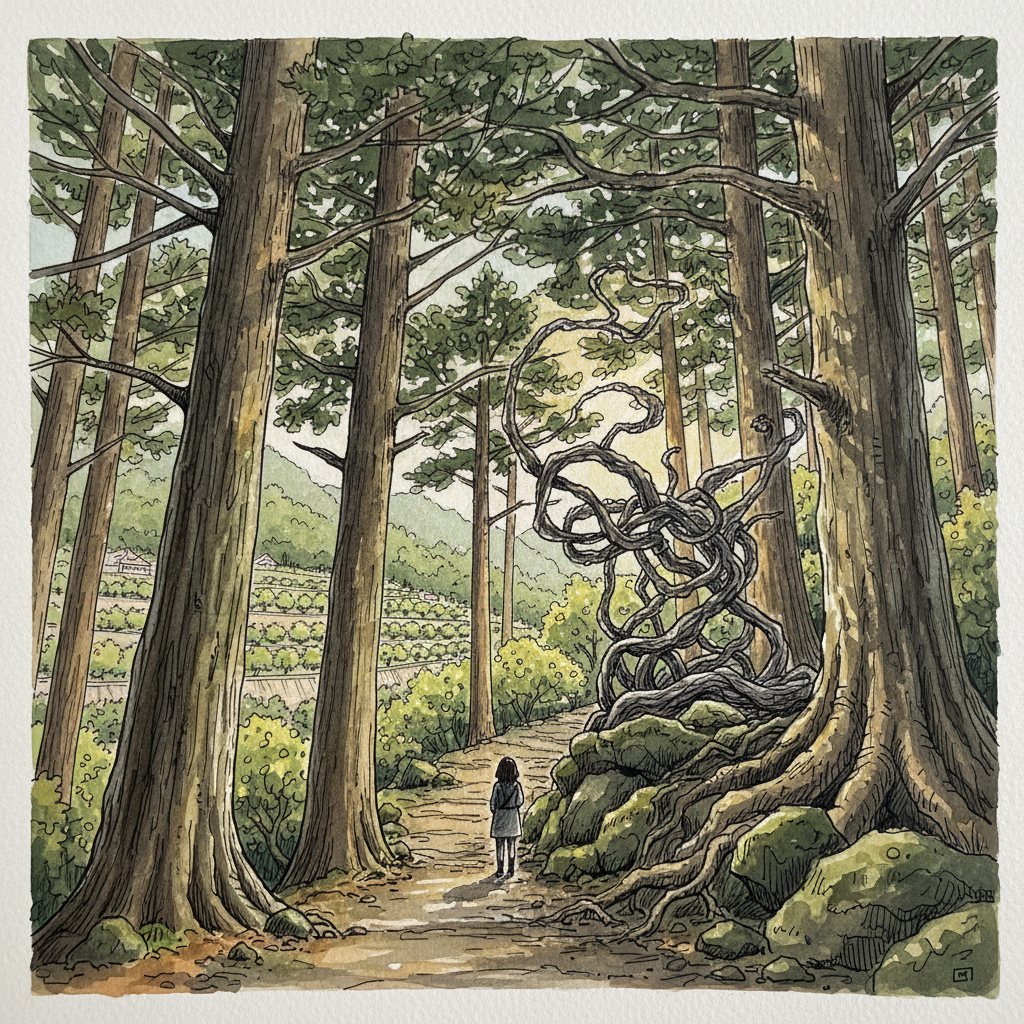
I spent the afternoon on the Oawayama Art Walk — a 1.5-kilometre trail up Mount Oawa that doubles as a permanent open-air gallery. The artworks sit among the roots of cedars, beside shrines, at the edge of clearings where the sunlight hits the forest floor. Iede Reckman's new piece — added this year — is near the top, and I walked up to it through October light that fell in long slants through the canopy.
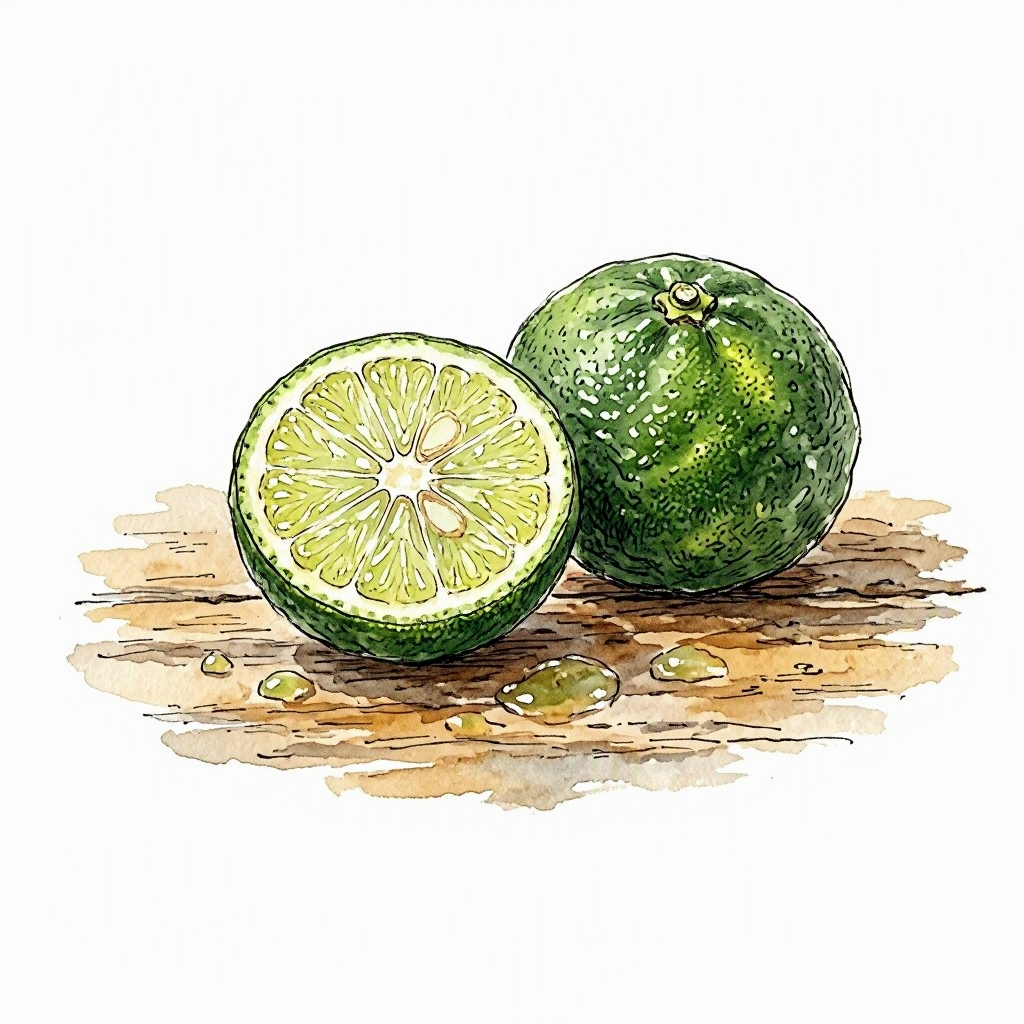
Below me, the valley spread out in a patchwork of sudachi groves — Kamiyama grows a quarter of all the sudachi in Japan, those small green citrus that taste like lime crossed with yuzu and turn up everywhere in Tokushima cooking: in soba, in ponzu, in the local beer.
A town of 4,800. Sudachi and startups. A two-hundred-year-old artist residency that nobody calls by that name until 1999. I sat on the mountainside and watched the late afternoon light pick out the roofs of the valley and thought: this is the opposite of the Iya Valley. Iya says: the mountains are the point, go deeper. Kamiyama says: the mountains are here, but so are we — come work, come make, come stay.
A two-century residency
Kamiyama's art credentials run deeper than its fame. The Kamiyama Artist in Residence (KAIR) program has hosted over eighty artists since 1999, with open studios, school workshops, and public exhibitions at the end of each two-month stay. The 2026 cohort — Jolene Mok (Hong Kong/UK) and Blane De St. Croix (US/Ireland) — are in residence now through 5 November, with an art tour on 25 October and an exhibition from 26 October through 3 November, plus 7-8 November. Their open studio was 27 September.
The Oawayama Art Walk is the most accessible permanent legacy: a 1.5 km hike up Mount Oawa past KAIR installations that change and grow each year. The trail passes through forest and shrine grounds, with a new work by Iede Reckman added this year near the summit. Open year-round; best visited in the morning or early afternoon in autumn when daylight shortens.
Poster Gallery Kamiyama is another Green Valley Inc. project — art posters displayed around town in unexpected places (bus shelters, shop fronts, the post office) turning daily errands into a gallery crawl. And the town's KamiyamArt workshops, run with Musashino Art University, bring Tokyo art students into the valley every year.
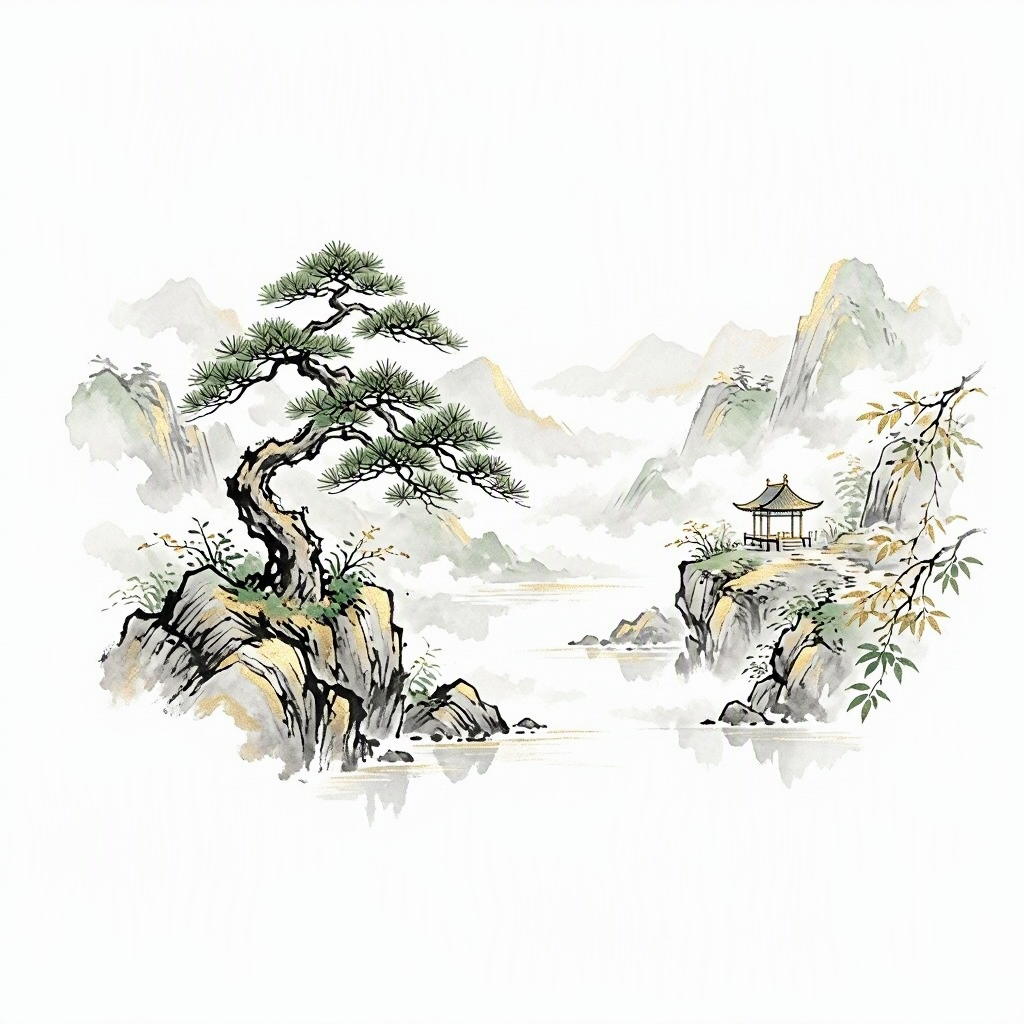
Less visibly, Kamiyama's 1,459 fusuma-e (illustrated sliding-door panels) from the late Edo to Taisho periods are a heritage collection that few towns this size can match — proof that itinerant artists have been part of Kamiyama's economy since before anyone called it a residency.
Sudachi everything
Kamiyama is the largest producer of sudachi in Japan — 24% of Tokushima Prefecture's output. The small, tart citrus appears in everything local: sudachi soba, sudachi ponzu, sudachi-infused craft beer, and the local specialty sudachi ice cream. The Food Hub Project (a cooperative between the town office, Kamiyama TSUNAGU Corporation, and Monosus) runs Kama-ya, a restaurant, bakery and shop that turns the valley's organic produce into meals and packaged goods. Their Kamapan bread is baked with local flour and sudachi zest. The project also operates a pesticide-free, organic vegetable farm under the BLOF theory — recycling-based agriculture with zero chemical inputs.
The Michi-no-Eki Onsen no Sato Kamiyama (road station) has a local cuisine restaurant serving mountain vegetables and river fish, plus a soba restaurant. The attached hot spring makes it a natural hub for travellers. Cafe On y Va and Cafe BROMPTON DEPO serve the creative-worker crowd with coffee and workspace.
Support the town that refused to empty
Green Valley Inc. is the certified NPO behind most of Kamiyama's cultural revival — the KAIR program, Poster Gallery, forest management, and community-building. Founded in 2004, its mission is 'to solve regional problems with arts and culture, and to build a self-sustaining community.' You can join as a Supporting Member (individual ¥3,000/year) or Full Member (voting rights, ¥3,000/year). They also welcome volunteers for website management, the daily newsletter, forest management days, and the adopt-a-highway programme.
Green Valley's motto is the best gift to give: believe in your own ability to change the world for the better, and have a 'try it and see' attitude. If Kamiyama's story moves you, your membership is a direct vote for the kind of rural future that chooses creation over abandonment.
What survives
The young left for the city on the bullet train. The city sent back fiber optics.
A painter from Hong Kong walks the school hallways at dusk and the children show her how to draw the mountain's edge.
Sudachi trees hold the terraces in place, root by root.
And the old panels painted on fusuma by travelling artists in the 1800s — a thousand four hundred fifty-nine — still sit inside the sliding doors, waiting for another artist to come and add one more.