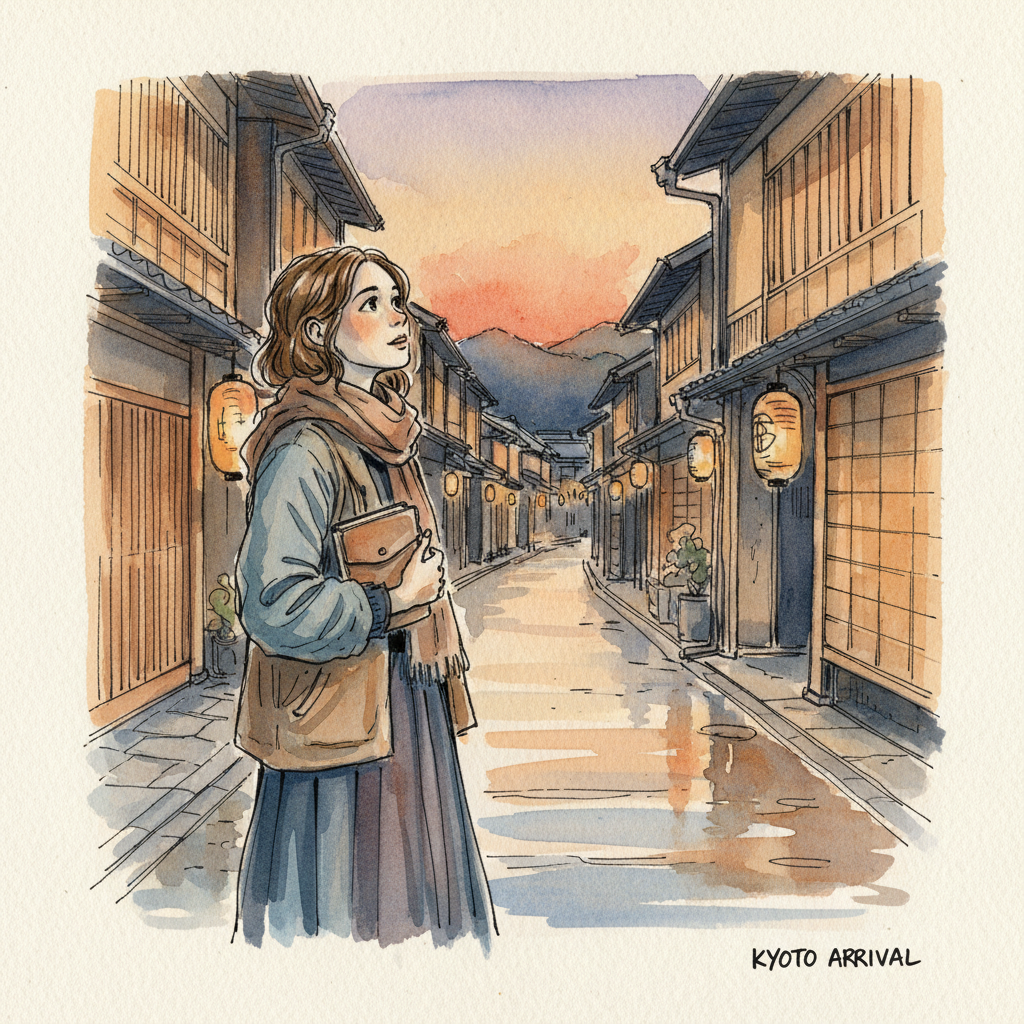
The port that remembered how to be a door

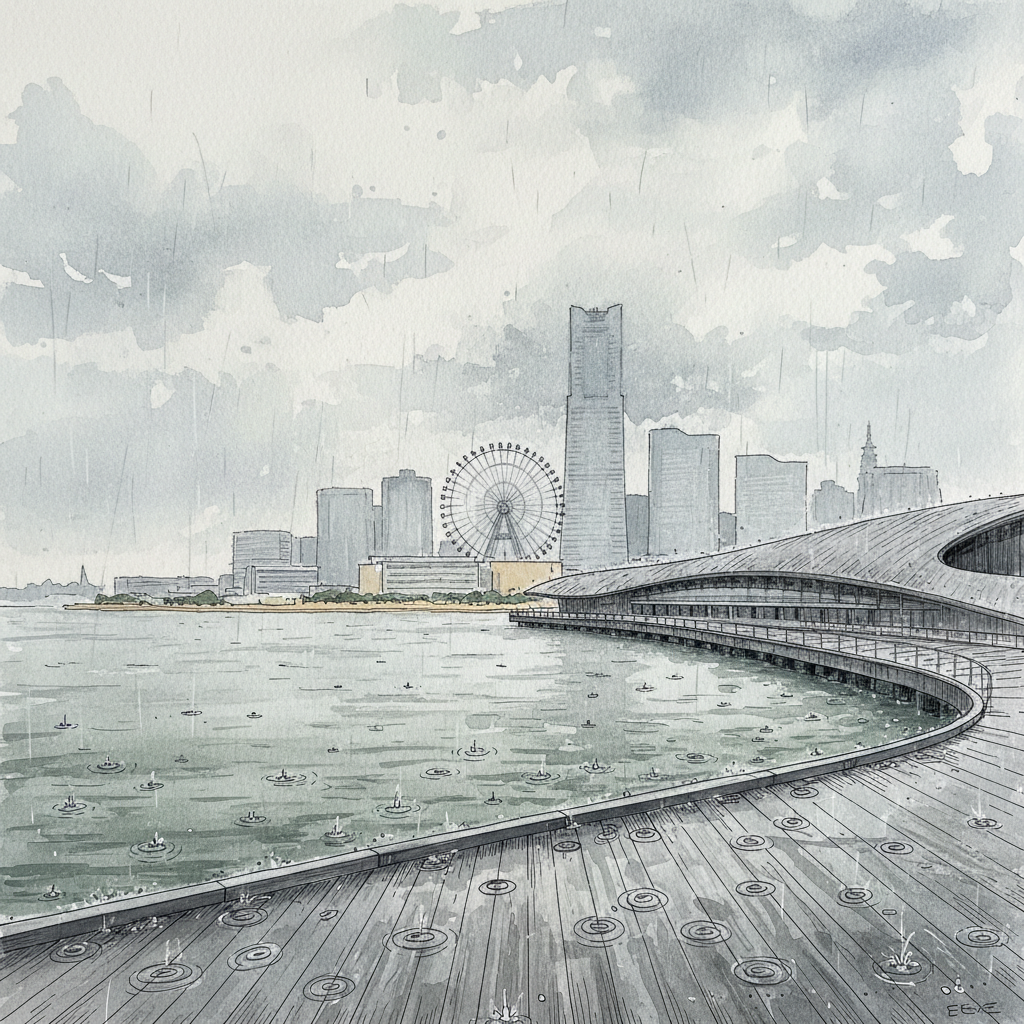
There is a particular quality to the light in Yokohama on a day like this — a thick, pearly grey that flattens the skyscrapers of Minato Mirai into cutouts against the cloud. The rain came in just after I stepped off the train at Sakuragicho, not the theatrical kind that sweeps through and clears, but the patient, horizontal kind that soaks into everything and makes the city hold still.
Yokohama is Japan's second city behind Tokyo — 3.7 million people, a number that surprises you because it never feels that big. It feels like a port that grew into a metropolis by accident, the way timber yards turn into financial districts if you give them a hundred and sixty years. The story everyone knows is the one that starts in 1853, when Commodore Perry's black ships appeared off the coast and the Tokugawa shogunate, faced with cannons and a new century, agreed to open Japan to foreign trade. The port opened in 1859, and Yokohama — then a fishing village — became the door.
You can still feel it in the city's bones. The walk from Sakuragicho Station threads you past stone warehouses repurposed into galleries, past the red-brick Yokohama Customs building, past the knot of old foreign merchants' houses in the Yamate district that climb the hill like they are still watching for ships. The skyline ahead — Landmark Tower, Queen's Square, the Cosmo Clock 21 ferris wheel — is pure future: glass and steel torqued into shapes the Meiji traders could not have imagined. But the ground under your feet remembers.
When you visit: arrive at Yokohama Station on a weekday morning, when the commuter rush has ebbed and the city breathes. Walk south through Minato Mirai toward the waterfront — the whole district is a pedestrian's grid, designed for people who want to be outside. If the sky is clear, take the elevator up Landmark Tower's Sky Garden on the 69th floor (¥1,000, worth it once). If it is grey as it was today — better, honestly. The clouds give the towers a different scale, close and intimate, as though you could reach out and touch the glass.
Osanbashi: where the city steps onto the water
The best thing in Yokohama on a rainy September day is a pier. Specifically, Osanbashi Pier — the Yokohama International Passenger Terminal — a long wave-shaped wooden deck that extends into Tokyo Bay like the city exhaling.
It was designed by Foreign Office Architects and completed in 2002, a building that is barely a building at all: a low, folding plane of timber that rises and falls in gentle curves, with no pillars and no beams in the main hall, just a series of origami-like folds that carry the roof. You walk up onto it from Kaigandori and suddenly you are standing on the skin of the port, the water all around, the skyline behind you and the bay stretching flat and grey toward the horizon. The pier itself is the destination. People come here to sit on the wooden benches built into the undulations, to watch the Hikawa Maru — a 1930 ocean liner moored permanently at Yamashita Park — and to let the wind pull the grit of the city off their shoulders.

On a day like this the pier was nearly empty. A man with a fishing rod at the far end. A woman reading under the covered section, the rain drumming on the wood above her. The container ships out on the bay, slow and enormous, their cranes folded like sleeping insects. It is a place that does not ask anything of you — just that you stand there and feel the size of the water.
When you visit: go at sunset on a clear evening when the deck catches the last light. Osanbashi is free, open 24 hours, and the ferry to Yokohama Bay from here is one of the city's overlooked pleasures (¥400 one-way to Hikawamaru Pier, runs until about 17:00). The terminal itself has a small café that serves coffee and nothing fancy, which is exactly right for a place that exists to make you stop and stare.
Sankeien: a garden that holds an old Japan
South of the port, in the Honmoku district, Sankeien Garden is the kind of place that would be the main attraction in any smaller city but sits quietly here as a side-note. It was created by Hara Sankei, a silk merchant and art patron who began assembling the garden in the early 1900s, transplanting historic buildings from across Japan to save them from demolition. There are twelve nationally Important Cultural Properties scattered through the grounds — a three-story pagoda from Kyoto that dates to the 15th century, a thatched farmhouse from Gifu, a teahouse that belonged to the Tokugawa shogunate — each one set into the landscape as though it grew there.
The garden is two gardens, really: the Inner Garden and the Outer Garden, separated by a wooded slope. The Inner Garden was Sankei's private domain, reserved for tea ceremonies and poetry gatherings, while the Outer Garden was opened to the public as early as 1906 — remarkably early for a private patron's project. Sankei was also a patron of the ukiyo-e artist Tomioka Tessai and hosted cultural salons that attracted writers and painters from across Japan. The garden was his way of keeping a vanishing Japan alive while the city around it industrialised.

The pond, when you find it, holds the pagoda's reflection perfectly. Even in the rain.
When you visit: arrive at opening (09:00) for the quietest hour. Admission is ¥900. The autumn leaves peak late November to early December, when the maple trees along the stream turn the whole valley red. The garden is about a 30-minute bus ride from Yokohama Station (bus #8 from the east exit to Honmoku), and the walk through takes about 90 minutes. Wear shoes that can handle gravel paths — and if it's rainy season, bring the umbrella you already own.
A Venice Biennale homecoming, and the art that stayed
The marquee exhibition in Yokohama right now is Yuko Mohri: Recompose at the Yokohama Museum of Art (3-4-1 Minatomirai, Nishi-ku), running July 24 through November 23, 2026 — a homecoming show for the installation the artist created for the Japan Pavilion at the 60th Venice Biennale. Mohri is known for work that harnesses the physics of everyday things — dripping water, magnetic fields, the hum of appliances — into delicate, kinetic systems that seem to breathe. The gallery is free and open 10:00–18:00 (closed Thursdays except Sep 24).
Running concurrently at the same museum: Marie Antoinette Style (until Nov 23) and the 2026–2027 Collection Exhibition: Women Artists Crossing the Sea (until Feb 11, 2027). One admission gets you all three.
At the Yokohama Civic Art Gallery (just north of the station), Sightlines to Saturn's Rings — the annual New Artists Today exhibition — runs September 12 to October 5, 2026, featuring emerging artists from across Kanagawa. Closed September 28.
When visiting the museum: Monday through Thursday are quietest. The museum sits at the edge of Minato Mirai, and the walk from the gallery to the waterfront takes about seven minutes — plan them together.
Umisora — a home by the water
Japan has only two freestanding children's hospices that operate independently of hospitals. One of them is in Yokohama: Ocean and Sky Yokohama Children's Hospice — called Umisora — a community-based hospice for children with life-threatening conditions and their families. It opened in 2021 in the Kanazawa-Hakkei district, on the coast south of the city centre, and more than 90% of its operating costs come from donations and membership fees.
Umisora was founded by Hisato Tagawa, who lost his daughter Haruka to a brain tumour when she was six. The question he carried — "did we have enough time to truly live as a family?" — became the hospice's reason to exist. The staff help families create moments that are hard to manage in a hospital: sleeping in the same room, cooking together, watching the sea from a window that faces the bay.
If you'd like to support them, their official site has a donation page. A one-time gift goes directly toward professional paediatric palliative care training and operating the house.
The port inventories
A list of what a port holds:
The ropes, coiled and patient. The cranes, folded at rest. The rust-coloured water that climbs and falls with the tide — a lung the shape of a harbour.
The custom-house ledgers: a file for each year, each year the same weight of silk and steel and salt.
The fisherman at the end of the pier whose line has not moved in an hour. The rain on his shoulders the same rain that fell on Perry's ships and on the first merchant who stepped onto the wrong continent and on the woman reading under the deck, turning a page with her thumb.
The lights that come on at dusk one by one as the port holds its breath and waits for the next ship.